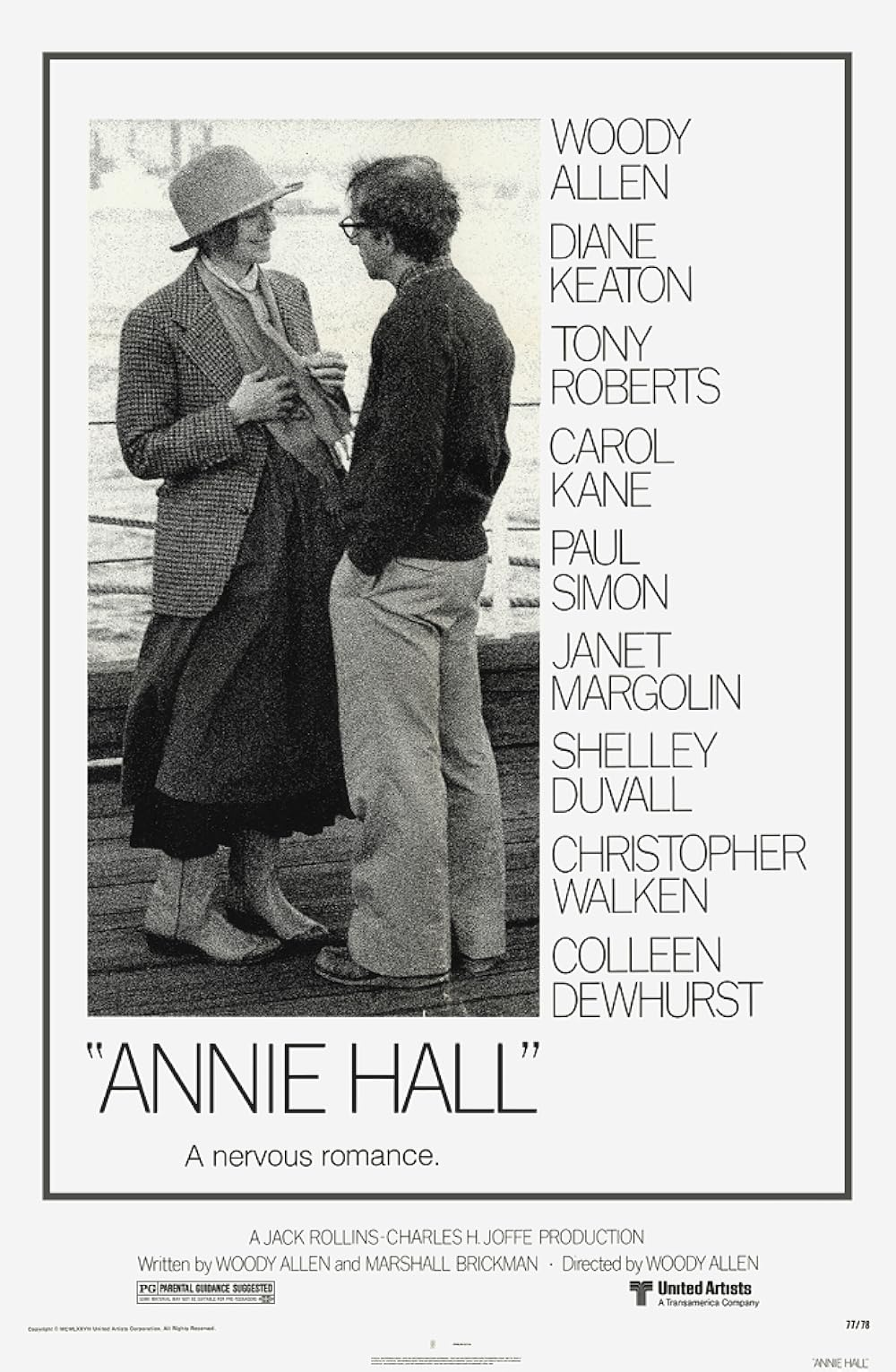



Annie Hall
Romantic Comedy • 93 minutes • United States • 20 April 1977

Director: Woody Allen • Written by: Woody Allen, Marshall Brickman • Produced by: Charles H. Joffe, Jack Rollins • Starring: Woody Allen, Diane Keaton, Tony Roberts, Carol Kane, Paul Simon, Janet Margolin, Shelley Duvall, Colleen Dewhurst, Christopher Walken • Cinematography: Gordon Willis • Edited by: Ralph Rosenblum, Wendy Greene Bricmont

In the end Woody Allen and Diane Keaton are two of the most iconic figures in all of contemporary cinema and whether together or apart, Annie Hall remains their signature film. A fever dream and a temperate breeze, whirligig and fever pitch yet slender and surprisingly touching and somehow hushed or still, it remains shockingly modern while containing the best depiction of a relationship ever put up there on screen.
Always an enigma, Keaton is at once a throwback to the flappers and the screwball era, most especially the high spirits and limber antics of Katharine Hepburn, but there’s something more alien about her, at the same time softer and more fiercely independent as she navigates and harnesses her own indeterminate will. As the titular heroine Annie Hall she breathes life not only into her character but also into Allen’s somewhat arch and referential manner, which isn’t always a given though here there’s a spark to him and the stand-in figure of Alvy Singer too.
At one point in the film, after Alvy performs his stand-up routine in front of an eager crowd at the University of Wisconsin, illuminated by a spotlight against the vast red curtain which makes him appear small and diminished like an ant or a child, Annie tells him that she’s starting to get more of his references but while he switches up his act – his twelve o’clock show is completely different from the one at nine, for instance – she skirts his code and is always a step or two ahead.
The screwball comedy was long gone by the time Allen made Annie Hall and so was the classic romantic comedy or comedy of manners with its lithe romance and rapier wit. The Apartment by Billy Wilder was the last movie that seemed to possess that kind of classical air, with films like Charade or Breakfast at Tiffany’s or The Graduate or Barefoot in the Park somehow more frantic and more laboured, containing too many twists and conceits, giving themselves over to a kaleidoscopic vision of the sixties or burdened with a sense of deadening fear.
Instead for all of its self-conscious neuroticism Annie Hall proves lucid and clear-headed. For his part Allen blew fresh life into that old romantic edifice and turned it into something with the same kind of aspect and similar graces but a manner that still feels decidedly new, sometimes helium-filled and as brisk and garrulous as any His Girl Friday but with a gentle rise and fall and a piquant freshness like the morning dew.
A series of vignettes which jump back and forth in time – ranging from Alvy’s childhood spent with querulous parents underneath the ramshackle tracks of a Coney Island rollercoaster to his two prior marriages while centring upon the sizzle and burn of his relationship with Annie Hall – the film has drawn comparisons with 8½ by Federico Fellini with its meta-narrative and heady dream sequences and the miniseries Scenes from a Marriage by Ingmar Bergman, a couple of touchstones especially as Allen sought to transcend the slapstick and satires on which he’d made his name.
Similarly many of the jokes and neuroses in Annie Hall drew no doubt from a tradition of Jewish comedy which Sigmund Freud himself analysed at length way back in 1905 in his book Jokes and Their Relation to the Unconscious, a tome nestled between The Interpretation of Dreams, The Psychopathology of Everyday Life and Totem and Taboo. Facing the camera in front of a camel or ochre background as he delivers the monologue which opens the film, Alvy references both traditions – the Borscht Belt and psychoanalysis – by way of explaining his outlook on life, saying:
There’s an old joke, um, two elderly women are at a Catskill mountain resort and one of them says, “Boy, the food at this place is really terrible” and the other one says, “Yeah, I know, and such small portions!”. Well, that’s essentially how I feel about life: full of loneliness, and misery, and suffering, and unhappiness and it’s all over much too quickly.
The other important joke for me is one that’s usually attributed to Groucho Marx, but I think it appears originally in Freud’s Wit and Its Relation to the Unconscious and it goes like this – I’m paraphrasing – um . . . “I would never want to belong to any club that would have someone like me for a member”. That’s the key joke of my adult life in terms of my relationships with women.
Yet in Annie Hall the comedian turned director puts everything together with such bravura, aided by his writing partner Marshall Brickman, cinematographer Gordon Willis and editors Ralph Rosenblum and Wendy Greene Bricmont. Alvy repeatedly breaks the fourth wall, pulls in passersby to comment on the essence of relationships and calls upon the eminent media theorist Marshall McLuhan to offer a riposte to a blowhard who is disrupting the ambiance as Alvy and Annie wait in line to see a film (The Sorrow and the Pity a lengthy documentary about the collaborationist Vichy regime). During their first meeting as they themselves ramble and pontificate, subtitles suggest their inner anxieties and more carnal desires, while the film also uses animated sequences and makeshift split-screens to juxtapose their family backgrounds and experiences in the psychologist’s chair.
The result blends formal experimentation and rapid back-and-forth dialogue to giddy but rarely disorienting effect. Allen in Annie Hall establishes a frame for the modern romantic comedy which few have been able to fill while distilling or pre-empting a range of popular postures and concerns.
Alvy variously ribs socialism while chalking up every slight or mishap to antisemitism, embodies the overanalysed and self-deprecatory comedian and uses political conspiracies (the ubiquitous JFK shooting) as a cover for his emotional inadequacies and interpersonal shortcomings. Meanwhile other characters briefly expose their own peculiarities and intrusive thoughts, like a penchant for vibrating eggs for instance or when Annie’s younger brother Duane (a stupefied Christopher Walken) divulges a call to the void, confiding in Alvy that he sometimes thinks about driving into oncoming traffic.
Coming after a family dinner which delineates the couple’s differences – Alvy imagines Annie’s old grandmother, who she affectionally calls Grammy, eyeing him as a stereotypical Jew with a fedora, payot and long beard – the next scene finds Duane driving his sister and a petrified Alvy back to the airport. Annie herself is an erratic and headlong driver, with Alvy in Annie Hall a quintessential New Yorker who views automobiles as death traps with their clatter and spurt even close to the death rattle itself.
While the two leads dominate the picture, other figures pop up on the margins in a slew of memorable supporting roles and cameos, first and foremost Alvy’s friend Rob (the regular Allen collaborator Tony Roberts) who uses a laugh track to add boisterous laughter and applause to the sitcom in which he stars out in Los Angeles, a blithely and almost stoically self-assured figure who talks of bedding sixteen-year-old twins while adding ‘Can you imagine the mathematical possibilities?’. Numerically speaking it’s safe to say that 1977 was a different time.
Carol Kane plays Alvy’s first wife, the youthful and wide-eyed Allison Portchnik, the singer-songwriter and Saturday Night Live host Paul Simon makes his theatrical debut as Tony Lacey, the music producer who eventually succeeds in luring Annie to Los Angeles, somehow at the same time both sleazy and staid, and Shelley Duvall as Pam serves as a brief dalliance who Alvy leaves post-coitus when Annie calls with an emergency, which turns out to be a spider in the shower, while at a house party at Christmastime in flakey Los Angeles a young Jeff Goldblum picks up the phone with a quandary, presumably asking the recipient for guidance as he says ‘I forgot my mantra’.
Just as memorable however are some of those outsized and one-shot character performances, portraying figures who imbue Alvy’s memories or bump into him out on the street. As a semi-famous stand-up comedian who has appeared on The Tonight Show with Johnny Carson, at one point Alvy is half-recognised as he waits for Annie outside of a movie theatre by someone who looks like a mob underling or part-time crook. He prods Alvy for his name, and when Alvy reveals it the man assumes all of that information as his own, calling over another passerby and providing Alvy’s résumé before asking for an autograph (‘It’s for my girlfriend’ he says, ‘Make it out to Ralph’). Played by the actors Bob Maroff and Rick Petrucelli, in profile they strike me as something like a broken-down, mid-seventies in New York City version of Richard Kind and Michael Richards, while Alvy escaping into the arms of Annie wails ‘I’m dealing with two guys named Cheech!’.
Add too the hacky comedian under whom Alvy once sought employment as a writer, a buttoned-down and middle-aged man who explains that his material needs to be ‘sensational’ in order to compensate for his classy look. The comic swiftly launches into a highly animated and ingratiating song and dance routine which leads into a trite set of jokes, all performed with such aplomb by the M*A*S*H actor Johnny Haymer that I’d happily watch a whole set of this stuff. Or on a trip down memory lane as Alvy recalls the standout figures from a welcome home party which his family threw in 1945 for his cousin Herbie, the child tormentor Joey Nichols otherwise known as Joey Five-Cents (Hy Anzell) and Alvy’s aunt Tessie Moskowitz (Rashel Novikoff) who proves that she was once a great beauty and all-round personality by showcasing her ‘lively’ dancing as Alvy, Annie and Rob giggle in the corner of the room.
Allen’s own take on Alvy is nebbish and infused with many of the dubious qualities he laments in others: a smothering degree of self-absorption and self-abasement which sits queasily alongside a sometimes inflated sense of self-worth, an overly referential frame of mind which can certainly seem pretentious even as he uses it both for comic purposes and as a kind of shield. Yet that rigorous and oppressive force of wit rubs up nicely against Annie’s la-dee-da personality, at once more impulsive and vacillating while harnessing a fiercely independent streak. And in fact Alvy in Annie Hall and Allen as a performer in some of these classic Woody Allen pictures has a remarkable penchant for giving space to his romantic partner, maybe from some mix of his neuroticism and self-deprecation, having too much and therefore too little to say.
Diane Keaton is an actress who even from the margins can light up the screen. While she credits Allen for helping to establish her career, saying ‘He gave me everything. He really did. Woody made it loose. That helped me enormously’, the pair first collaborating back in 1969 on Allen’s hit Broadway comedy Play It Again, Sam with its Casablanca riffs, in turn Keaton also made Allen a better performer and writer, especially of women.
While the solicitous Alvy presses Annie to take up adult education with tangled results, she aspires to be a singer (provisionally lowercase). After a few nightclub performances she is spotted by the record producer Tony Lacey and encouraged to head out west. Alvy the habitual New Yorker chafes at everything in Los Angeles, from the weather to the architecture to his friend Tony’s ‘immoral’ use of the laugh track.
If opposites attract in the case of Alvy and Annie given their family backgrounds, their approaches to therapy and starkly different results plus their combative attitude to sex, as Annie relies on the use of weed to relax while Alvy demands a kind of needy and overanxious presence, New York and Los Angeles are rendered as worlds apart with the Annie Hall cinematographer Gordon Willis (in what would prove the first of eight collaborations with the director) explaining that he used a ‘hot golden light’ for those scenes in California while Manhattan though lovingly rendered often bore grey overcast skies.
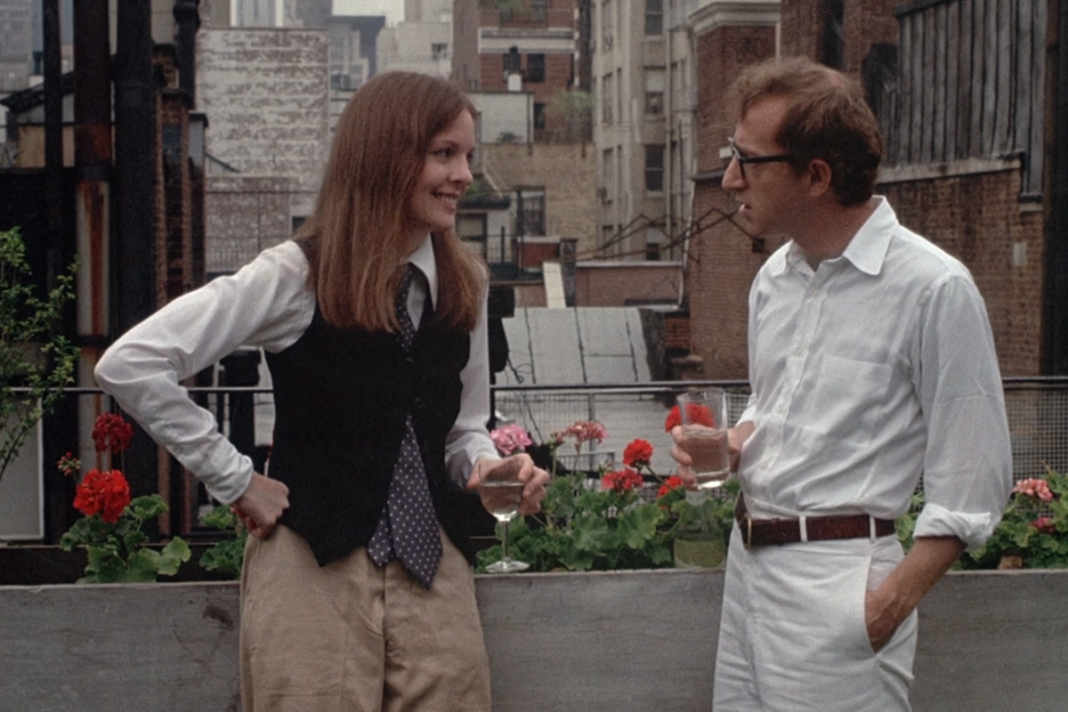
Those oppositions extend to the wardrobe, as back home Alvy typically dresses himself in a neat-fitting palette of browns, greens and russets, often wearing tucked-in check shirts and plaids while Annie takes a mix-and-match approach – for instance in the iconic combination of black waistcoat, long silk tie and loose khaki trousers – where she is not wearing more casual attire. On the other hand Los Angeles abounds in open-chested shirts, pastels and white garments plus other accoutrements like spiky shoulder pads and bone necklaces.
Loose and free, when Alvy briefly reunites with Annie who is now residing in the City of Angels she too has adopted the look, arriving to a fraught lunch in a flowing white robe with floral decorations while Alvy sniffs and swelters in plaid and tweed. In a desperate gambit he asks Annie to marry him, and when she says they are just friends he tells her ‘you love me. I know that’ to which she responds ‘Alvy, I can’t say that that’s true at this point in my life. I really just can’t say that that’s true’. She compares him to an island, calls New York a dying city and brings up Death in Venice, recalling that Alvy only ever bought her books with ‘death’ in the title while he protests that it’s ‘an important issue’.
Note however that on their very first meeting back home in New York City, brought together by a game of doubles tennis before Annie in roundabout fashion offers to drive Alvy home in her Volkswagen car, it is Alvy who is all in white, looking very dapper in a crisp white shirt and trousers which are accentuated by a brown belt. And before heading out onto the roof terrace of her apartment, it is Annie who tells him the funny story of her grandmother’s brother George who had narcolepsy and one Christmas, while waiting in line for his union turkey, simply stood there with his eyes closed and turned out to be dead. So there has been a kind of reversal of roles over the course of this relationship.
For the time that they are together, sparks fly and it’s an easy friction. In one of the standout scenes from Annie Hall, shown early in the film almost as an encapsulation of their chemistry, they bicker and giggle and tumble in and out of helpless laughter as they endeavour to pick up their intended meal of lobsters which are strewn all over the floor. In the twilight they take a walk on the beach and relate their past relationships, as the downfall of Alvy’s second marriage segues seamlessly into their meet cute at the tennis court. But later in the film, back at his beach house in the Hamptons with another woman and more lobsters, all of Alvy’s attempts at humour fall flat. Nobody else can quite compare.
The structure of Annie Hall with those vignettes which jump back and forth but always in the past tense imbues all of this lightness with a note of melancholy. Scenes stick in the mind as though marked for posterity and through all of its comedy the film involves a kind of sloughing off, without being marred by conflict or engaging in the kind of trauma dumps which mark so many modern romances. They are making memories together and amid all of their hijinks, Annie’s two nightclub performances are like a deep intake and exhale of breath.
For her audition she sings the Isham Jones and Gus Kahn standard ‘It Had to Be You’, a film staple which was later cribbed by When Harry Met Sally, while the song which gets her noticed by Tony Lacey is a winning rendition of ‘Seems Like Old Times’, a forties favourite by Carmen Lombardo and John Jacob Loeb which Allen dusted off. ‘Seems like old times / Having you to walk with / And it’s still a thrill / Just to have my arms around you / Still the thrill / That it was the day I found you’ she sings carefully with a smile and a glimmer in her eyes, and when the song comes back around at the end of Annie Hall, over a montage sequence as Alvy begins to reflect on their relationship, in this most lively and gracious of films it droops and falls like the sweetest of blows, one that lands like a punch in the gut.