



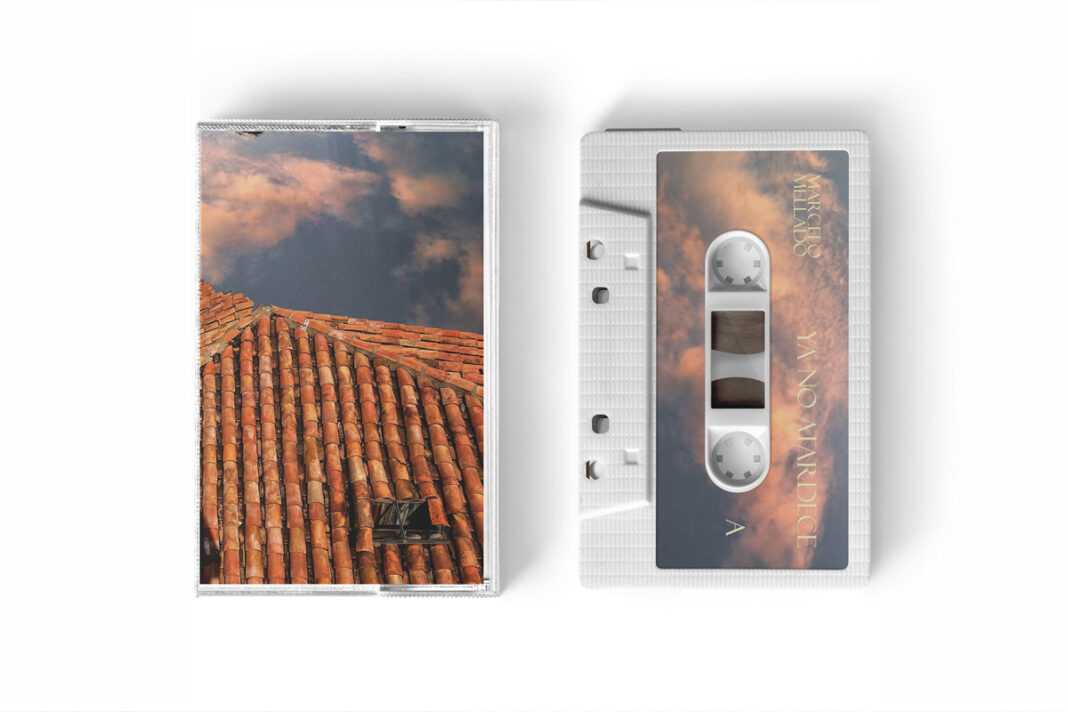
Sometimes even the most compelling drone music can sound a little austere or academic while post-rock guitar textures might feel inherently minimal whether we are talking about rhythmic swells and overlapping phrases, whose breadth is based in repetition, or more angular lines which emphasise a sense of space. At a certain point the more copious end of the post-rock genre became synonymous with a kind of emotional tumult, whose slow builds and shifting dynamics encoded an interplay of melancholic drift or decay offset by cathartic release.
For his debut on Buh Records the Cusco-based artist Marcelo Mellado instead manages to infuse his own particular brand of post-rock with a sense of fullness and emotional constancy. Blending aspects of electroacoustic collage, including field recordings and digital synthesis, with his own training on the electric guitar, he succeeds in cutting a swathe between post-rock and all out drone music. And just like some of the best bands associated with that post-rock genre, he manages to evoke discrete locales and conjure an immediate sense of the inhabited or cohabited or lived-in.
In fact Mellado for Ya no atardece captured field recordings in a number of resonant locations, with the sounds of running streams, rain, hail and storm and vehicle engines gathered ‘in Apurímac, at the Las Bambas mining site, in the village of Collpapuquio in Cotabambas, in the city of Cusco, both urban areas and routes toward the Sacred Valley, and in Lima, in the city center and along the coast’.
What’s more, the artist notes that he recorded some of the conversations he had with fellow passengers and route drivers along the course of his travels, even weaving talks with his grandmother into the rich fabric of the mix. These assorted field recordings blend or blur into his cutting edge use of digital synthesis, where an instrument built with the Max visual programming language allowed him to generate oscillating sine waves which mutate in real time, while a granular synthesizer developed in SuperCollider created sustaining timbres from a collection of his rendered audio files and previously recorded work.
In this sense Mellado is part of a growing trend and a growing number of composers who are using programming languages to generate music whose parameters can be adjusted in real time. The use of such technology cuts across genres, with the double bassist Thomas Morgan for his leader debut Around You is a Forest enlisting some of the top names in jazz to collaborate with his WOODS virtual instrument, which he designed in SuperCollider based around the timbral qualities of West African lute harps, Asian zithers, the Eastern European cimbalom and the marimba.
In the case of WOODS and Around You is a Forest, the sounds generated typically became more harmonically and melodically abstract over time as Morgan guided these improvisations and handed them over to such luminaries as Henry Threadgill, Bill Frisell, Ambrose Akinmusire and Gerald Cleaver for a series of exploratory duets.
Ya no atardece consists of four lengthy tracks which last between seven and nineteen minutes. The album’s title roughly translates to ‘It’s no longer getting dark’. Mellado says that the record is meant to function as an ‘act of resistance to the experience of Lima’ as it looks instead to what lies beyond the city, ‘far from traffic or the faith in the dollar [. . .] skimming the mountains’. Yet the opening track ‘Lluvia’ sounds embedded in the city even if it evokes the sounds of a train commencing on some kind of departure, as the hollow echo of a station, the whooshing roar of passing trains, commuter beeps and train signals and some snippets of passenger conversation cede to a sudden drop like from a processed bass drum.
This is perhaps always the mode or feeling of departure: a sense of embeddedness or entanglement mixed with detachment and the looming prospect of some kind of release. There are moments of liminality and spectrality, voices which sound more disembodied and regale one another with laughter as the route becomes more sinuous, curving around bends with a touch of the melancholy or picaresque. We hear amid the patter of ‘Lluvia’ – the Spanish word for ‘rain’ – tannoy announcements and at the same time a kind of glimmering or twinkling static, as though this particular outing or the very process of travel was enchanted by a Studio Ghibli-esque smattering of fairy dust. The journey drifts like this for a while before embodying a more propulsive rhythm or beat.
Perhaps we are not quite out of the city yet or it still lingers large in the rearview because ‘Icógnita Territorio’ through its gloaming passages seems tinged with a neon light. Its oscillating drones cede to a barrage of pulsing and rumbling textures near the midpoint of the composition, a throbbing mass offset by synthetic blips and beeps. Yet whether Mellado imbues his tracks with a certain mistiness or turbulence they never feel remotely tearful or overly plaintive or somehow menacing but instead proudly upbeat, as though buoyed by a prevailing sense of wonder.
At once contemplative or deliberative and amorphous, like a vapour harrying its way through city streets and their surrounding valleys with aimless intent, the teetering drones billow and surge expressively from the middle of the composition, now joined by the phenomenal verticality of Mellado’s electric guitar as he fills the space with his gleaming pulls and ringing plucks. Choppier polyrhythms which call to mind plucked zither traditions emerge near the close of ‘Icógnita Territorio’, like the bustle of a city at twilight after the sun has skipped below the horizon and everyone engages in one last big intake of breath before being subsumed by the night.
‘Metamorfósis’ opens on the sound of a train honking and screeching unassumingly down the line. This piece is laden with staticky and surging industrial textures, conjuring a kind of futurist landscape. There are faint traces of train whistles and locomotive bells as a series of vocal recordings begin to inhabit the heart of composition, despite their provenance sounding here, shorn of context, like dialogue from a television drama or daytime soap.
Peru is famous for its telenovelas while the country has a patchwork rail system, driven by a compelling mixture of geographic and socioeconomic factors. Inland routes tended to focus on freight to and from the country’s mining regions, while the iconic Ferrocarril Central Andino which links the coastal capital of Lima to Huancayo at a highest elevation of 4,800 metres runs a scenic passenger service only several times per month. Mellado’s sense of travel on Ya no atardece is not limited to trains but incorporates buses and cars, a notion of hiking and a more general or casual air of being and dwelling and perpetual to-and-fro, but Peru’s steep terrain and the difficulties faced by the rail system – whose ascents demand various tunnels, bridges and zig zags or switchbacks – seem worth bearing in mind as we cede to his record’s pulse or flow.
By the long second half of ‘Metamorfósis’ those staticky industrial textures have given way to a gauzy throb which gradually seems to overlay an organ melody, then becomes more brackish or nightswept. As the organ begins to carry the spectre of an old fairground ride, this curiously suggestive ‘Metamorfósis’ takes on the aspect of a haunted house but quite peaceable as the near-nineteen minute composition finally draws to a close.
The album’s notes indicate that Mellado’s motivation in composing the record stemmed not only from his various travels – to the Marcahuasi plateau, Rúpac which is sometimes referred to as the Macchu Picchu of Lima, the town of Challhuahuacho near the Las Bambas copper mine and Pisac a village in the Sacred Valley region – but from his enduring ‘fascination with the Indigenous cultures that chose the highest elevations to build their homes and fortresses, despite the logistical challenges’.
And while there have been traces throughout the album, especially on the opening track ‘Lluvia’, it is on the closing piece ‘La muerte de una estrella’ that some quintessentially Peruvian or more to the point Andean musical textures come to the fore. That’s not only the semblance of huayno rhythms with their interlocking melodies and signature pattern of one long and two short beats, a genre which combines urban dance with rural folk traditions and might feature high-pitched vocals, quena flutes and siku pipes, saxophones and harps, charangos plus more ubiquitous string instruments like violins and guitars.
For from the opening moments of ‘La muerte de una estrella’ some of the lilting panpipe melodies and shriller sounds also call to mind ancient and ceremonial Andean instruments like pututos made from conch shells, antares panpipes and Chimú whistling vessels, all of which were recovered or repurposed on another Buh Records standout, the album El tiempo quiere cantar by the duo of Dimitri Manga Chávez and Ricardo López Alcas as Pacha Wakay Munan.
Those wispy winds and lofty pitches combine with roving night ambiances, which on ‘La muerte de una estrella’ produce an effect of wafting lanterns or floating tea lights. Even set within a harsher environment of restless breezes and stiffer gales, the track retains a certain luminous urbanity, almost like a localised or nature-oriented take on the electronic dreams of AraabMuzik. The song’s title here means ‘The death of a star’ and whatever stage we are at in the life cycle, the gesture as ‘La muerte de una estrella’ progresses is resolutely upturned, a gazing upwards as though looking through a telescope at a series of mountainous peaks or stellar objects and small helical ascents.
Mellado’s electronic processes figure those helixes and suggest celestial transmissions as the song nears its end, and yes the lines of communication become obscure or glisten and glow like wiry filaments but the composition seems interested most of all in signalling an openness for dialogue, with the details of any given conversation a private matter or beside the point and in the face of such a fond commitment to the process or the journey, anyway for now just as soon left unsaid.