


M.I.A. has always elicited her share of controversy in a way that much like her music cuts across fields or genres or zones and resolutely subverts all expectations. That might involve the trenchant support for the Sri Lankan Tamils which is part of her heritage, her daring evocations of the immigrant experience which suggest a capacity to engage and refract as well as to resist and overthrow and her avowed condemnation of genocidal behaviours or it might mean her pandemic-era opposition to vaccines and 5G which folded into a clothing line and even some kind of cursory support for Donald Trump.
Anyone who has checked out from her music owing to any of these factors likely won’t be drawn back in by what occurs on the cheekily-titled M.I.7. The brisk collection of songs and horn-clad interludes is all about her conversion to Christianity and rife therefore with juxtapositions and declamations which pit demons and devils against the saving and ultimately all-conquering power of the Lord.
M.I.7 is then an album of gospel music or spirituals sometimes with a vaguely didactic bent. Yet as always the artist in her guise as singer, composer and collagist manages to imbue her work with all kinds of propulsive beats and shimmering or reverberating textures which pull gleefully yet even-handedly from popular music and from other traditions, notably those pertaining to South Asia as well as parts of Africa and the Middle East. The result – even for someone who might see conversion narratives or the effable rhetoric of born-again Christianity as some kind of artistic dead end – still sounds not only different but rebellious and defiant, self-contained and proud, in many respects quintessentially M.I.A. with M.I.7 unfolding even for the nonbeliever mostly like a shot of radiant energy or a slick healing balm.
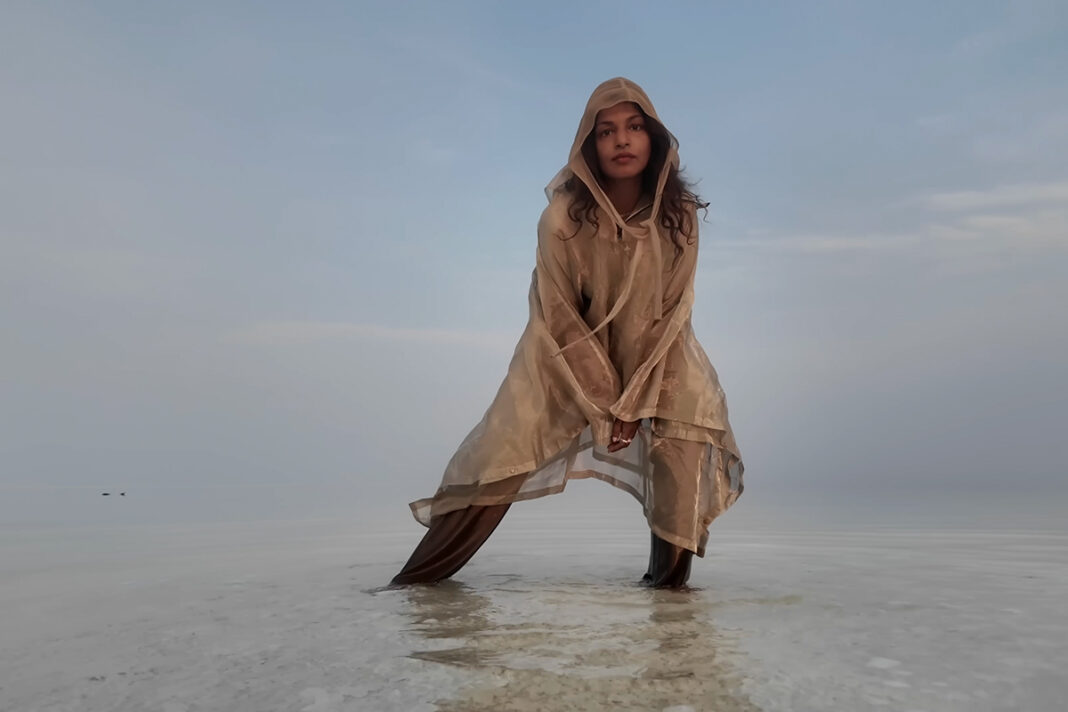
Notably the album does not include a couple of standout singles in ‘Armour’ and ‘Safe’ which she released over the past year and a half. Musically and thematically those would have fit just fine on M.I.7 but they served to both announce her conversion and to support in some way her clothing line OHMNI which is essentially a collection of silvery or coppery fabrics, constructed with plenty of drape, with the aim of forming in the line’s own words ‘a conductive barrier that works to block, absorb and deflect 99.999% of electromagnetic signals’. The clothing then is meant not just to protect against 5G and other alleged forms of radiation but to veil or camouflage the wearer amid a world of ‘indiscriminate mass surveillance’ including smart cities and the rapacious implementation of AI.
What you do get are some of the same gestures, both spiritually and rhythmically. In fact M.I.7 possesses a pretty clear structure with nearly each song prefaced by a ‘trumpet’ fanfare made up of some kind of declamatory spoken word lyric and a clipped or synthesized horn. Numbered one-thru-seven, those spoken word declamations each start with the phrase ‘God thanked it, said it’s time for the [nth] trumpet’ while the horn fanfares interpolate the snippet from Bill Conti’s ubiquitous Rocky theme ‘Gonna Fly Now’ which featured on M.I.A.’s early classic ‘Bucky Done Gun’.
‘Bucky Done Gun’ was inspired by baile funk as well as hip hop and grime. Now on M.I.7 she continues to draw from those genres, with her songs broadly shifting between the shimmering realms of dream pop or synth-pop and more beat-driven artefacts which use house music as a structural frame, as M.I.A. and her select band of producers – which includes Swick, Christopher James Selfe, Thom Bridges and Boaz – use shrill baile funk sirens as accents and co-opt jungle and grime for their syncopated breaks.
Yet when it comes to the precise textures and timbres which inhabit these dance structures, riotous and unwieldy as they well might be, M.I.7 often evokes folk instrumentation from Sri Lanka and beyond. Where the basslines of ‘Armour’ seemed to suggest the sintir or guembri – the three stringed, skin-covered bass lute which provides the Gnawa music of southern Morocco with its low end or heartbeat – by way of their buzzing overtones and percussive character, on M.I.7 the percussion calls to mind the udukkai which is widely used in Tamil rituals and storytelling traditions, the tabla which is the key percussive instrument in Hindustani classical music with its distinct treble and bass or the djembe which is characteristic of a wide swathe of West African rhythm-making.
So she’s coming to Christianity through a complex lens not just spiritually but musically. And while the lyrics on M.I.7 might seem to some listeners to flatten complexity with their sometimes boilerplate embrace of the Lord’s saving grace and their casual invective against evil and sin, M.I.A puts it all together with a characteristic jaggedness as her slantwise rhymes, direct metaphors and offbeat juxtapositions, canny use of slang or code switching and incantatory repetitions – sung limpidly, rapped or recited as spoken word – ally with the diverse timbral palette to produce something which can feel truly rhapsodic, the seven trumpet structure giving a formal quality to the gossamer or tossed-together nature of the work.
M.I.7 is her seventh studio album and draws overtly from the Book of Revelation, where the number seven features more than fifty times and symbolises a complete cycle, a concept of the number which stretches back to other ancient near eastern mythologies and cosmologies as evinced by the Epic of Gilgamesh. M.I.A. somewhat loosely characterises the album as ‘seven songs, written in seven places, over seven days’ with the artist recording across India, Egypt and Ethiopia, Australia, London and Los Angeles.
The album’s opening piece ‘Trumpet 1’ expounds this retinue of sevens, a broad swathe from the seven days of creation and the sevenfold spirit of God to candlesticks, golden balls, lamps and pipes and the Seven Churches of Asia to seven seals and seven plagues, all of which M.I.A. intones like a sunbeam through a lush foliage of running water and bird calls. When she gets to the ‘seven horns’ of Revelation the mention kicks off the first of those trumpet fanfares redolent of ‘Bucky Done Gun’, here sheathed in production which not for the last time on the record conjures Kanye West’s scabrous Yeezus, and its hip house or acid house beats or most explicitly here the blaring trap breakdown of ‘Blood on the Leaves’ (whose horns are themselves culled from the track ‘R U Ready’ by the electronic duo TNGHT).
As the language turns more fiery and apocalyptic, the effect is to make ‘Trumpet 1’ sound rapturous. In a similar kind of vein ‘Prayer 777’ the first proper song on the record sets an incandescent repetition of the word ‘fire’ and a series of identifying metaphors – as M.I.A. describes herself as a ‘prayer, living the life of favour’, ‘a curse breaker’, a ‘woman of war’, a ‘warrior’ and as fire itself – against glinting keys, shimmering sines and a propulsive beat. The glistening echoes and reverberations of her voice might call to mind both a dreamy glossolalia and a kind of Boschian landscape or garden of earthly delights, the song a kind of flickering vision seen through a burning bush as M.I.A. – the angels firmly in her corner, draped in God’s protective armour – shrugs off or sets fire to past worry and doubt.
‘Trumpet 2’ replaces house or trap dynamics with a more clipped or plasticky horn and on ‘Jesus’ the Sunday Service Choir entreat the Lord to ‘set me free’ over a synthetic melange of faintly oscillating fanfares and drum patterns which sit somewhere between djembe and steelpan traditions, dubby and barebones like the spare ribs of a ship. The Sunday Service Choir was put together by Kanye West in early 2019 ahead of the release of his own Jesus Is King and the subsequent group effort Jesus Is Born, and in the second half of the song ‘Jesus’ cedes to cherubic or seraphic gospel music replete with swelling organ and wobbling beats as M.I.A. envisions herself fighting the good fight, sword in arms before switching focus to keenly search for some kind of everlasting release.
‘Sacred Heart’ which immediately follows is watery, pellucid and decidedly elfin, with its chorus – whose vocals are credited to the artist’s mother Kala – drawn from the ‘Ellaam Yesuvae’, a Tamil Christian song which finds respite in God from this troubled world. The third trumpet interpolates the coda to ‘Matangi’, the title track from M.I.A.’s fourth album, while ‘Money’ again offers an echo of Indian and West African drums like the tabla, the djembe and dunun with their springy mix of bass and treble registers. In fact the rhythm of the song and its busy cross-pollination of elements calls to mind some of the artist’s earliest hits like ‘Galang’ or ‘Paper Planes’ as here the clinging of cash registers sounds more attuned to the crypto age, a bit like Patti Smith’s whirling ‘Free Money’ but focused on accumulation and transaction rather than dreamy excess as M.I.A. delivers a paean to currency, glad that money keeps falling into her pockets.
The juxtaposition or cross motion between a kind of limpid or even celestial spirituality and more hard-hitting beats continues through ‘Trumpet 4’ and the glimmering synth-pop of ‘Circle’, which slaps more towards the close as M.I.A. declares herself ‘too global to be local / to real to be loco’ and spurns lust, jealousy and envy among all those other vices.
The next trumpet duly summons the destroyer Apollyon and his plague of locusts while on ‘Calling’ the Sunday Service Choir emerge again to offer both a balm and a promise, on a song which serves to commingle traces of the African-American spiritual ‘Go Tell It on the Mountain’ with contemporary Afrobeats.
‘Trumpet 6’ then sounds like vuvuzelas at a football match, a prelude to the climactic fight scene of ‘Ride the Sky’ with its loping and skittering percussion. M.I.A. says she’s ‘big like Suge Knight’ and vows that ‘good wins, rid sins, God bins Satan’s jins’ as tabla drums develop, taking the place of the processed pattern, and a lavish Middle Eastern melody drapes and vaults above. What we get then on ‘Ride the Sky’ is less the fight sequence itself and more of a slow-motion montage which recapitulates the flow of the battle, a pinkish and ambery smoke parting to reveal a golden horizon with the decisive engagement of the war having already been won.
‘Seventh trumpet finally blew, unleashing what God already knew’ begins the bucolic and triumphant revery of ‘Trumpet 7’, as in the wake of a great victory God suggests ‘these days are for loving, and they be lots of good times to be having’. ‘You guys were all worth saving’ his voice concludes, and so we can all stand together and thank God for that.
That leads into the celebratory closer, ‘Everything’ a song of propulsive and hypnotising and whirligig praise as M.I.A. conjures the image of Jesus returning to earth ‘like a thief in the night’ and delivers one of her finest rhymes in the chorus. With her distinctive vocal styling, that limpid yet buzzing swarm like a watery throng she sings ‘No I won’t live in sorrow, money I won’t borrow / I will be blessed in all of my tomorrow / No tears to swallow, no fears to make me wallow / Joy is gonna grow in my kingdom and my borough’ concluding with a nice nod to her hometown of London as ‘Everything’ ends in a sworl of keys and strings before M.I.7 cedes to a billed thirty minutes of silence.
The quavering sine tone cuts out soon enough but M.I.A. does rejoin us with a few minutes to spare for a shapeshifting lullaby in which she sings about keeping vibes high, blessings falling from the sky, being baptised and riding the wave ‘like a rip tide’ while also sharing a few of her bêtes noires like the absence of all privacy. With a final message to ‘step outside, feel the grass and feel the breeze, see the leaves and see the bees [. . .] sprout your greens and kiss your morning sky’ she draws the veil then, slipping wispily through the slender eye of nature.