


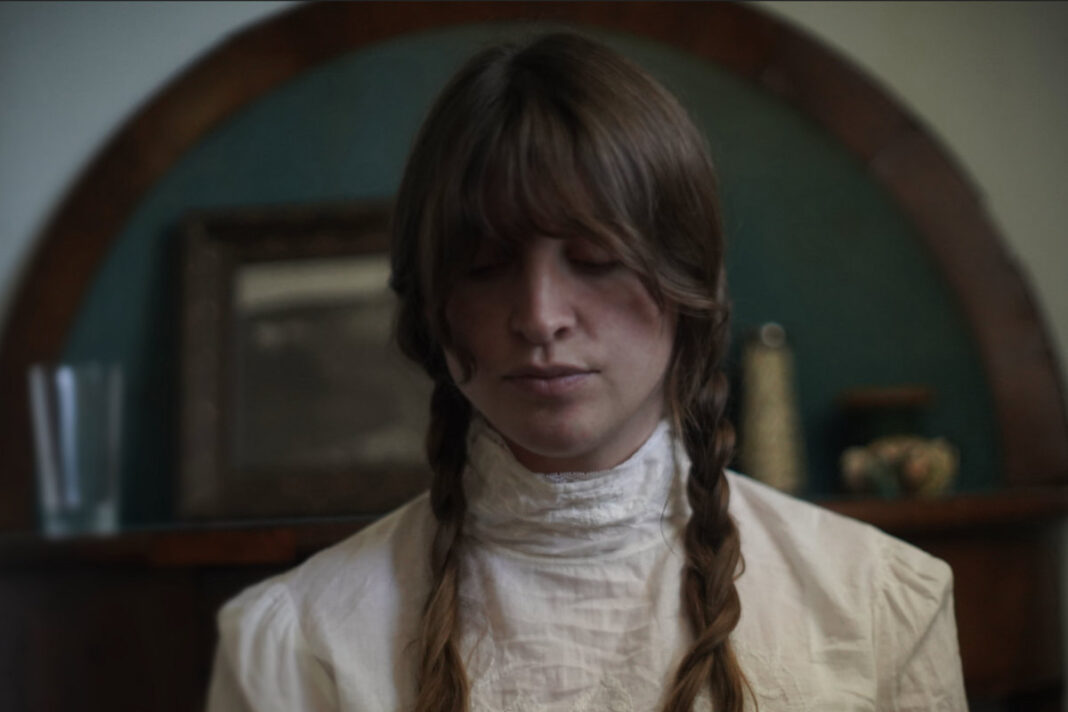
Over the course of what is now three extended plays Natalie Wildgoose has summoned apparitions of the North York Moors – with their purple blooming heather and their hobs and witch hares or mermaids as they reach the cliffs of the coast – while offering a compelling blend of British and American roots traditions. On her debut First Birdsongs she even approached the Nashville sound through harmonic swells, swooning strings and shuffling percussion while Come into the Garden was more folksy and spectral as she swapped the guitar for piano and cosseted her vocals more deeply with the homespun and staticky mix.
As a songwriter Wildgoose might evoke those folk songs or Broadside ballads which often take a devious or accusatory or even murderous bent, stuff like ‘Barbara Allen’ or ‘The Banks of Red Roses’ which have been sung to stark ends by some of Britain’s finest folk practitioners including Shirley Collins and June Tabor amid their journeying back and forth across the Atlantic. In lyric and phrasing there is also a stream of American influence or at least a shared consciousness, from the revivalism of Joan Baez and Judy Collins to modern standouts like Jolie Holland and Joanna Newsom who might reassemble the tradition or shape echoes and traces while forging – even foraging – their own resolute pathways.
Rural Hours keeps the same flickering hearthside intimacy of Come into the Garden while being even more eerie and spectral and also too more instrumentally diverse. Spare and sustained piano keys with little coiling wisps of melody accompany the brief opener ‘A Dream in Winter’ as Wildgoose warns ‘Do what you’re told / Don’t ever get older / Hope’s in your hands / And love on your shoulders’. It sounds like a faint and cooing message from someone who once fell foul of those rules, transmitted in quavering fashion through the vestiges of time by virtue of some old music box or phonograph player.
‘Nobody on the Path’ with its rambling melodies shrugs off its wary guitar introduction to sound winsomely at one with lonesomeness and the surrounding nature, even where those surrounds threaten to tumble and bury or circle and dart. Suspended piano keys and doleful accents from a banjo elaborate the accompaniment, with Owen Spafford switching between the fiddle and banjo over the course of the record and Matt Robinson contributing additional piano while Chester Caine and Chris Brain – a nubby double header – play guitars. As the music acquires a certain stately though nagging momentum, in almost a swoon Wildgoose begins ‘Nobody on the path today / Only birds circling above / Like burnt black pieces of paper’ a striking and crinkled image to which she soon returns.
Crows beat their wings in palpable protest and wild rain swamps the singer’s brain with a sense of rot or toxicity in the refrain before ‘Nobody on the Path’ reaches its lilting climax. It is an ode to the practice of listening as well as to the inimitable nature of her chosen art, something in the manner of say ‘Headphones’ by Björk as Wildgoose continuing her walk sings ‘But music hives / Like honey in my head’ which is a lovely oozing sentiment. She and her song cede then to a gnawing fiddle, which swoops and soars and takes a diverting course in the grey-caked azure of the firmament.
By contrast ‘River Days’ sounds ebullient as it embraces despite a lingering disquiet the great outdoors and on ‘Sibyl’ she returns to wafting piano intricacies against a folksy backdrop. The song roots itself in ancient Greek myth and such sources as the Metamorphoses and Satyricon mostly by way of T. S. Eliot, with Eliot in the epigraph to The Waste Land quoting from the Satyricon as follows:
For I indeed once saw with my own eyes the Sibyl of Cumae hanging in her jar, and when the boys asked her, ‘Sibyl, what do you want?’, she answered ‘I want to die’.
There are references too to grains of dust or sand and a stirring evocation of wet hair and arms full of hyacinths, all passages drawn from The Waste Land, while Wildgoose also plausibly broaches Bluebeard and his fateful doors and walls, a folktale which has been conjured by a wealth of artists including Charlotte Bronte, Cocteau Twins and Joanna Newsom. Yet for all of that, the musical backing to ‘Sibyl’ with its sawing and tinny fiddle or twining banjo and guitar reminds me most of Catalpa by Jolie Holland, with a melodic affinity for the ‘Hallelujah’ of Leonard Cohen in the coda as Wildgoose sadly sighs ‘I was once gifted music / Could’ve wished to be a star / Now that’s left is just a voice / Trapped in a little glass jar’.
The piano beneath ‘Wind Callers’ possesses a roiling quality amid the vocal coos and deft plucks or brisk strums of banjo and guitar. Spafford’s fiddle then begins to crest the piece, which manages to combine say the inner turbulence of Ruins by Grouper with the sweeping elegance of Irish tradition. Rural Hours then draws to a close on a plaintive note and through another rich seam of evocations, with the wonderful ‘In the North’ drawing another strain of intimacy from Wildgoose’s voice which sounds raw and affectionate and almost untethered.
A rising tide against the simple piano accompaniment, at various moments on Rural Hours the singer might call to mind Vashti Bunyan, another native northerner with a penchant for tender inflections and the mucking together of folk influences. But here the sonority of her voice and its solitariness is most clearly redolent of the prescient singer-songwriter and disappearing artist Connie Converse, especially her song ‘One by One’ which was memorably covered a few years ago by the soprano Julia Bullock.
There is also more than a trace of the ‘Wichita Lineman’ for its desolation and sense of homesick or homestruckness as Wildgoose holds onto her thought with just the hint of a quiver or tremble, beginning ‘In the north / The fog runs off / The moorside that closes above us’. Pungent depictions of place through sodden walks and grouse in the heather give way to a gothic narrative of lost love, the surreptitious passing or full-court press of time and once sprightly limbs laid under the dank turf as she continues through the refrain ‘And tomorrow I’ll be back in the city again / Where old age will hurry me to you’.
She summons up or strolls through that graveyard school and a tradition which was ornamented or complicated by the Romantic poets and gothic writers on both sides of the Atlantic, from Gray and Poe or Byron and Coleridge to Brontë and James before reaching a kind of culmination or endpoint in the modernism of The Waste Land or ‘The Dead’ from Dubliners. Yet the perspective and the imagery laden as it is with shapes and spectres remains firmly transfixed upon the North York Moors and their surrounds as Wildgoose concludes ‘Nearly happy again, in the winter night rain / With the hillsides and woods, saw the grave where we’d stood / You’d said the future looks good in the north’ sentimental and sad, blurring the coming and passed, but with more than a touch of dark irony as the last line would be enough to launch a dozen political manifestos.