


The 58th iteration of the Umeå Jazz Festival brought some familiar faces to the north of Sweden, offering its usual blend of marquee names and local favourites alongside other enticing if lesser-known acts. The festival also continues to expand its approach to the rest of the city, with a week-long calendar of events heralded by Jazzcafé Swingfabriken astride Umeå University’s arts campus to the east of the centre including breakfast and evening performances at some of the city’s premiere hotels and restaurants, a workshop at the culture school and a jazz and poetry session at the city library.
This year’s guest of honour was Josefine Cronholm, a vocalist who has worked with Django Bates, Marilyn Mazur, Kirk Knuffke and Steen Rasmussen and whose latest album Wild Geese with her Near The Pond ensemble draws from the writings of the twelfth-century Japanese poet Saigyō. As is tradition music students from Midgårdsskolan introduced the festival on Wednesday evening while as part of Umeå Jazzstudio’s fall schedule, Thursday night served as a release party of sorts for the Johan Lindström Septett as the acclaimed septet’s third studio album Humankind was just released on band member Jonas Kullhammar’s Stockholm-based label Moserobie Music Production.
The festival proper though never really gets underway without an appearance from an Öberg ensemble, with the brothers Sten and Staffan Öberg two of the founding members of the Swedish jazz scene, Umeå natives whose relationship with the festival now stretches back decades. The drummer Sten Öberg played on the trombonist Lars Lystedt’s cherished 1963 album Under the Midnight Sun, and when Lystedt founded the Umeå Jazz Festival five years later Öberg played accompaniment alongside the soaring tenor of Dextor Gordon, who was then in the midst of a long European sojourn as he spent fourteen years living between Paris and Copenhagen.
In the years since Sten Öberg has often appeared beside his brother and other Swedish jazz luminaries like Lars-Göran Ulander as part of the Staffan Öberg Nonet, but this year the drummer led his own ensemble, a quartet with Ulander on the alto saxophone and Jens Marklund on the tenor while Hanz de Ward completed the rhythm section on the bass. They played on the mezzanine level adding to the ambiance at Freja, the returning pop-up bistro whose clinking chatter also gave way over the two nights of the festival to performances by Dogwill and a Sarah Vaughan tribute act called Sassy Swings.
Other highlights on Friday included the captivating, probing but always engaging Space trio who opened proceedings down in the club atmosphere of Studion, the contemporary home of Umeå’s jazz scene. Made up of the pianist Lisa Ullén, the bassist Elsa Bergman and the percussionist Anna Lund, the trio have released two albums on New York City’s independent bastion Relative Pitch Records and have drawn comparisons to the Feel Trio, one of modern jazz’s touchstones as Ullén’s playing shares a certain rhythm and spirit with the cluster chords, deft polyrhythms and all-around percussive attack of Cecil Taylor plus more contemporary piano practitioners like Satoko Fujii and Sylvie Courvoisier. The trio arrived in Umeå having recently closed the Stockholm Jazz Festival in a double bill with Pat Thomas’s acclaimed quartet أحمد [Ahmed].
Later in the evening the Aleph Quintet – a Brussels-based fusion of contemporary jazz, Gnawa rhythms and Sufi melodies – took to the red-hued stage of Studion, one of several performances during the Umeå Jazz Festival to be broadcast live on Sveriges Radio P2. And they were followed in turn by Blackknuss, the formidable Swedish collective founded in the early nineties by the drummer Martin Jonsson who are renowned for their southern-inflected strain of funk and soul, a sound which has sometimes seen them referred to as Sweden’s answer to The Roots.
Meanwhile on the main stage of the Idun theatre Eric Bibb led a quartet, the blues singer’s own roots stretching all the way back to the Greenwich Village folk scene of the sixties while he spent many of the proceeding years based out of Stockholm, and the Trondheim Jazz Orchestra whose climactic performance at last year’s festival featured the shapeshifting talents of Mats Gustafsson and Anja Lauvdal this year spotlighted Sigrid Aftret, the composer and saxophonist who has been busy touring her new work for the ensemble.

Westward rather than eastward bound and across a smaller sea than the Atlantic, the Helsinki label We Jazz Records sent over more than a smattering of artists, including the third stream quartet Ainon whose commingling of jazz and classical music is helmed by the cellist and composer Aino Juutilainen. They performed in the festival’s small experimental space Tonsalen after a set by the Swedish double bassist Christian Spering, who was paying tribute to his friend and role model Palle Danielsson, a member of Keith Jarrett’s European quartet who also played alongside Jan Garbarek, Enrico Rava, Charles Lloyd and Peter Erskine as part of a long relationship with ECM Records.
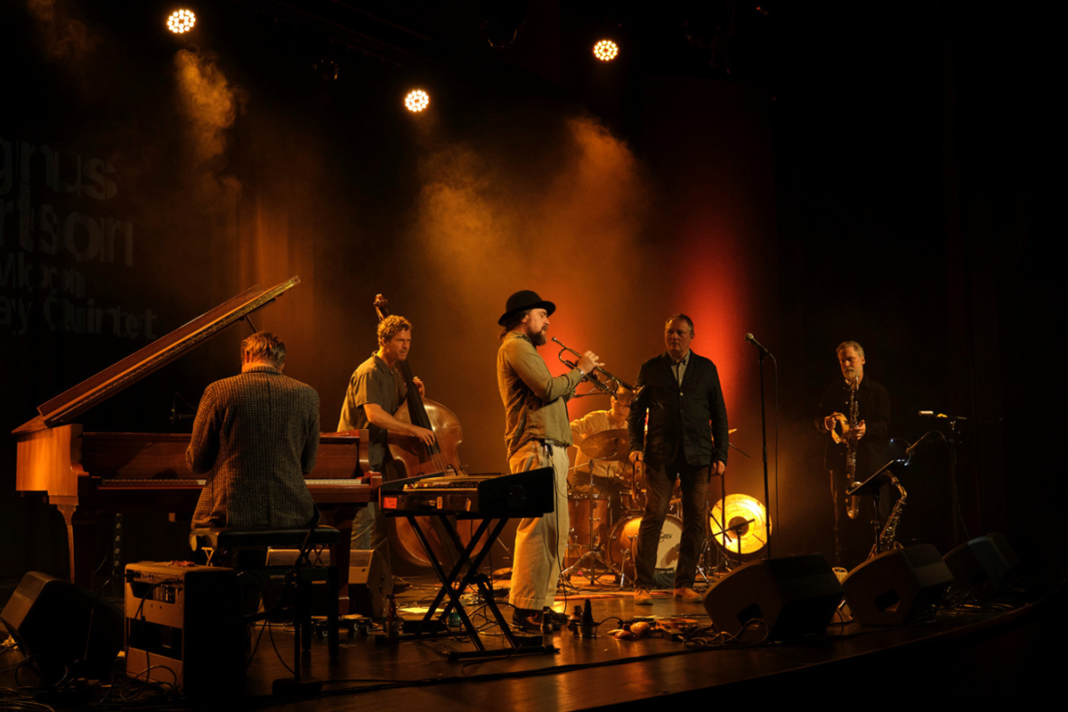
On Saturday the silvery and sometimes louche Magnus Carlson and his Moon Ray Quintet capped the night in the Idun theatre. One of several acts at this year’s Umeå Jazz Festival with links to the Stockholm club landmark Fasching, the band are returning from a decade-long hiatus and will release a new album on We Jazz in December, entitled Shadows as the singer Carlson and his quintet led by the Tropiques and Cosmic Ear trumpeter Goran Kajfeš tackle diverse favourites by everyone from Marion Black and Al Jolson to David Bowie, Sufjan Stevens and Scott Walker.
And in one of the festival’s standout performances, the Helsinki group Superposition led by the drummer Olavi Louhivuori played an engrossing set in Tonsalen as attendees faced a stark choice between Carlson on the main stage, Superposition in that intimate space and the guest of honour Josefine Cronholm who was about to get underway down in Studion.
Anyone who opted to sit in on Superposition would have found it hard to tear themselves away. The drummer Louhivuori made his debut at the festival back in 2000 as part of the Joona Toivanen Trio and has returned several times since, for instance in 2010 as one of the Tomasz Stańko Quintet, these repeat visits making Umeå by his own admission a place especially dear to his heart. On the small elevation of a stage in Tonsalen he also described the Umeå Jazz Festival as a ‘door to the darkness’, a suggestive phrase redolent of occultism although its meaning was more prosaic, as Louhivuori gestured to the season and the impending clock change, explaining ‘after this it’s gonna get really dark, but I like it’.
Following two well-received albums on We Jazz Records in 2020 and 2024, the quartet now have a third effort on the way and its songs made up much of their setlist in Umeå. The group comprises Louhivuori on drums and other percussion plus Mikael Saastamoinen on the double bass and the twin attack of Adele Sauros and Linda Fredriksson who together wield all manner of saxophones.
Their sound is rooted in past experience. Alongside his many other projects and diverse collaborative partners like Tomasz Stańko, Mats Eilertsen, Yelena Eckemoff and Emma Salokoski, the bandleader Louhivuori steered the experimental band Oddarrang who were known for their sometimes glacial post-rock soundscapes, akin to say Sigur Rós or the cinematic sweep of Anoice before 2024 brought their self-titled and self-professed finale. Meanwhile the alto and baritone saxophonist Fredriksson fuses jazz, punk and a distinctly Finnish naturalism as part of the Mopo trio and Saastamoinen under his Perussastamala monicker flits between ambient jazz, progressive rock and more dreamy electronics.
Yet they also draw from a wellspring of influences, including for example the bluesy hard bop of the fifties and sixties or Ornette Coleman’s pioneering free jazz of the era, but perhaps most clearly in some of this newer work the world fusions of Don Cherry, from the Organic Music Society which he established with his wife Moki after moving to the southern Swedish village of Tågarp to the three album he released on ECM Records with his groundbreaking Codona trio.
In fact as the saxophonists of Superposition opened proceedings with a drone, shifting between the tenor and alto before Saastamoinen introduced his rumbling, sometimes plummy bass and Louhivuori his deft drum hits, the first two compositions called to mind a bit of Motown soul and an Ayleresque dirge replete with sunlit rays of truth-seeking. Shakers began to open out that second piece as the dynamics of the quartet subtly shifted from loose and spare to squawk and squall, with a smartly constructed bass solo holding the audience in its thrall before the tune shuffled to a close.
The compositional share has continued to evolve with the band’s first album featuring eight original pieces by Louhivuori while their second effort spread out the songwriting process. At least with some of this newer material Superposition tended towards a kind of purposeful indefiniteness, often opening their compositions with a loose and shaggy wash of percussive gestures like shakers, cymbal rolls and spurting horns.
One piece managed to seamlessly blend bronzed and burnished passages with sounds redolent of the Australian outback from watering birds and fowl to the wobble board and didgeridoo. Between hyperventilating vocalisations the quartet managed to conjure a gilded romanticism, even glowing like an old jazz standard as Sauros maintained a fine tone on the tenor and Fredriksson dropped in on the baritone saxophone. Another piece incorporated whistles and flutes, with the jaunty ‘Bobby’ as composed by Fredriksson one of the set’s high points.
While the process here was one of creating space and finding a way towards a rhythm, as Superposition turned to some of their older material – starting with the stirring ‘Antiplace’ the opening track from their debut album – they showed their penchant for a harder bop and thicker grooves. Whether bowing in the deep or creating a surface warmth without stirring up too many waves, they showed an almost uncanny knack for harnessing their raw parts and taking each composition where they wanted it to go.
The same kind of control was on display down in Studion with Josefine Cronholm and her Near The Pond Ensemble, whose lineup here starred Kirk Knuffke on his distinctive cornet, Bent Clausen on vibraphone and drums, Thommy Andersson on bass, Marta Potulska on viola and Melissa Coleman on cello. As they delved into Wild Geese and the poetry of Saigyō, full of moonlit skies and fallen snow while often embodying themes of isolation and loneliness, Cronholm’s babulus vocals straddled the line between jazz and folk and even sometimes carried a Celtic flavour. Beneath her untamed yet imperious command, loping grooves from the drums and bass were sawed into with a degree of verticality by Potulska and Coleman’s judicious string section.
After elaborating the colours and sentiments of Wild Geese, the band played three songs from their debut album Near the Pond which was billed as a trio record with Cronholm, Knuffke and Andersson supported by Kenny Wollesen on percussion plus the strings of Lena Fankhauser, Potulska and Coleman. More bluesy and less folksy or classical, this earlier material contained some of the same loping rhythms and heartfelt themes while drawing instead on the poetry of Carl Sandburg.
If the assorted song titles on Wild Geese include ‘If Only’, ‘Empty as Sky’, ‘Winter Deepens in a Mountain Home’ and ‘I Know That’s The Moon’s Light’ some of Sandburg’s poems share similar sentiments, a mixture of solitariness and reticence, tenderness stayed by an almost pained delicacy. Take the poem ‘White Shoulders’ for instance, a setting of which served as the penultimate track on Near the Pond with Knuffke up on stage explaining that the words already carried their own innate musicality:
Your white shoulders
     I remember
And your shrug of laughter.

     Low laughter
     Shaken slow
From your white shoulders.
or the forlorn ‘I Sang’ which the band played here to a percussive accompaniment of shifting sediment:
I sang to you and the moon
But only the moon remembers.
     I sang
O reckless free-hearted
          free-throated rhythms,
Even the moon remembers them
     And is kind to me.
Then on the evocative Near the Pond opener ‘Clara Mathilda’s Dream’, as Cronholm implored the hushed audience to ‘Dream of a landscape, pastures and meadows, a place to be’ the creaking and droning of viola and cello were offset by a soft patter of footsteps conjured up by the vibes, as Knuffke’s arch cornet soared in the sky and Andersson’s bass also took up the melody.
Shifting back to Wild Geese as their lengthy set stretched into the small hours, drawing a late and opulent curtain on the Umeå Jazz Festival, glacial strings and bowed vibraphone vied with the offbeats of the bass and a sputtering cornet. Changing the order of the album’s final two tracks, Near The Pond played ‘Only the Moon’ whose music box melodies and chimes evoked Björk’s wintry opus Vespertine with Potulska’s viola taking one last star turn as the band closed us out with ‘Time On My Pillow’.
Earlier on Saturday the vocalist Vivian Buczek and a Lindha Kallerdahl trio had taken the stage of Studion while the Thai-Swedish artist Sirintip kicked off proceedings in the Idun theatre, presenting their new interdisciplinary ‘Mycelium’ suite which explores the wonders of fungi and plankton. And to Äpplet the glitzy yet flexible restaurant space with its mirrored bar and vast floor space Duo Siqueira Lima brought a flourish of classical guitar, with the Uruguayan and Brazilian duo of Cecilia Siqueira and Fernando de Lima virtuosic players who have also achieved a degree of virality for their four hands on one guitar routine.
They were followed by Svante Söderqvist and his freshly launched endeavour The Rocket, which brings together the members of the Svante Söderqvist Trio – the bandleader on the double bass and occasionally the cello, Adam Forkelid on piano and Calle Rasmusson on drums – with the Estonian-Swedish accordionist Tuulikki Bartosik. A fine-fettled trio who tend towards classical airs, the addition of the accordion – always redolent of the bal-musette – adds colour and breadth to their music, whether playing brackish drones or sounding like the flue pipe of an organ, tempering romances with a bit of wistfulness or rakish guts and adding a winnowing, spectral quality to their more rustic moments.
While half the fun of such a festival revolves around exploration and the discovery of new or otherwise neglected acts, the various settings and the music itself always a force equaliser, if there was a headliner at this 58th iteration of altogether Umeå jazz it came no doubt in the form of the Dave Holland Trio.
Holland has visited Umeå on numerous occasions in the past, leading his quintet in 1999 and 2008 while in 2013 he performed with his Prism quartet. He has also led or co-led various trios over the course of his long and distinguished career, from the decades-hopping Gateway trio which also starred John Abercrombie and Jack DeJohnette to the 1988 album Triplicate performed alongside Steve Coleman and DeJohnette as he strayed from larger ensembles in his work for ECM Records, with the past few years bringing Good Hope with Zakir Hussain and Chris Potter, the acclaimed Without Deception a studio session with Johnathan Blake and Kenny Barron and Another Land with Kevin Eubanks and Obed Calvaire.
On this occasion he brought along two of the East Coast’s finest practitioners in the saxophonist Jaleel Shaw and drummer Nasheet Waits. After a brief introduction, the trio launched into ‘Triple Dance’ from Triplicate with Shaw’s alto and Waits on percussion standing in for Coleman and DeJohnette (the legendary jazz drummer who unexpectedly passed away on Sunday at the age of 83). Whereas the relatively spare album Triplicate showcased Coleman’s unique approach to harmony and the light touch of DeJohnette, here the trio gambolled with a certain circuitousness and restraint. Shaw strung together short phrases with lithe lyricism and not too much vibrato while Waits’s patter on the drum kit was crisp and clear.
Their take on ‘Passing Time’ from Another Land felt more deeply embedded and urbane. And on their third piece of the evening Shaw led the trio out, with he and Holland dropping back to make space for a blazing drum solo by Waits, all pots and pans and pistons firing in what was a truly dazzling display of precision and pace. The percussionist (son of the drummer Freddie Waits) has enjoyed fruitful partnerships with Jason Moran, Tony Malaby, Avishai Cohen, Ralph Alessi, Armen Nalbandian, Eric Revis and more recently Tim Berne while Shaw is equally at home in jazz and crossover settings, featuring alongside Roy Haynes, Robert Glasper, Lage Lund, Alicia Olatuja, High Pulp and Sasha Berliner to name but a few while his latest album Painter of the Invisible was released on his own Changu Records earlier this year to significant acclaim.
Introducing a composition by Waits, the bass of Holland proved more stringy and plaintive, teasing and traipsing its way towards a groove as Shaw reached the upper register of his instrument, now holding onto his tone. Dashing off a few cymbals and maintaining the rhythm, suddenly it was threshing season as Waits propelled the group into a lively climax, whittling the wind.
Throughout their performance in the Idun theatre, mottled colour abstractions sometimes with geometric patterns rolled behind the trio on the big screen. Their last song was ‘Rivers Run’, a piece from Triplicate dedicated to the versatile instrumentalist and Studio Rivbea overseer Sam Rivers who led several Blue Note sessions in the sixties and performed with Miles Davis, Bobby Hutcherson and Andrew Hill before commencing a long collaborative partnership with Holland in 1973 upon the release of the bassist’s debut as a bandleader, the landmark album Conference of the Birds where Anthony Braxton and Barry Altschul rounded out the quartet.
Holland returned to ‘Rivers Run’ in 2008 on Pass It On with a sextet. Here with a more slender ensemble the opening to the piece sounded rambunctious and free. Holland took his fullest solo of the evening, which at times adopted folksy and even baroque airs, while Shaw and Waits engaged in some nice interplay. Bouncing off one another and gaining a sense of urgency, the saxophonist began to squall while Waits responded with some martial beats. Billowing and painterly while still incorporating a steady drill of drum rolls, he slowed things down and built up a head of steam in another astonishing show of control and rhythm. Holland and Shaw briefly sat out then returned to arouse a chugging groove, blurring the gaps between notes as the trio trundled on in glad concurrence.