


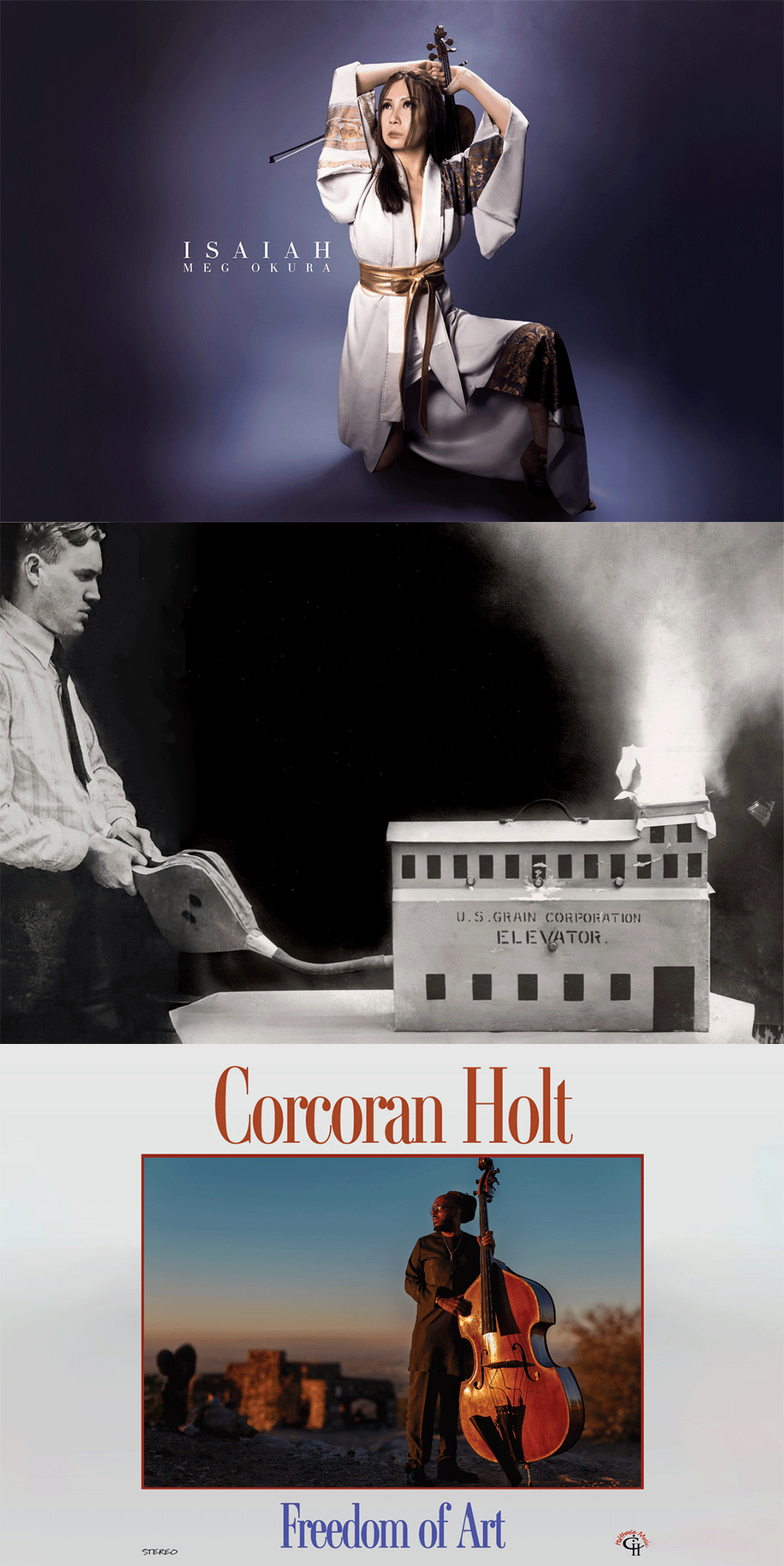
The acclaimed violinist and erhu player Meg Okura does more than assemble a stellar cast for her virtuosic new album Isaiah, which she describes as ‘a musical memoir of my shifting identities . . . a realm where I am not an outsider’.
A stellar cast she does assemble with the flautist Anne Drummond and clarinetist Sam Sadigursky leading a sometimes winnowing and sometimes spellbinding attack, now mainstays of Okura’s big and bold Pan Asian Chamber Jazz Ensemble, which has carved out a reputation for its rich blend of jazz, classical and folk music and is now entering in this new guise its twentieth year. David Smith plays trumpet and flugelhorn and Rebecca Patterson the tenor and bass trombone, with Riza Printup on the harp, whose duo album Pag-ibig Ko, Vol. 1 with the saxophonist Matthew Muñeses has been one of my favourite and most listened to records of the past year, a suite of gently flowing compositions inspired by the Filipino love song genre kundiman where the strings of her instrument sometimes call to mind Spanish traditions or the fingerstyle playing native to Hawaiian slack-key guitar.
Brian Marsella on the piano also returns from Okura’s last ensemble album Ima Ima while John Lee plays a chugging or blistering guitar and Evan Gregor and Peter Kronreif on bass and drums complete the rhythm section. Yet the hefty addition on several tracks of the trumpeter Randy Brecker and Okura’s husband Sam Newsome on the soprano saxophone – plus features from Remy Le Boeuf on the alto saxophone and clarinet and Rogério Boccato on percussion – turns Isaiah almost into a big band album, with plenty of dazzling and overlapping interplay produced to sometimes dizzying effect.
So it is certainly a very busy album but this teeming quality is part of the point. Okura more than ever is concerned with not quite reconciling but laying bare the different parts or aspects of her self and all that has fed into her music. She notes that she grew up as part of a tiny Protestant minority in Japan before moving to New York City to study at the Juilliard School, then began performing as part of the Jewish band Pharaoh’s Daughter and eventually converted to Judaism, while she has been married to Newsome since 2004 and continues to reside in the Bronx.
She also arrives with Isaiah in the wake of another personal and career landmark, as last November her Shaon Overture premiered at the Carpenter Center in California, a work for the 68-member Symphonic Jazz Orchestra which featured Terri Lyne Carrington and Ben Williams plus Okura herself as the violin soloist.
Isaiah then gets underway with a big glissando of keys and strings, with a musical countdown introducing a kind of march – whose throbbing bassline and slapping percussion calls to mind Led Zeppelin on some of their heavier and bluesier tracks, like their take on the Kansas Joe McCoy and Memphis Minnie song ‘When the Levee Breaks’ – before Okura leads her ensemble through its first recitation of the dazzling theme.
Over the course of Isaiah heads or themes despite their catchiness and Okura’s penchant for a kind of surging melodicism are not broad introductions, stable homes or subjects which may be in some way discussed or ridden out at length. Instead they function like illuminated merry-go-rounds at the heart of lively theme parks where the attendees hop on for a brief swing before jumping loose and peeling off in yet another direction.
And this opening song ‘Sushi Gadol’ – itself a provocative title, as it brings together the traditional Japanese raw seafood dish that we all know and love with the Hebrew term for something monumental or of the highest rank or more colloquially ‘great’ or ‘awesome’ – loosely inhabits two zones or spheres, one where a lead instrument drives a brisk and sworling melody with the piano comping aside the high march of the drums and the swampier tones of bass and trumpet, the other more lilting as it features a mellower brass section, delicate winds and some twinkling harp, steering readily between bucolic nature or fluttering fantasy and gambolling romance.
Drummond’s lively flute might crest either sphere or section, and after Okura on her violin leads the introduction of the theme, for the second go-around it is Lee’s turn on guitar, before a curious retinue of zephyr winds, tremulous keys and aching trumpet suddenly suggest something of David Bowie’s transitional Berlin-era classic ‘A New Career in a New Town’. We come out onto a Latinate rhythm, somewhere between the samba and a rumba, with folksy melodies played on the violin and flute plus a handclap breakdown ahead of one last recapitulation of the theme, now played on brass and woodwinds. And there is still time for a moment of guitar shredding as the ensemble swirls and ends the composition with a sixties-style comic book ‘sock’ or ‘pow’.
‘Sushi Gadol’ then is a stirring and somewhat discombobulatory introduction to Okura’s album, which like pretty much all of Isaiah will render more detail and direction on subsequent listens. Yet it is also sweet and fond and it turns out that Okura has dedicated the composition to her brother, whose own career trajectory saw him transition from heavy metal drummer to Protestant pastor in the kind of sweeping yet nibbling movement aptly mirrored by his sister’s track.
The second piece ‘Blessing’ opens with an anticipatory quiver before a lush swell of erhu and some glistening harp. The brass section adds languor to those lavish strings, conjuring the impression of a gondola ride illuminated by string lights, an oversized moon and the stars. Newsome makes his first appearance with a muted and silvery soprano saxophone solo in the middle of the track, which is accompanied by some sighing vocals from the bandleader, who says that the song is inspired by both the pre-haftara blessings she and her daughter chanted at their bat mitzvahs and by the rhythms and timbres of a jazz waltz. For this listener another parallel or evocation lies in the self-styled cinematic instrumental music of the Tokyo ambient collective Anoice.
On the title piece some wah-wah guitar is tailed by Le Boeuf on the clarinet, as slinky winds and strings seem to echo and multiply and regenerate. The violin leads a bit of a hoedown before another section of wah-wah fusion and funk, with ‘Isaiah’ sustaining this movement between winsome and wide-open pastoralism on the one hand and on the other something more tilted and urbane.
If both ‘Sushi Gadol’ and the title tune teased folk themes and atmospheres, it is on ‘Rice Country’ that this aspect of Isaiah really flourishes. ‘Rice Country’ was composed by Okura during an Aaron Copland House residency and in the bandleader’s own terms, it explores immigrant identity by way of Japanese pop fragments refracted through a Coplandesque Americana which tends to find its sense of home and purpose out there on the prairie or plain.
Its tender opening strings bear that strange yet familiar admixture of quiet contentment and yearning wonder at the something more. A wiry bassline and all of those open harmonies or dovetailing melodies and accents of the winds and strings imbue the piece with a provincial character, as though the ensemble or some of its smaller relations were performing a square dance or strip the willow at a country fair. Then the gang trace a couple of foundational themes in the form of the folk song ‘She’ll Be Coming ‘Round the Mountain’ and the African-American spiritual ‘Swing Low, Sweet Chariot’ before ‘Rice Country’ turns into a slower shuffle replete with diverting bends of guitar.
With nods to Duke Ellington, George Gershwin and stride the song continues to echo or refract some of its themes and motifs as Marsella’s fine flowing piano encourages the Pan Asian Chamber Jazz Ensemble to progress with gushing force. There are a few martial drum rolls and a piano rag as Okura and her retinue chase the tradition with both earnestness and a certain playful impishness. Then through a darker drama of piano rolls and trills, ‘Rice Country’ opens out once more onto a vision of a town square, with sprites of dust still shimmering in the late afternoon light but the signs of the day’s revelry all swept away.
Now pressing into the cushioned heart of the album, most of the remaining songs feature both Brecker on the trumpet and Newsome on the soprano sax. And an introductory slice of ‘Afrasia’ from Okura and the Pan Asian Chamber Jazz Ensemble’s acclaimed 2010 album Naima – which sets the horns in a verdant and pellucid atmosphere full of bird calls, string swells and the odd clave – leads us straight into an interpretation of ‘African Skies’, the charged centrepiece from Randy’s brother Michael’s record Tales from the Hudson which was released in 1996 starring an all-time cast. McCoy Tyner stepped in with some hypnotising figures on the piano, Jack DeJohnette and Dave Holland swapped polyrhythms on the drums and bass, with Don Alias adding another layer of percussion as Michael Brecker led on the tenor saxophone, shadowed throughout by Pat Metheny who tended his distinctive voice on guitars.
‘African Skies’ offers a graceful blend of big and small gestures, from its Latinate rhythms aided here by the presence of Boccato on percussion to its soaring trumpet and tumbling harp. As we enter the moodier middle section there is also a watery undercurrent where Marsella and Printup play with the translucent moistness of a Cristal Baschet, while Gregor’s bass keeps things moving at a steady pace. A choppier passage features roiling key clusters while a staggered rhythm section completes its patter through shakers and a sputtering trombone. And with the percussion now maintaining a slicker groove which gestures towards West African rhythmic patterns, Okura on the violin helps to pull us out of this mottled yet still kind of festooned or someway luxurious mire.
The final section of ‘African Skies’ releases whorling winds, a wafting harp and a guitar that sounds like it is somehow on stilts in the manner of the Ghosted sessions or recent duets starring Oren Ambarchi, before a loose recap of the opening theme now bears traces of traditional Japanese music like the sighing intervals or sinuous melodies that might be played on a shakuhachi or koto.
A clangorous opening to ‘Sunset Bells’ unveils a more dolorous pastoralism on the bass clarinet, with the theme taken up by the rest of the ensemble for a composition which feels smooth and balladesque. ‘Sunset Bells’ is kept on its toes by some winnowing flute accents and the undertow of the low end, as gradually the soprano saxophone comes to the fore, Newsome first sounding burnished and reflective before building up to a screeching squall. Not for the first time Marsella’s keys sound like vibes and a guitar solo blends hard rock and metal plus more experimental frameworks, full of bends and amplifications while accompanied by the emphatic crash of rolling drums. Okura and her ensemble then amble back through the town and finish under the steep arch of church bells as the song assumes an amber or twilight aspect.
‘Jubberish’ by contrast is jaunty and propulsive, played with real bombast as fiddle and flute partake of one melody while a big cymbal crash compels them to dizzying heights atop the beefy horns. That back and forth interplay is the essence of Isaiah, whose chugging beats and hoedowns cede to the ‘Hava Nagila’ before syncopated handclaps present a return to the theme and more woodwind flourishes, on a track which pulls equally from klezmer and European folk. Then finally Okura’s album closes with an uninflected or openended question, a baroque introduction on the violin, now somewhat plaintive or mournful, commencing ‘Will You Hear My Voice’.
Lee’s guitar picks up the thread, before Drummond’s spiralling and corkscrewing flute plumes through the airflow left by Okura’s swooping violin, like a delicate landspout which clears the way for some flamenco guitar stylings. Soon enough Smith’s trumpet beckons the setting sun, and the Pan Asian Chamber Jazz Ensemble begin to draw a lavish curtain, almost in the manner of The Wizard of Oz and Dorothy’s return to her native Kansas, with Le Boeuf’s alto and that trusty violin helping Isaiah to reach a homespun close.
Brandon Seabrook meanwhile debuts a new quartet on Pyroclastic Records following his previous work for the label in the form of the solo recording Object of Unknown Function and brutalovechamp which was the copious produce of his Epic Proportions octet.
For this Hellbent Daydream the utterly idiosyncratic guitarist and banjoist melds forces with Erica Dicker on the violin, Henry Fraser on the double bass and Elias Stemeseder on piano and synthesizers, an ensemble which constantly shifts shape without ever quite bleeding together and which tends to cohere in three forms or modes. Seabrook’s dazzling yet dissonant array of guitar effects – including wiry tremolos, revving strums and stacked chord clusters – lead off Dicker’s violin, as often as not played pizzicato; or the ensemble engage in hoedowns whose temperament and atmosphere is led by the banjo; or they segue through more veiled and ambiguous passages whose pensive chromaticism leaves a metallic taste in one’s mouth.
Seabrook conjures a unique sound and it can take a while for the listener to fully attune oneself to the curiosities and peculiarities of his world, but when it happens the effect shimmers beyond a ceaseless horizon. Hellbent Daydream will reveal new patterns on every listen and each time seem imbued with another wafting fragrance of pressure of air. Still everyone is to some degree shaped by or susceptible to their influences and what perhaps differentiates Seabrook in this regard is that he appears to have a kind of untrammelled access to some of America’s defining musicians and songwriters even as they span distinct mediums and forms.
The opening moments of Hellbent Daydream commence through a few vibraphone glissandos before we tumble headlong into the heart of the waltz, as Seabrook begins playing these twinkling guitar lines which conjure fairground rides or slot machine jingles anchored or offset by Fraser’s blocky bass. Pizzicato violin plays counterpoint, a touch of the baroque adding to what is already a disorientating array as between piquant plucks and cluster chords we can also hear a few quavering piano keys and perhaps also too some prepared piano.
Still dancing ‘Name Dropping is the Lowest Form of Conversation, Waltz’ becomes more decorous or languorous but only for a moment before the head or motif returns and the midsection of the composition heaves at the low end like the laden hull of a ship. Soon enough Seabrook’s guitar distortions herald a kind of funk or fusion breakdown, replete with some fuzzy space textures redolent of Atomic Age aesthetics or Frutiger Aero design. And the quartet emerge out the other side with a reeling take on the motif as some open strums and bowed violin add to the sense of restless or careening expectation.
‘Bespattered Bygones’ introduces another of the ensemble’s modes as Seabrook plucks out a refrain on his banjo almost in Scruggs style but more limpid and legato, tending in the direction of the great bluegrass innovator Béla Fleck. A bowed fiddle comes in and the bass bows steeply across the strings, burrowing down beneath the composition into an accompanying role as Dicker’s fiddle nags away and synthesized flute sounds begin to hoot and holler like a little woodpecker. Then that papier-mâché bird or woodwind pastiche starts to swallow dive through a series of arpeggios, glissandos and trills with the odd slur as the quartet chug away from underneath.
It is down-home bluegrass with a twist as a short banjo transition cedes to a gauzy synthetic mist. The component parts of the machinery settle and whir and chirp-cheep. Then we get a brackish, back-and-forth drone on the violin, as though sweeping or dredging sediment while the bass shrugs heavily and Seabrook’s deft fingerpicking sounds more submerged.
By contrast the title track ‘Hellbent Daydream’ rides the waves, Seabrook’s strings shimmering over the churning tide and frothy spume for a seasick surf scene whose surfsick melodies evoke the Beach Boys and surf rock at its crest or peak. The melody of the composition is steadily shrouded or subsumed by wiry strums, gleaming pulls and their overtones which can still be discerned against the cloudy buildup of strings and synths, those milky clouds with greying edges letting through crepuscular rays before a surging synthesizer tugs at the borders of the scene and ends up upending our dauntless surfer.
‘I’m a Nightmare and You Know It’ furthers the evocation of the Beach Boys as it calls to mind Smile and the rustic ‘Barnyard Suite’. Van Dyke Parks was of course essential to the direction of that mythologised and long unrealised album, conceiving it as a ‘musical kaleidoscope’ of America in the manner of George Gershwin’s defining Jazz Age classic ‘Rhapsody in Blue’, with Parks – who partnered with Brian Wilson to work up many of the album’s arrangements – a former student of Aaron Copland while the ‘Barnyard Suite’ was meant to be the beating rural heart of the record, comprising ‘I’m in Great Shape’ and ‘The Old Master Painter’ while arising from Wilson’s piano reworking of ‘You Are My Sunshine’, another totem of the Great American Songbook.
Here on Seabrook’s subversive piece a squibbed opening through muffled strings cedes to a queasy interplay of styles as wiry tremolos, treading arpeggios, scraped bows and shared if slightly befuddled walkabouts replete with close harmonies vie with moments of smeared metallic chromaticism. With the bandleader back on guitar a dallying, waddling duck walk and a moment of heightened tension eventually give way to that steely chromatic drift.
‘Existential Banger Infinite Ceiling’ continues in the same chromatic vein only more subdued, its tinge of tenderness mottled by other sentiments. The song slowly builds a sense of portent through some hurried strumming of the strings and a thick low end of forte keys, its laden atmosphere not really changing even when the violin becomes more elegant and rounded and the strings peal at a higher register and Stemeseder’s piano plays a spattering of raindrop tremolos and glisses.
If the prior ‘Bespattered Bygones’ was down-home and rustic while ‘I’m a Nightmare and You Know It’ subverted a popular strain of make-do Americana sweep, then ‘The Arkansas Tattler’ – which riffs on the folk song ‘The Arkansas Traveler’ – is certainly the biggest hoedown on Hellbent Daydream. The song interpolates the melody from ‘Bespattered Bygones’ and features a spindly banjo, highfaluting fiddle and hopping bassline plus a few woodwind wisps before clearing the space for a deft bass solo, whose low surety leaves a satisfied belly as the ensemble build out through agglomerated strings and a synthesizer drone which together conjure a kind of rhapsodic montage of the threshing of wheat.
That leaves us with ‘Autopsied Cloudburst’ where glistening pulls and their harmonics plus woozy or queasy bends chain out like misshapen pearls over a tangled morass of string and piano accompaniment, toing and froing with more wiry passages before we reach a lull in the scene. It is as though the ensemble have hunkered down for one last campfire as their spare music sounds fond and nostalgic, even honeyed or lacquered before they hump around the corner in ragged array, making for home and reaching for the doorknob together just as a few thick clouds and loose howling winds begin to gather and swirl and moan overhead.
Hellbent Daydream is therefore a rare achievement that might momentarily partake in the melting pot of Appalachia while straying nonpartisanly from coast to coast. It is the kind of album that seems copious to unpack but will pique the curious listener’s ears and leave them coming back for more.
Freedom of Art by the bassist and bandleader Corcoran Holt seems to be situated within an altogether different strain or lineage. A member of Kenny Garrett’s band for the best part of a decade, appearing on the albums Pushing the World Away, Do Your Dance! and Sounds from the Ancestors, he has also collaborated with Javon Jackson, Brian Settles and Marcus Printup. And while the saxophonist Garrett got his start with the Duke Ellington Orchestra under the auspices of Mercer Ellington before appearing on late sessions with Art Blakey and the Jazz Messengers, Miles Davis, Freddie Hubbard and Woody Shaw, as a composer Holt draws from the tradition while suggesting something of Wayne Shorter for his easygoing or talkative melodies, stepwise chords and darker accents or even Maria Schneider who has conjured fiery or evanescent nature plus a discrete Minnesotan pastoralism through her works for big band and orchestra, cawing especially on The Thompson Fields and her new piece American Crow.
Holt’s album then sits fairly contentedly within a broad field of American music, tracing at its interstices some of the throughlines or atmospheres of Americana and fusion while carrying plenty of swing and summoning especially the deep wellspring of the blues. His bass leads with a firm hand while still shaping plenty of space for the standout qualities of his ensemble, while through a series of spoken word interludes he attempts to establish a kind of narrative thread or least afford the listener a telling peek behind the scenes, emphasising the joys but also some of the ruptures of family life in a way that most clearly evokes the interludes on hip hop albums like Acid Rap by Chance the Rapper or good kid, m.A.A.d city by Kendrick Lamar, the worldly wisdom and motivational guidance afforded by Janet Mock on the Blood Orange record Negro Swan or those interludes concerning self-peace and self-worth on the Solange breakout A Seat at the Table.
At more than an hour and seven minutes, Freedom of Art stretches long and its interludes sometimes feel a little bit canned. It is easy to imagine a tighter album which might perhaps better showcase the musical adventures of Holt’s ensemble. In the end though his decision is right because the sprawling length of the record and the fondness and variety of those interludes do seem to make Freedom of Art more than the sum of its unwieldy parts, an engaging listen that exerts a certain pull or sway, better perhaps for not amounting to a strident artistic statement.
There are a wealth of participants on Freedom of Art but the heart of the ensemble lies in the interplay between Holt on the bass, Benito Gonzalez on the piano and the percussion which for most of the album is handled by Kweku Sumbry, a skittering mesh of quick cymbal work which undergirds Holt’s resonant and leading bass lines and Gonzalez who shifts seamlessly between passages of dramatic flair and more standard chordal accompaniment. Stacy Dillard arrives with some blazing lines on the tenor and soprano saxophones and Josh Evans is a recurring and in some ways recursive presence on the trumpet, with the drummers Lewis Nash and Thomas Glass dropping in on one song apiece while Seth Finch also contributes on the keyboards.
The record opens with ‘Theme for Ma’ its first interlude where aching and rustic arco bass is overlaid with spare and dolorous plucks, implying the possibility of momentum as a series of voice messages from Holt’s mother abound in loving sentiment and trace the stresses of everyday life while gesturing perhaps at contemporary societal or political tumult.
It leads into the sweep of ‘Breathe in Peace (Kharyallah)’ which thematically traces Holt’s journey from New York to DC to Phoenix where he currently teaches at Arizona State University. Starting out as a kind of staggered walk, as his bass completes short, milling back-and-forth circuits while Sumbry’s cymbals stagger ahead in knock-kneed fashion, it is Gonzalez who provides the sparkle as his Fender Rhodes plays glimmering notes and engages in funky runs. A third of the way through the piece Dillard’s tenor comes in with its slightly squawking tone yet brisk and decisive movements. The piano switches into an accompanying role and the percussion shimmers across the deck or field and Holt continues to play the same ostinato figure, with a lengthy drum workout and some trumpet fanfares before the close as the bandleader on the upright plays the outro.
‘Transition Blues’ contains the same skittering sheets of percussion and chordal accompaniment from the keys but more dashing interplay between the horns and a dexterous, rubbery bass solo. And as we approach the heart or midpoint of the album, ‘Rae Ray’ is a straight-ahead trio composition for the bass, piano and Nash on the drums, apparently conceived as a tribute to Holt’s wife Raven plus the swinging bassist Ray Brown, with a late piano feature landing somewhere between the Hokey Cokey and the folk tune ‘Shortnin’ Bread’ (a Brian Wilson passion which has been variously interpreted by everyone from Fats Waller and Mississippi John Hurt to Dave Brubeck and Charles Mingus).
Then the bandleader tackles his mentor Kenny Garrett’s song ‘Kiss to the Skies’, from the album Beyond the Wall in 2006 which overtly explored Chinese instrumentation like the erhu and Asian cultural motifs, while featuring beyond the rhythm section of Robert Hurst and Brian Blade the pianist Mulgrew Miller plus Bobby Hutcherson on vibes and Pharoah Sanders opposite Garrett’s alto on the tenor.
Here some intraband chatter at the start of the recording states ‘This is ‘Kiss’ take one’ before Corcoran explains to a slightly befuddled Gonzalez that ‘the rhythm section sets it up first’, telling him to just vamp. It’s a playful and intimate and pleasingly throwaway start to a dynamic composition and one where the trumpet bends and bleeds into the group, rather than hovering above the music feeling now more like part of the fabric.
Moody and restless and dramatic, this ‘Kiss to the Skies’ is emblazoned with some high-wire piano runs and a kind of plangent percussion whose cymbals both gird the composition and spark like small firecrackers all over the mix. Evans plays a fine trumpet solo midway through the piece and in contrast to Dillard’s more angsty and urgent strains, now on the soprano the saxophonist sounds more fond and fitful, cavorting in wisps and curls before the two horns engage, wailing in unison and tangling in the mid-air. In this manner and beyond an agglomeration of influences or references, Freedom of Art fully engages in a gushing and declamatory strain of spiritualism.
If the uptempo pieces on Freedom of Art share many of the same characteristics, the slower passages and tender songs prove diversely impish. ‘Hello’ follows up on an interlude entitled ‘Golson’s Call’ where the late tenor player and bandleader Benny Golson asks with concern after Holt, wanting him to link up with his band as a substitute for Buster Williams. Holt is evidently not responding to Golson’s messages and we get one clue as to why when Golson asks the absent Holt if his baby has come yet.
The cycle of life then as this tribute to Golson, who died in the fall of 2024, leads into ‘Hello’ which is a take on the Milt Jackson ballad. Here it plays like the closest thing on Freedom of Art to a jazz standard, a little bit redolent of ‘Over the Rainbow’ as Gonzalez’s affectionate piano measures out a place in which Holt might introduce the melody. That melodic line passes from the bass to the trumpet to the sax and all the way back around again, for an interpretation of Jackson’s ballad which is proud and upbeat yet still contained and languorous.
‘Ibou & Art’ repeats the pattern, as the song is introduced by the second of two interludes to feature Holt’s young kids, who have earlier appeared in the recitation of their daily affirmations. Crisp claves add a rhythmic counterpoint and the briefest of swirling woodwinds provides some harmonic lift to the richly bowed bass and glimmering keys of this otherwise fond and lurching composition. Then the tenor wrests control about halfway through the piece, with the interplay between its swooping melodies and the rhythmic emphases of the clave imbuing ‘Ibou & Art’ with an Afro-Cuban character.
There is also the requisite solo offering from Holt, who on ‘Kaz’ seems to trace the steps of a winding staircase while on ‘Flatbush’, a Benito Gonzalez composition, that skittering or careening percussive bed, a silvery coin case, copper crisp, vies with a runaway bassline and a bravura display of acceleration and technique on the keys as Gonzalez indulges in all manner of tremolos and glisses. The trumpet joins in to add a kind of harrumphing clearing of the throat and Dillard’s saxophone burns rubber and then skids out before the headlong rush of the song halts abruptly.
It was Gonzalez who made the introduction between his friend Holt and bandleader Garrett and the chemistry between the bass and keys is palpable throughout Freedom of Art. Of the three records being reviewed, this is certainly the one with the most overt appeal to jazz traditionalists and considerably extends Holt’s practice as a composer following his leader debut The Mecca from 2018.
Still there is ample room for a bit of sauciness, as the final interlude finds Holt’s wife seeking a bit of ‘me and you time’ which is to say some alone time, her brief rendition of the chorus from the eighties classic ‘Love You Down’ by Ready for the World exposing her meaning in no uncertain terms.
Then on ‘Free’ a squealing sax plays off the muted yet multiplying fanfares of the trumpet, before a djembe solo from Sumbry makes lively use of the instrument’s penchant for diverse rhythms and tones. And it is Holt himself who delivers the spoken word creed at the album’s close, addressed ‘To my dear ones’ as over plucked bass and bird calls he urges personal responsibility and being true to one’s self. ‘No bandwagon travels this route, the sojourn is your own, sea breezes refresh’ he begins, noting that ‘few will taste, but all who partake savour’ and calling ‘the divine’ the ‘constant’ before signing off ‘paternally yours, eternally connected, your father the ageing scribe’.