


Brandon Seabrook has already delivered one of the best records and record titles of the year through the curious yet evocative Hellbent Daydream. A slower burn which captivated me as winter bit and springtime beckoned, the album featured an uncanny blend of spumy coast-hopping surf rock, steely and pensive chromaticism and spindly hoedowns where his banjo led the dance, clocking on in almost workaday fashion to take over from his shapeshifting guitar.
Seabrook rolled out all of his techniques and effects from wiry tremolos, revving strums and stacked chord clusters to misty washes as he was joined for Hellbent Daydream by the pizzicato strings and brackish drones of Erica Dicker on the violin, Henry Fraser who played a bowing and shrugging double bass and Elias Stemeseder who might tinge the mix or emerge stirringly on piano and synthesizer to add moments of a keenly visual interest.
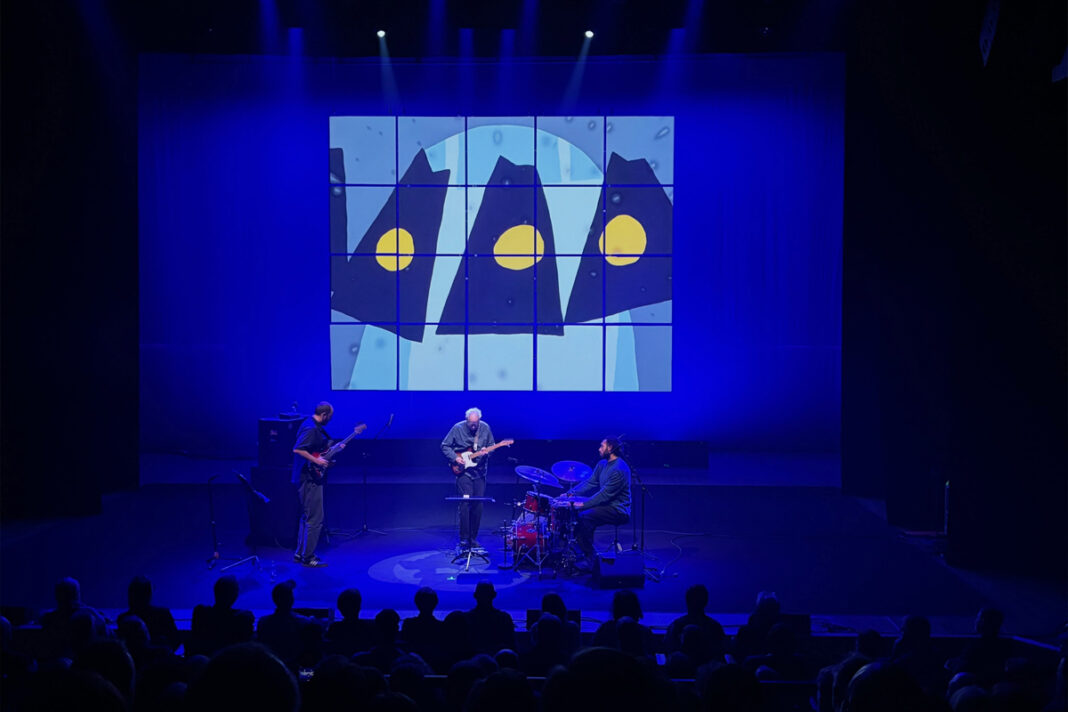
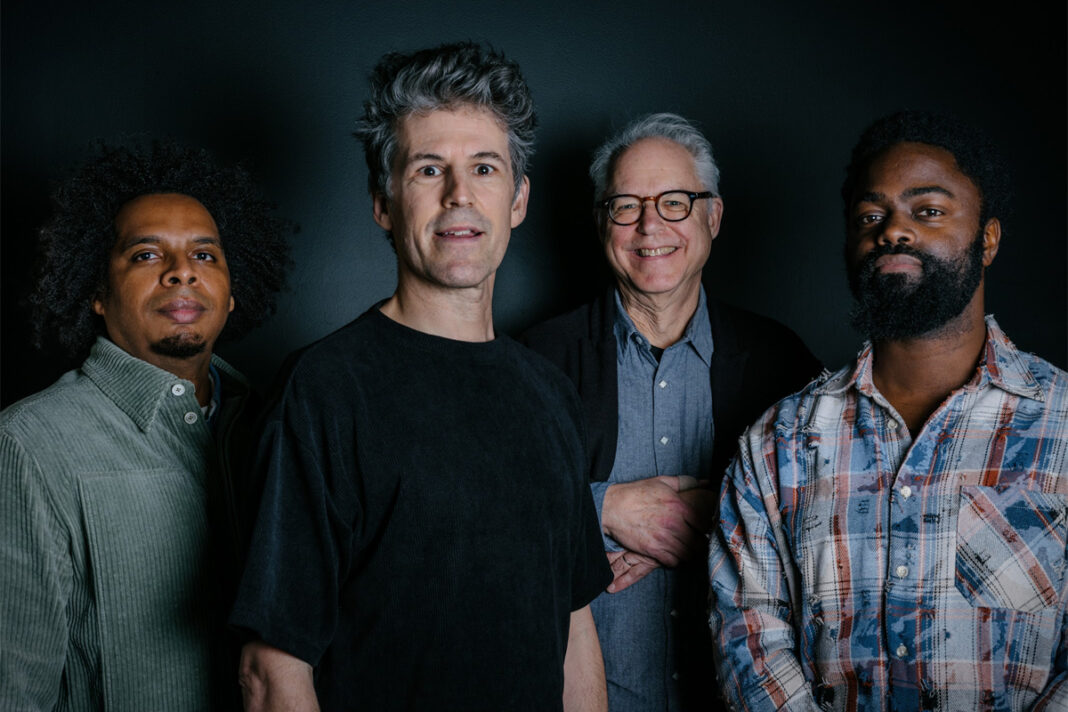
A few months down the road, Seabrook’s new ensemble with Bill Frisell immediately suggests something more rollicking and audience-facing even in the manner of an old travelling show. We might expect much of the interest here to lie in the push and pull between Frisell’s relatively warm, spacious and inviting take on Americana and Seabrook’s shared penchant for paraphrasing the tradition but from a perspective that seems more coastal and briny and somehow askew. Rashaan Carter a bassist who draws smoothly from funk and soul and spiritual traditions and Marcus Gilmore whose skittering propulsions skirt and glide like pure flow serve to complete the new quartet.
Still another way of looking at this ensemble would be to ask just what is a Utility Modern, taking our cue not just from the lineup and its array of styles and sensibilities but from the Rothkoesque album cover whose darkening squares from sunshine and satsuma orange to firebrick red are actually by the painter Josef Albers from his long-running series Homage to the Square.
Albers worked on the Homage to the Square series between 1950 and his death in 1976. For three years between 1964 and 1967 the series was the focus of a travelling exhibition organised by the Museum of Modern Art while in 1971 dozens of the Homage to the Square paintings were gathered by the Metropolitan Museum of Art as Albers became the first living artist to be granted a career retrospective by the institution.
His approach drew from colour theory and his early career as a student and professor at the Bauhaus with the Homage to the Square series at once absorbing and studious as the paintings seem to inhabit their own cosmos. But it’s interesting to note the particular painting which Seabrook has culled from the series, because while the Homage to the Square paintings tended to follow a rigid process of geometry and preparation – Albers coating Masonite panels with six layers of white primer before using a palette knife to spread paint straight from the tube – the various studies for the Homage to the Square series are sometimes looser in terms of their materials and finished form.
The painting displayed on the cover of Utility Modern is a study for a Homage to the Square dated between 1970 and 1973 with oil and graphite on blotting paper rather than Masonite panel. It is a study in orange and red and bears a distinctive smear or bleed in the bottom-right corner. So while its colour alone is striking enough it also stands out from the series proper for its wobblier lines and those smudges and smears.
The name ‘Utility Modern’ is itself redolent of the mid-century, suggesting an era of functional design whether we’re talking about Eames chairs and Knoll sofas, a transatlantic current which spread from the Nordics via such figures as Alvar Aalto and Eero Saarinen or famous architects from Le Corbusier to Mies van der Rohe. Closer to home we might start to think of some of the music of the period, including everything from doo-wop and chamber pop to rockabilly and surf rock to hard bop with its stonking admixture of gospel, burgeoning R&B and the well-trodden blues.
Utility Modern opens with ‘Crater for Ascending Angles’ though the first sound is not of a rending or a depression but of the coming or sloshing together of Seabrook and Frisell’s guitars. Seabrook takes the left channel and Frisell the right though the overtones from his acoustic waft all over the mix. Gilmore initiates a funky groove and the guitars shimmer on its surface, their tremolos glinting with watery limpidity while they sometimes drop in for passages which give equal bearing to the drums and bass.
The sense is of something being opened out for the listener in a way that reminds me of Hindustani classical ragas or say the closing passage from Joanna Newsom’s folkloric ‘Go Long’ from Have One on Me. From the halfway point ‘Crater for Ascending Angles’ builds and congeals, with an ominous drone developing in the background of the composition while the percussion chimes and rattles like clangorous bells. The quartet go into overdrive but swiftly relinquish the thread as electrified guitars and bass dole out funky pulls and licks before Seabrook and Frisell return to the wash of the opening theme.
The opening phrase of ‘The Serial Fabulist’ feels balladesque but splinters and spindles like a spider stretching its legs. Unison strums and pinging distortions help Seabrook and company to spin a yarn which is less about narrative than formal or dramatic effect. There’s a hard rock cladding to the guitars and drums and ‘The Serial Fabulist’ seems ready to breach its walls but remains more wily and circumspect.
Slantwise rhythms and palm-muted guitar call to mind some of Oren Ambarchi’s work as ‘Star-Crossed Phantasms’ gets underway. Meanwhile the sustained tones of the bass can sound like a trumpet or trombone blown with a bit of a sputter. The interest in texture and process and the formal relationship between the parts does make Utility Modern sound like functional music, but to what end one might wonder as notes of pensiveness and chromaticism emerge here on ‘Star-Crossed Phantasms’ whose statements and gestures seem foreshortened or forestalled.
Of course the title is a Shakespeare reference on an album that readily evokes literary forms and after wiry rhythms from Carter’s bass and Gilmore’s barrelling drum solo, ardent looks abound in the closing section of ‘Star-Crossed Phantasms’ through peals of guitar which soon disperse into more garbled communications and entanglements, dialup tones making hay.
‘Once Upon a Time in the Quest’ suggests everything from Arthurian legend to Don Quixote to spaghetti Westerns with the defining feature being a deceptively ragged picaresque. Like on ‘Star-Crossed Phantasms’ the piece features chunky percussive guitar work from Seabrook and Frisell but closer and more conventional harmonic interaction plus gleaming moments which sound like the glint of shared labour at night. Gilmore appears to be working a punchbag then turns into a blacksmith as sparkling alchemy or sparking metallurgy sprays from the guitars while the bass retains a funky squelch.
In a similar vein, on ‘Document and Tapestry’ distended chords almost like fairy dust waft and fall in the space. Seabrook sprinkles them out and Frisell gives them resonance and weight. The effect is enhanced by Gilmore’s pooling cymbals, deft brush work and circular scrapes. ‘Document and Tapestry’ carries a steady bloom before the lead guitar peels off and begins to play something with a romantic yet discursive bent, and the quartet again assume a hard rock mantle while retaining a stark and glacial pace.
Seabrook has said that he wanted Utility Modern to sound like ‘one giant guitar’ but while a semblance of the banjo might be heard elsewhere on the record (notably on the opener ‘Crater for Ascending Angles’) the instrument does get one major showcase. We are back in hoedown territory on ‘Membrane Soundtable’ where Seabrook’s spindly banjo begins to throb and throng as Frisell’s hammer-ons, pull-offs and harmonics impart a reflective warmth to the piece.
Carter’s bass slouches in almost comic fashion, a barbling undercurrent while Gilmore’s drums maintain a much brisker pace. As the piece progresses ‘Membrane Soundtable’ threatens to careen off the rails. The banjo skids out, the drums shake the scene through a frantic rumble that feels like an incipient earthquake and the bass and guitar throb and pulse like a beeper or alarm or muffled foghorn blasts. At last Seabrook – who frequently bows his banjo and conjures numerous violin-family effects, from tremolos to spiccato to col legno – evokes a sul ponticello wail, a glassy sound full of high harmonics before ‘Membrane Soundtable’ ends in a gaseous haze.
On the record’s lead single ‘The Guitar is a Weather Event, Even’ those twin axes kind of amble out of the gates. The drums and bass kick in pretty swiftly while the interplay between Seabrook and Frisell produces a brackish or briny effect. Their array of slides and pulls evoke ice cream jingles while a sudden pause in the composition reminds me of the chorus to ‘Round and Round’ by Ariel Pink.
It is a choppy and evocative composition that can taste like a splash of sea water in one’s face. ‘The Guitar is a Weather Event, Even’ blends early-seventies soft rock in the manner of the Beach Boys with angular Minutemen punk and fusion grooves from the thick distortions of Sonny Sharrock to the impressionism of the Weather Report whom Seabrook might even be nodding towards by virtue of the song’s name. Eventually the guitars lock together like churning bodies of water while drum rolls and cymbal crashes add the froth and spume, with the quartet battering the breakwaters in the final moments of this brisk team-bonding experience.
‘Tapestry and Document’ which closes Utility Modern is not simply ‘Document and Tapestry’ played in reverse but it does momentarily sound like the ensemble backtreading or rewinding the tape. Then a big cresting cymbal roll buffets the bronzed or sepia atmosphere and we’re back in choppy waters, now stranded out at sea.
Frisell just seems to inhabit the space with a grim sense of foreboding while Seabrook still seeks out the movement within. And they never have to right an upturned ship but their vessel appears as a small squib of colour in an otherwise vast and unvariegated landscape. In other words they’ve sailed through choppy waters and remained upright then we’re soon back on dry land for a parade of effects. A show is held beneath billowing and brightly-striped fabrics or a celebration takes place with confetti and church bells as Seabrook and his merry retinue hold on to a few sustained tones then crackle out or dissolve from the frame.