


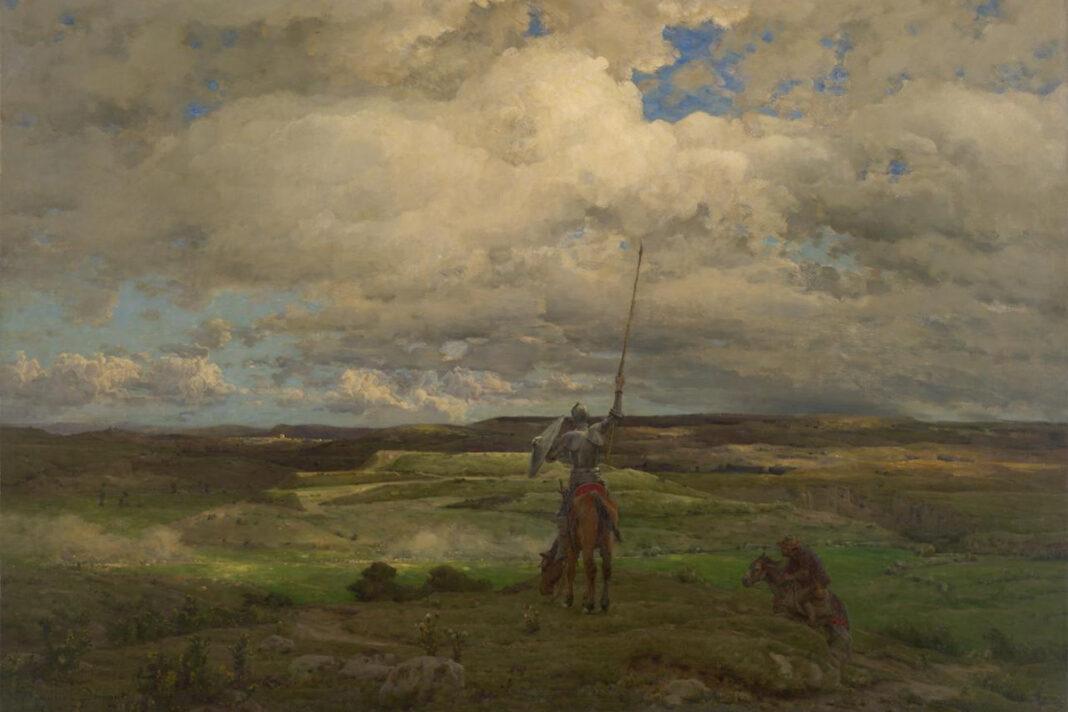
The poem ‘Vencidos’ by León Felipe offers a touchingly elegiac depiction of a crestfallen Don Quixote crossing the plains of La Mancha some time after his defeat on the beach of Barcelona at the hands of the Knight of the White Moon. Compelled by the terms of his defeat to lay down his arms and cease all attempts at chivalry, Quixote is perhaps heading home to die. That is the fate which befalls him in the second part of the famous novel by Miguel de Cervantes, though here in Felipe’s rendition Quixote cuts a restless figure as if doomed to roam a deserted La Mancha for all time.
Yet in the eyes of the speaker there seems to be a certain nobility to Quixote and perhaps even more specifically to his fate, calling to mind Jorge Luis Borges’s observation ‘defeat has a dignity that noisy victory doesn’t deserve’ (from his ‘Nota para un cuento fantásico’ as published in his late collection La cifra). And while Felipe’s verse abounds in repetition, the speaker can at least envision a world stretching beyond that of the novel and the poem, where Quixote might indeed retire to the countryside to become a shepherd and spend a fruitful period or else live out his remaining years.
‘Vencidos’ is part of a long tradition of elaborations on Don Quixote, which has provided the basis for operas and ballets, song cycles and concept albums while the novel has been adapted time and again on television and film. Influencing many a great work of literature, its formal play compelled Tristram Shandy (whose author Laurence Sterne defined his sense of humour as ‘Cervantick’) while its picaresque style was echoed by Dead Souls and Quixote’s fictional world found a counterpart in the dashed illusions of Madame Bovary.
Yet in modern or postmodern contexts some of the most memorable and haunting riffs on the novel have concerned questions of authorship. ‘Pierre Menard, Author of the Quixote‘ by Borges for instance takes the form of a literary review of a French symbolist writer’s attempt to recreate Don Quixote from the ground up, word for word. And in City of Glass by Paul Auster a refracted version of Auster himself is portrayed within the text as a Don Quixote scholar, weighing the identity of Cide Hamete Benengeli the fictional Arab historian whose manuscript Cervantes cites as the crux of his work.
More closely Felipe was following a Spanish-language tradition where the mythologising, humanising and deflating of Don Quixote could occur often at one and the same time. Vida de Don Quijote y Sancho by the Spanish essayist Miguel de Unamuno was especially significant as a kind of paean to Quixote’s madness while the Nicaraguan poet Rubén Darío – the father of modernismo – in ‘Letanía de nuestro señor Don Quijote’ wrote about the character in spiritual terms.
Felipe who first published ‘Vencidos’ in 1920 would return to Quixote in later years, typically in political contexts following his experience in the Spanish Civil War where he fought on the Republican side before spending the remainder of his life in exile in Mexico. ‘Vencidos’ was given a second life within popular music when Joan Manuel Serrat adapted the words of the poem for his song of the same name, which served as the closing track of his classic 1971 album Mediterráneo. Yet the poem remains curiously hard to find in a steady English translation, which is what I have attempted to produce below.

Vanquished
Across the plains of La Mancha
once again the figure
of Don Quixote is passing by . . .
And now, idle and dented, his armour rides on the donkey,
and the knight rides idly, without breastplate or backplate,
burdened by bitterness
for here lies the end
of his ardent struggle.
Burdened by bitterness
for here his fortune remained
on the beach of Barcelona, fronting the sea.
Across the plains of La Mancha
once again the figure
of Don Quixote is passing by.
Burdened by bitterness
the knight, defeated, returns to his own land.
How often, Don Quixote, across that very same plain
in moments of dejection do I watch you pass by!
And how often do I cry out: Make room for me on your mount
and take me to your land,
make room for me on your mount
defeated knight!
Make room for me on your mount
for I too am laden
with bitterness
and I cannot fight.
Set me behind you
chivalrous knight,
set me behind you
and take me
to be a shepherd at your side.
Across the plains of La Mancha
once again the figure
of Don Quixote is passing by . . .
Vencidos
Por la manchega llanura
se vuelve a ver la figura
de Don Quijote pasar . . .
Y ahora ociosa y abollada va en el rucio la armadura,
y va ocioso el caballero sin peto y sin espaldar . . .
va cargado de amargura . . .
que allá encontró sepultura
su amoroso batallar . . .
Va cargado de amargura . . .
que allá “quedó su ventura”
en playa de Barcino, frente al mar . . .
Por la manchega llanura
se vuelve a ver la figura
de Don Quijote pasar . . .
va cargado de amargura . . .
va, vencido, el caballero de retorno a su lugar.
Cuántas veces, Don Quijote, por esa misma llanura
en horas de desaliento así te miro pasar . . .
y cuántas veces te grito: Hazme un sitio en tu montura
y llévame a tu lugar;
hazme un sitio en tu montura,
caballero derrotado,
hazme un sitio en tu montura,
que yo también voy cargado
de amargura
y no puedo batallar.
Ponme a la grupa contigo,
caballero del honor,
ponme a la grupa contigo
y llévame a ser contigo
pastor . . .
Por la manchega llanura
se vuelve a ver la figura
de Don Quijote pasar . . .
Notes on the Text
‘Vencidos’ appeared in 1920 as part of León Felipe’s debut collection Versos y oraciones de caminante. A second book of poems under the same heading followed almost a decade later in 1929. The text of ‘Vencidos’ which I opted for above comes from a facsimile edition of both books or volumes of Versos y oraciones de caminante which was published by the Madrid house Visor Libros in 2022.
As a poet Felipe wrote predominantly in free verse, but ‘Vencidos’ features nuances of metre and rhyme whose characteristics have been discussed (in Spanish) by Fernando Carratalá at Todo Literatura. The particular version of ‘Vencidos’ that appears above and in the facsimile edition of Versos y oraciones de caminante preserves several formal and structural qualities which have been subject to change in so far as they drop in and out of other published versions of the text.
Some versions of ‘Vencidos’ for instance chop the five stanzas above into six or seven stanzas, typically by inserting a space before line 27 of the poem ‘Ponme a la grupa contigo’ which I have translated quite loosely as ‘Set me behind you’. This creates a short stanza which emphasises the yearning and elegiac quality of the speaker’s voice and Felipe’s verse towards the close of the poem.
More rarely line 16 is separated from the rest of the short third stanza, creating a single-line stanza which serves as its own small island where ‘va, vencido, el caballero de retorno a su lugar’ (translated here as ‘the knight, defeated, returns to his own land’). In relation to these choices it is worth noting that the single word ‘pastor . . .’ which is captured in the facsimile edition as line 31 of the poem in some versions gets incorporated into the previous line or else some of line 30 jumps down to make for a longer line 31 (for example ‘y llévame / a ser contigo pastor’).
Several versions of the text cut the longer lines 4-5 and 16-19 in half, which has the effect of standardising the poetic line. ‘Vencidos’ then becomes a poem of short regular lines which suits the almost aphoristic and incantatory brevity of the phrasing arguably at the cost of a more rapt and gushing rhythm.
In either case ‘Vencidos’ reads like a parable though beyond the gospels and other poems which take Don Quixote as their theme, it seems to find a kindred spirit in any poem or work of art which bears loss with a slender and sanctified demeanour, sublimating apparent defeat into a gesture of transcendence or at least a humble and transfiguring grace. I think for instance of ‘The God Abandons Antony’ by the Greek poet Constantine P. Cavafy which considers the defeat and demise of Mark Antony in Alexandria (a poem which like ‘Vencidos’ has been set to music in this instance by Leonard Cohen and Sharon Robinson on Ten New Songs).
Felipe’s apparent penchant for ellipses – evinced by the facsimile edition of the text where those three suspending dots dominate in particular the second stanza – has been curtailed or scorned entirely by many who have chosen to amend and reprint the text, with an ellipsis often being maintained only for the last line of the poem. And finally many versions of the text use exclamation marks for the despairing and indeed exclamatory lines in the fourth stanza where the speaker suddenly addresses Don Quixote and asks (in my rendering) ‘make room for me on your mount’, though the facsimile edition suggests that these marks were not native to Felipe’s original publication.
Notes on the Translation
My translation takes a hybrid approach to these matters, retaining some of the formal properties of the facsimile edition such as the five stanzas and the longer lines between 4-5 and 16-19 while treating other characteristics – like the potential use of ellipses and exclamations – with a blend of instinct and containment.
That is to say that that I’ve opted for fewer ellipses than in the facsimile edition where in my view those pregnant pauses almost risk tarrying or overburdening the taut rhythmic lines of the text, especially in the second stanza of the poem. But as a bare minimum I am fond of an ellipsis at the end of the first stanza, which seems then to bleed or dissolve or anyway open out into the body of the poem, and at the end of the final stanza where an ellipsis is standard and closes out the poem with an anticipatory air. On the other hand I have added a couple of exclamation marks to the text even though they are not present in the facsimile edition, feeling that they suit the heightened register at the start of the fourth stanza.
‘Vencidos’ relies on a steady repetition of phrases and formulas and distinctive word choices so another important question concerns how to translate these and to what extent to preserve their repetition. A lengthy formula like ‘Por la manchega llanura / se vuelve a ver la figura de Don Quijote pasar’ demands repetition as it shapes the beginning, middle and end of the poem. The same is true of ‘Hazme un sitio en tu montura’ (translated here as ‘make room for me on your mount’) which appears three times within six lines of the fourth stanza in that pleading and incantatory fashion.
‘Va cargado de amargura’ also appears three times as a distinct formulation which I have rendered each time as ‘burdened by bitterness’. Felipe though riffs on the formula once more in the fourth stanza across the lines ‘que yo también voy cargado / de amargura’. Ostensibly that should be rendered the same way in translation with ‘burdened by bitterness’ like ‘cargado de amargura’ appearing for a fourth and final time. I’ve chosen however to break the repetition in this case, substituting ‘burdened by bitterness’ for ‘laden with bitterness’ which seems to match the speaker’s register as it grows more personally resigned.
I have translated both ‘vencido’ and ‘derrotado’ as ‘defeated’ which is certainly plausible as they are close synonyms, though ‘vencido’ may indicate something like ‘vanquished’ in contest whereas ‘derrotado’ can imply more of a spiritual defeat and the despondency that flows as a result. ‘Defeated’ is more than capable of carrying both connotations but while ‘vanquished’ feels too elaborate for Felipe’s verse and the voice of the poem it seems to capture the almost vanishing quality of Quixote’s spirit and Felipe’s mournful theme. ‘Vanquished’ therefore fits nicely as the poem’s title, despite the word not being echoed within the body of the translated text.
‘Ociosa’ and ‘ocioso’ appear consecutively in the first two lines of the second stanza. For my own part I opted to swap the adjective ‘idle’ for the adverb ‘idly’ in the second line of the stanza, which maintains a clear sense of rhythm and repetition while hopefully capturing the listlessness rather than laziness of Quixote.
The phrase ‘quedó su ventura’ is contained within quotation marks in most versions of the poem, an explicit reference to the relevant passage of the novel which does not really appear – at least by my own estimation – to survive translation. Short of a definitive English translation of Don Quixote, the quotation marks are better shed in a translation of the poem with the second stanza still evoking Quixote’s defeat on the beach.
By the same token ‘el rucio’ in the first line of the second stanza is how Sancho Panza – Don Quixote’s loyal yet comic squire – refers to his own light-grey donkey increasingly and with affection during the course of the novel. Some of the earliest English translators established ‘Dapple’ as more of a proper name for the humble beast. Felipe’s use of ‘el rucio’ is telling then because of what is left absent. Sancho Panza is trailing Quixote back home but only his donkey receives mention, bearing Quixote’s dented armour while the defeated knight rides on Rocinante his famous ‘mount’ or steed.
All of this is not explained of course within the poem but left up to context and setting and one’s familiarity with Don Quixote. And with ‘Dapple’ – however common in translation – not to my mind identifying Sancho Pancho’s mount as clearly as ‘el rucio’ does in Spanish, my sense was that ‘donkey’ alone in this instance adds clarity and generality or anyway will have to suffice.
I found the phrase ‘amoroso batallar’ in the second stanza one of the hardest to translate. ‘Amorous battle’ or ‘amorous struggle’ would be almost transliteration while ‘loving battle’ sounds like an oxymoron or makes it seem as though Quixote loves the battle or the struggle itself. I therefore went with ‘ardent struggle’ which for me carries a sense of both Quixote’s romantic passion for Dulcinea and a more spiritual yearning, a worldview and life-force which has been defeated by his loss and submission on the beach.
Otherwise ‘the plains of La Mancha’ seems suitably literary or idiomatic. In the fourth stanza ‘take me to your land’ is more definite and literary than Felipe’s verse while the closing phrase ‘to be a shepherd at your side’ makes for a longer line. Both instances do though capture the elegiac quality of the verse and the nature of the speaker’s entreaty, which remains humble and companionly even as it rings out desperate and forlorn.
‘Fronting the sea’ is less natural than ‘facing the sea’ but I like the slight blockiness here, which emphasises the impersonality of that loitering fortune which has in a way been sloughed off as much as lost. ‘Backplate’ gives line 5 a biting rhythm, while the use of ‘chivalrous knight’ (as opposed to say ‘honourable knight’) conjures a long tradition of chivalry. In any case my translation could no doubt be bettered by anyone with more competent Spanish, yet I enjoyed the process and believe that the result serves as a canny basis for an appreciation of León Felipe’s text.