


We’ve heard Jacob Wick’s voice before on Standards and Something in Your Eyes but here on his latest album I’ll make you coffee while you still sleep it’s the first thing we hear, or more precisely a deep intake of breath before the words start tumbling out of him, less a sequence of observed images than the staggered relay of someone who appears to be caught inside a happening, registering even somewhat defensively or haplessly a series of collapsible events.
‘Waiting by the phone, you’re waiting, hoping for some rain, you’re waiting, hearing things I never will’ he begins, ‘Screaming in the street, they’re screaming fuck you bitch but you did nothing, I never will. If you listen you can hear it, all the things I never will’. Each clause and image bumps into the next as the ensemble plunges headlong around him, through short staccato drum phrases and drum rolls that sound like someone humping heavy furniture down the stairs while hurried plucks of the double bass state their own frantic case.
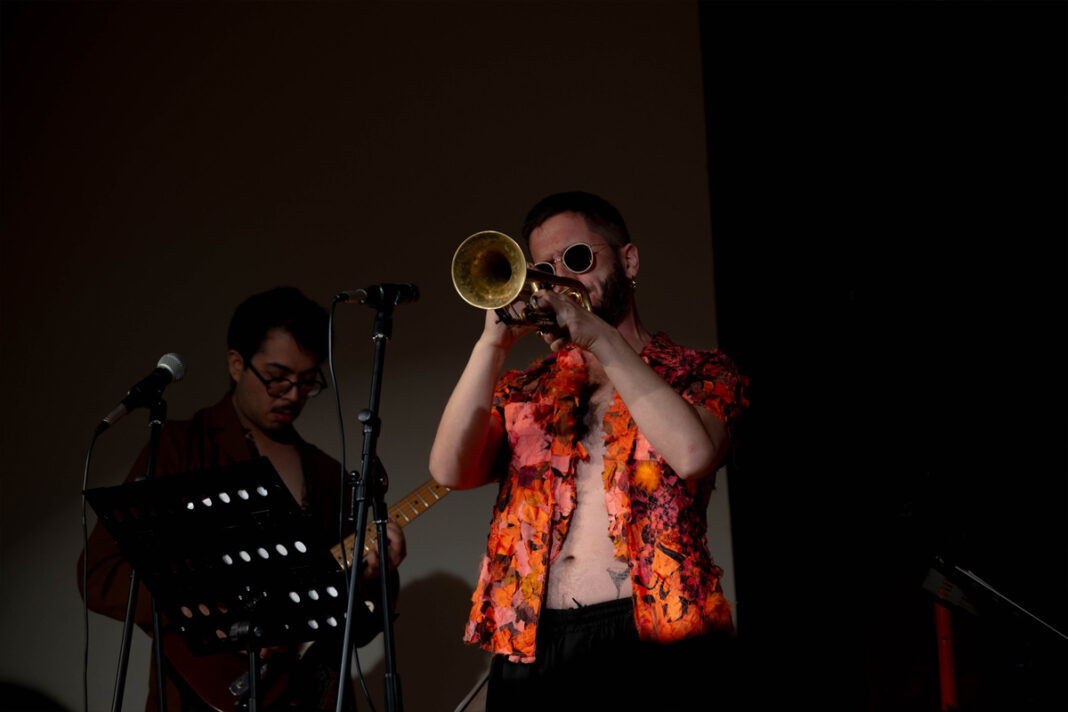
The guitar on the other hand splays overtones or harmonics, which waft over the top of the mix like an ocean breeze from a far-off place. Then the bandleader’s trumpet comes in and those surf rock licks get a smeared brass underbelly. The mixture of elements and the ramshackle quality of the percussion reminds me equally of the shimmering chromaticism of Brandon Seabrook and the math rock-cum-free jazz capers of Teen Prime. Staticky guitar slides and distortions then reintroduce Wick’s voice as he reprises the opening lyrics over his song’s last minute and a bit.
‘Every day I stand on the balcony and hope you walk by’ is then a stunning opening, stricken and dolorous but wonderfully listenable with a title and a sensibility that might call to mind such theatrical standards as ‘I Walk a Little Faster’ by Cy Coleman and Carolyn Leigh or the swaying Lerner and Loewe staple ‘On the Street Where You Live’. If you’ve listened to a Jacob Wick ensemble before it instantly captures everything that is lovable and exceptional about his band while if you’re new to his music it might well be a real thrill to hear someone playing so loosely and plangently with the tradition, just laying it out like dollops of paint on a canvas smeared with big colourful strokes.
Wick has collaborated with such varied artists as the percussionist turned sound collagist claire rousay and the Human Feel reedman Andrew D’Angelo (within the structured setting of his DNA Orchestra) while also releasing a steady stream of free improvisational records on the labels Astral Spirits and Relative Pitch. Duets with Brad Henkel and Phil Sudderberg were followed by Carne Vale a second trio outing with Michael Foster and Ben Bennett then the return earlier this year of Tres Hongos where Wick on the trumpet with Marc Riordan on piano and Frank Rosaly on drums laid down More Chips.
But his personal life and increasingly his musicianship has orbited around Mexico City since he moved there back in 2014. The recent run of work under his own banner follows an utterly idiosyncratic template where old standards drawn from the Great American Songbook and a handful of personal favourites are reworked in shattered and headlong fashion as he forces their lyrics brashly and sputteringly onto ramshackle rhythmic frames.
Yet on Standards there was a certain Brechtian irony to some of his singing, especially on ‘Stop the World and Let Me Off’ where he seemed to lean into the grotesque: overtly performative, enunciating his words with rounded lips, an occasional warble or even the odd sneer. And on Something in Your Eyes his vocals sounded somehow distanciated, as though sung through a megaphone from a position deeper within the ensemble as everything around him chugged and careened off the rails.
Here on I’ll make you coffee while you still sleep his voice sounds more mellifluous and full of open sentiment, a big barrelling and slightly florid thing. The album ‘explores the quiet moments that define queer relationships’ and given the context and his intonation it is tempting to compare him with everyone from Lorenz Hart and Billy Strayhorn to Theo Bleckmann and Stephin Merritt.
Standards the first album he recorded in Mexico City with his working ensemble featured an interpretation of Strayhorn’s signature piece ‘Lush Life’ by turns sunken and swollen, bitter and portentous and proud alongside other songs by Bruce Springsteen, Carl Belew and the jazz pianist Andrew Hill. Something in Your Eyes meanwhile featured lively takes on ‘Rough and Rocky’ by Emmylou Harris, ‘Ptah, the El Daoud’ by Alice Coltrane and ‘Hey Lover’ by Kylie Minogue before a slow, intoxicating to the point of stuporous evocation of Billie Holiday’s lilting classic ‘You Go to My Head’.
I was captivated by that rendition but the rest of the album was surprisingly diverse as spurred by the varied song selections and Wick’s use of experimental scores – which drew upon both conventional and graphic notation – the musical palette covered everything from countryfied tangles of brass and strings to folksy airs, flamenco toques or similar gestures, the swelling chamber pop of say Bobby Darin or Roy Orbison and swirling free jazz or spectral fusion.
All of these performances were covers not just in the loosest possible sense because where there are lyrics, Wick tends to follow them at least mostly while shifting the perspective by changing a few colouring terms. In fact one could argue that Wick covers this material more fully by inhabiting each song not just as a piece of music but as a part of his life: a constant of memory and a sensory experience for its rich emotional connotations all of which pour out of him to orchestrated but unruly ends. ‘Nacho’ the closing track from Standards was an exception, an original text and a culmination to the album both rhapsodic and elegiac.
Standards revolved around the quintet of Wick on trumpet and vocals, Federico Sánchez on guitar, Mabe Fratti on cello, Amanda Irarrázabal on the double bass and Gibrán Andrade on drums. Between the release of that album and his next as a bandleader, Wick added smeared trumpet fanfares to the arresting and stylistically diverse Mabe Fratti record Sentir que no sabes. Something in Your Eyes then expanded his ensemble with Sánchez, Fratti and Andrade returning while Alina Maldonado played violin and Saúl Ojeda took over the duties on the bass.
This time around it’s a smaller ensemble with Alonso López Valdés playing bass and therefore buttressing the rhythm section while Andrade and Sánchez remain on drums and guitar. But the smaller ensemble creates perhaps more balance or shape with most of the songs retaining a core dynamic or division of roles: shugging and staggered but often quite upbeat percussion which is full of ringing cymbals and deft brushwork, a plummy, bobbing and occasionally meandering bass and those surf rock licks and billowing overtones from Sánchez which seem to exist on a slightly different plane or sphere. Each instrument gets ample opportunity to feature while Wick is free to unburden himself vocally, crest the ensemble or join the vortex on his horn.
‘New Jersey Turnpike 3am cold coffee stale milk’ is another great title, a slice of life. As for myself though having never shared that experience, the song instead evokes something of an early-to-mid-morning atmosphere as the trumpet unfurls an anticipatory air. A misty thinness hangs over the setting while the guitar remains in the territory of surf rock or Roy Orbison (calling to mind here the shimmy and sails of ‘Blue Bayou’).
As the piece progresses those guitar licks turn more shoegaze and spectral while from the midpoint there is effectively a duet between Sánchez and Valdés, with the guitar sloshing and quavering between channels while the bass bounces around at the back of the mix. Andrade keeps up a slack accompaniment and the guitar recedes to give the bass more of a feature before Wick’s trumpet returns with a nice burgeoning, slightly fluttering tone.
For all of its internal drama and the fuchsia grandeur of Wick’s voice, at times I’ll make you coffee while you still sleep is capable of washing pleasantly over the listener, courtesy especially of that hazy surf rock dynamic. ‘Fate should have made you a gentleman’s ____’ sounds bluesier from the outset, almost balladesque with fine brushwork and an early bass showcase. The piece has a mid-century tenor to my ears, like a film score by Adolph Deutsch. The bandleader after a brief opening foray sits it out until later in the composition, returning with some relaxed trumpet fanfares while showing a willingness to rely on the skills and intuitions of his group. In fact sometimes his ensemble constructs the suit or evokes a landscape and Wick arrives later with a drenched bouquet or ready to pin the boutonnière in the relevant spot.
As the title might imply, ‘Sentado en la barra con un nazi y Ramón’ which translates to ‘Sitting in a bar with a Nazi and Ramon’ sounds quizzical with its hesitant bass line and slow chugging drums. Meanwhile the squiggly lines of the trumpet still deliver a late-night burgeoning, conjuring such images as emptying streets or departing trains sodden and glinting in the rain. ‘Sentado en la barra con un nazi y Ramón’ also boasts a sweet guitar solo, with Sánchez’s background allowing him to move in his own terms quite freely between electronica, tropical music and both the straight-ahead and more experimental avenues of jazz.
The short ‘Ya’ sounds like a coda or segue then tightens up and simultaneously tilts off the rails, with the drummer Andrade rapping his sticks and effecting the sound of a zipper being pulled while the guitar gets bubbly and carbonated and some rasping or sputtering emanates from the low end courtesy of the bass rather than the trumpet, which stays high and brisk.
Then we are on into the musical thoroughfare of ‘My Way’ as Wick tangles with Frank Sinatra’s towering legacy, though Sánchez’s playing here actually reminds me of ‘Sleep Walk’ by Santo & Johnny with the distinctive glissandi or crying sound of its steel guitar. Wick purposely muddles the lyrics, mucking Sinatra and the lyricist Paul Anka together with the rock band Europe as he sings ‘so I face the final countdown’ and substituting ‘that’ for ‘this’ to produce the refrain ‘more, much more than that, I did it my way’. It is invigorating to listen to such a loose, somewhat louche take on the song which leans into tropicália and bar room karaoke.
And while Wick and his ensemble uphold that fun and free-spirited or even liberatory bent, this version of ‘My Way’ grows not only more boisterous but regretful and defiant, embittered and tart as with relish Wick sings ‘and now, as years subside, I find it all so amusing’. Liberation cedes to libation with a lean and a rasp as over the last minute and a half the song completely collapses in on itself.
And let’s face it this is the very essence of ‘My Way’ which is not righteous or proud but bloated and boastful and rash. Bratty even, the indignant lament of someone staring into the bottom of a glass. It implies a certain amount of maudlin sentimentality and Sinatra reportedly wound up hating it.
‘My Way’ in this rendering collapses and remains tremulously suspended mid-air before finally drifting out at sea or sinking like jetsam beneath the surface. ‘Paso y vamos juntos caminando de la mano’ which translates to ‘I step forward and we walk together hand in hand’ finds Wick’s voice rising and falling in baritone plumbness to trace the blocky shapes of guitar and bass, an interplay punctuated or aspirated by the hiss of a cymbal.
His trumpet arrives amid a wash of guitar just prior to two minutes, muffled at first as he begins to unspool a more languid refrain, sweet and verdant but perhaps tinged ever so slightly by wistfulness or melancholy. Overtones pool from the guitar while the bass almost plays a bit of a rumba as it rubs up against the percussion. In fact here on ‘Paso y vamos juntos caminando de la mano’ the band gets a bit of a groove going with the guitar pinking and oranging the sky as they languor together in a fragrant and redolent landscape, the revolution of a day which tends from morning crispness to glowing sunset.
Just like on the album opener where Wick reprises his lyrics, on ‘Paso y vamos juntos caminando de la mano’ his voice returns towards the end of the song with a depiction of place that involves kissing and the assemblage and sharing of a fruit plate. Here more than elsewhere it’s a deliberately off-pitch or ungainly vocal that makes no pretence towards neatness or conventional musicality. Instead its pleasure and sentiment resides in a certain flatness, the crystallisation of an evening and the thrill of song itself as Wick repeats the title image, singing ‘I’ll see you at 8 pm and we’ll walk hand, hand in hand and you’ll tell me all of your dreams, and then you’ll tell me about your past but never today. I’ll make you coffee while you still sleep and the conversation never ends’. So again there is this sense of revelling in the moment and also of preoccupying oneself in a way, happy but at some remove with the spectre of things surreptitiously stalling out.
‘Un día nos vamos a morir’ is a lower-key interpretation of the lead song from the Mexican artist Luisa Almaguer’s collection Weyes. In fact it sounds like bluegrass or nascent rockabilly as the guitar staggers out astride the rickety drums and bass, almost like a slapdash and starstruck take on ‘Blue Moon of Kentucky’. That atmosphere changes when Wick begins to sing, here for the only time on I’ll make you coffee while you still sleep in Spanish. The title actually translates as ‘One day we’re all going to die’ but the song doesn’t sound as doleful or fateful as all that and it conjures a bit of marching band or mariachi by the close compelled by the steady patter of Andrade’s drum kit.
I’ll make you coffee while you still sleep then arrives at what seems like an orthodox close but proves another point of departure. ‘Every Time We Say Goodbye’ the Cole Porter standard opens in this rendition through a strident trumpet with the rhythm section urging on the brass. Some slurs open up the melody and the ensemble begins to swing. The song is a kaleidoscopic swirl of all those elements that make the album special.
And when the bandleader’s voice enters in the final third it has a kind of stunting or staggering effect, as Wick almost drawls out the lines, singing them flatly but probingly. The ensemble slows down or distends slightly, bowing at the middle to make space for a fatuous and unruly energy. That’s not a criticism but that is the gesture, unruly and agitated, song as provocation before Wick kisses off with a sweeter goodbye and one that says we hope to see you again.
We hope the same thing because while the previous albums by his ensemble were musically rich dives into material that remained somehow out of reach or was rendered askew, I’ll make you coffee while you still sleep feels like a flowering from within the tradition even while it possesses fewer covers and finds Wick making this rarefied atmosphere more fully his own. As for ‘Every Time We Say Goodbye’ he admits that ‘There is a special kind of saccharine sadness that I would like to claim for queer love, and I think this jazz classic from the Great American Songbook captures it perfectly’.