


As sure as the cold begins to bite and darkness takes big gulps out of the afternoon, the Umeå Jazz Festival arrives full of warmth to portend a season of bonhomie and deliver in the meantime plenty of great music. Now in its 59th edition, the festival – established by Lars Lystedt in 1968 and boasting over the years a who’s who of jazz from Duke Ellington to Ella Fitzgerald to Miles Davis – was preceded as usual on Wednesday night by a concert from the students of Midgårdsskolan, one of several avenues or arteries by which music remains the lifeblood of the city.
Then on Thursday night for the weekly Jazzstudio concert some familiar faces returned to Umeå in the form of the vocalist Anni Elif, saxophonist Pauli Lyytinen and drummer Olavi Louhivuori of the Finnish experimental trio Elifantree. Showcasing material from their recent album Florescence, all three musicians have forged relationships with the city, with Louhivuori in particular debuting at the festival back in 2000 as part of the Joona Toivanen Trio then appearing alongside Tomasz Stańko in 2010 before he led an engrossing set last year with his quartet Superposition. Elif performed in 2017 as she set the poems of Edith Södergran to music and the saxophonist Lyytinen returned to Folkets Hus on Friday as he brought material from his acclaimed solo project Lehto / Korpi to the small space of Tonsalen.
As the festival proper got underway on Friday it was the much-cherished Staffan Öberg Nonet who commenced proceedings, as they partook of their now customary role from the veranda level and pop-up bistro Freja. The first act on stage came courtesy of the tabla player Suranjana Ghosh and sarod player Sougata Roy Chowdhury. Both musicians are schooled in the Hindustani classical tradition and have established international reputations, with Suranjana a regular on the Swedish scene having performed in the past with the likes of Goran Kajfeš and Erik Steen while turning her drums to a variety of jazz, folk and flamenco contexts.
Suranjana appeared at the festival a couple of years ago with the violinist Manoj Baruah. Down in Studion on Friday evening, she and Sougata could hardly have been more entwined or provided the gathered attendees with a better portal onto a weekend of listening. They played three lengthy compositions, with Sougata paying tribute to his mentors Ustad Dhyanesh Khan, Ustad Aashish Khan and Pandit Santosh Banerjee. Aashish Khan collaborated with Ravi Shankar, Alice Coltrane and the Beatles as he crossed over into fusion and even disco music, with he and Dhyanesh sons of the great sarod master Ustad Ali Akbar Khan whose 1955 album Music of India: Morning and Evening Ragas is credited as a pioneering release which helped to popularise Indian classical music in the West.
Sougata noted too the several minutes it tends to take the musicians to tune their instruments in preparation for each raga, but there was no lead-in or lull to the first tune as the spacious plucks of his sarod produced wafting overtones, almost a separate life force as they accompanied those stately plucks in a manner somewhere between servile retinue and thronging chorus. Steeply meditative, sometimes his sarod carried the rustic wiriness of a banjo joined by a treble bounce as Suranjana’s tabla drums kicked in.
The duo sat on an elevated and illuminated platform in the middle of the Studion stage. Their first raga lasted around twenty-five minutes with the bass laying out a beat and the treble chomping into the sarod’s melodies and drones. Short flurries that refused to settle into a steady groove and some brisk trading between the musicians pit a bubbling cauldron or volcanic terrain against a sweeter honeyed flow. The headiness of the piece gave way to woozier states of mind come the second raga, set against a more loping beat. And after a galloping rejoinder Sougata introduced their final piece as a lighter composition, with a courtly atmosphere and a winding melody until passages of call and response led into a driving close.

Performances at the Umeå Jazz Festival tend to overlap between four or five stages over the course of two lengthy evenings. As the duo of Sougata Roy Chowdhury and Suranjana Ghosh were winding things up in Studion and Paul Lyytinen was wrapping his solo set in Tonsalen, the first big showcase of the weekend in Idun, the venue’s largest theatre, saw Norrlandsoperans Symfonieorkester accompany the reedman Per ‘Texas’ Johansson and vocalist Emmalisa Hallander for a tribute to the baritone saxophonist and composer Lars Gullin.
In the fifties and sixties Gullin emerged from the Swedish jazz scene to work with the likes of Clifford Brown, Lee Konitz and Archie Shepp while Per ‘Texas’ Johansson has an extensive catalogue of work with vocalists and orchestras whether accompanying Rebecka Törnqvist or serving as a member of Fire! Orchestra, Gard Nilssen’s Supersonic Orchestra or the Orkester Omnitonal which he currently leads. The tribute was conducted by Johan Siberg while its other featured soloists included Jonas Östholm on the piano, Niklas Fernqvist on the bass and Konrad Agnas on drums.
The first impression though was of Hallander’s vocals and it took a moment to realise she was singing in Swedish rather than French. That’s because one strand of the concert was very much in the vein of chanson and the chanteuse, as rosily intimate vocals were accompanied by shuffling percussion, a big swooning horn section and Johansson’s velvety sax.
Hallander’s voice lagged fondly behind the beat, with ‘Danny’s Dream’ – a Gullin composition with lyrics by Lisa Nilsson – combining a Disney fantasia with the styling of Chet Baker or a trace of the melodic line from ‘I’ll Never Fall in Love Again’. The ballad ‘Silhouette’ set fluttering woodwinds over low squawks from the brass, with the keys and drums initiating a slinky groove while the orchestra swelled and swept from right to left then back again. Hallander vocalised to the rasps of the baritone sax which was joined by muted trombones for a comic closing section.
One song was introduced by way of Fernqvist’s pizzicato bass and another spotlighted the tenor saxophone and tuba through a playful duet, while Johansson and Hallander contributed pieces which throbbed and surged, bobbed and grooved or pattered and flowed like melancholy rhapsodies with a rain-on-windowpane effect. Johansson between the saxophone and clarinet maintained a low-slung ease with the orchestra matching Hallander’s bluesy phrases. And after a big swinging number reached a bombastic climax, a spirited rendition of ‘Toka Voka Oka Boka’ featured almost baroque airs from the clarinet as Norrlandsoperans Symfonieorkester conjured a stirring backdrop and the percussion dabbled with an Afro-Cuban clave.
Big bands of various comportments have appeared over the past few years of the Umeå Jazz Festival with the Trondheim Jazz Orchestra and I LIKE TO SLEEP collaborating in 2024 to produce a pulsating wall of noise, experimental and psychedelic and brash. The tribute to Lars Gullin starring Per ‘Texas’ Johansson, Emmalisa Hallander and Norrlandsoperans Symfonieorkester was expressive in a different way, more overtly refined with the shapely material and the sheer weight of the musicianship up on stage giving a certain splendour to the night.
Viktoria Tolstoy brought a similar elegance to Idun as she opened proceedings there on Saturday. A breathily intimate singer who excels at the torch song, on her latest record Who We Are in collaboration with Jacob Karlzon her sound is more cosmic and spectral atop sparkling keys. Here on the other hand backed by Krister Jonsson on guitar, Martin Sjöstedt on the piano, Mattias Svensson on bass and Rasmus Kilberg on drums the vibe sometimes veered towards roots rock and funk. At the crest of the show Svensson engaged in a lengthy bass solo, scatting to the delight of Tolstoy who held the microphone close to his face, before she and the band closed with a winning rendition of Paul Simon’s blissfully something-or-other ‘Have a Good Time’.
Audiences were eased into the evening elsewhere on Saturday as Bach Jazz performed their jazzily deft and wood-panelled reworkings of Johann Sebastian Bach in the cabaret-style space of Äpplet while the Midgårdsskolan teachers hit the stage in Tonsalen and the Jan Levander Festival Orchestra did likewise down in Studion. Prior to that performance the bassist Viktor Skokic received the first ever Jazzverk prize of 100,000 kronor, an initiative of the composer and songwriter association Skap, The Royal Swedish Academy of Music and Umeå Jazz Festival with the winner commissioned to write a piece which will premiere at the festival next year.
But on Friday anyone who happened to arrive late or wander early from the Per ‘Texas’ Johansson and Emmalisa Hallander concert of anyone who simply happened to be in the vicinity of Freja around seven o’clock might have caught one of this year’s best kept secrets in honour of the great Norwegian jazz singer Karin Krog. The slot was billed around the release of the new record Öppet Fyra, the fourth in a series of archival finds curated by the saxophonist Mats Gustafsson, researched by Roger Bergner and published by Caprice Music.
The series focuses on a burgeoning Swedish experimental scene in the sixties and seventies with the prior editions of Öppet taking in turn the Nisse Sandström Group, the saxophonist Lars-Göran Ulander and the Roland Keijser Kvartett. Öppet Fyra is certainly one hell of a record that shows the sheer experimental breadth of Krog’s practice, with her voice urging comparisons with everyone from Billie Holiday and Sarah Vaughan to Sheila Jordan and Norma Winstone or from say a period contemporary like Janis Joplin to such modern freeform vocalists as Fay Victor and Sofia Jernberg.
The first four tracks of Öppet Fyra are group recordings from the NDR studios in Hamburg in May of 1970 where Krog heads up an exceptional septet. Ulander and Calle Neumann play the alto saxophone and flute, Berndt Egerbladh sits behind the piano and organ and Terje Rypdal dredges and rips on the electric guitar while Niels-Henning Ørsted Pedersen and Sten Öberg make up a fine rhythm section. Listening to Öppet Fyra over the weekend I was especially taken with Pedersen’s bass but this is swirling jazz that seems to linger on the threshold of many different traditions, bluesy and folksy and free. The final two pieces – captured at SWR in Baden-Baden in December of 1970 – are more overtly experimental as Krog sings scattered vocalese accompanied only by the percussionist Pierre Favre.
Anders Cangenmark of Caprice joined Gustafsson and Bergner for a brief conversation in Freja as Öppet Fyra was unveiled prior to a performance of some of Krog’s material. And it was an exceptional rendering with Amanda Törngren supplying the vocals, Ulander still maintaining his exceptional tone on the saxophone and Alex Zethson playing piano with Elsa Bergman on the double bass and Sten Öberg steady behind the drums.
The ensemble created a whirlpool of sound with Törngren rowing atop Bergman’s full-bodied bass and Zethson’s glimmering keys and Ulander’s throbbing horn. I only caught a short stretch of this performance but it had an intoxicating effect and shows how the festival’s format might cause the odd personal misstep while invariably leaving you coming back for more.
Mats Gustafsson was heading downstairs to pair off with Kimmo Pohjonen for the screeching tandem of winds and accordion which characterises their recent duo album Two Balls Are Enough. An native of Umeå who was nourished on the city’s jazz and punk scenes, the local favourite Gustafsson and the acclaimed Finnish accordionist were born just a few months apart, share a penchant for noise and have become stalwarts if not titans of experimental music yet Two Balls Are Enough is their first recorded collaboration.
Gustafsson and Pohjonen gave an eager audience extended takes on several of the pieces from Two Balls Are Enough after first using the microphone to emphasise the ice hockey influence which crashes headlong into the boards or skates adroitly throughout the record. Crudding beats and sludgy electronic processes squeezed out strident science fiction marching motifs before the duo faced one another and shredded beneath the flashing purple-blue lights, a cross between an apocalyptic gameshow and a cosmic countdown sequence. Later cinematic frames of reference came even more to the fore as rasping clarinet and some gusty digital static gave way to a barrelling low end and some plosive vocalese, with Pohjonen and Gustafsson variously evoking the star gate from 2001: A Space Odyssey or the manic marionette-type figures of A Clockwork Orange.
At the same time they could be slender and sylvan, elfin and pellucid as damp reeds and the duo’s amplified percussive fingerings splunked and splashed like water droplets or suggested ambiances redolent of kosmische and Popol Vuh and Aguirre, der Zorn Gottes. Often they accomplished both modes within a single piece of music as they elaborated on some of the opening tracks from Two Balls Are Enough including ‘Ice Heaven’, ‘Magna’ and ‘Snow. Linat’.
With impish intensity Pohjonen wielded his specially modified electroacoustic accordion throughout as his tone shifted between lucid pastoralism and horror house theatrics while those amplified fingerings laid down a ricocheting percussive bed. On the album Gustafsson dives into his ever-expanding bag of woodwinds and other instruments including his archaic 1922 Swanee slide saxophone and his beefiest bass saxophone. Here however he limited himself at least somewhat to a vetivery clarinet and its stubbier, shriller A-flat variant which on at least one occasion glissed like a slide whistle, a harmonica and a watery flute, his thick tenor saxophone and a baritone sax that briefly resounded like a great Highland bagpipe as through staccato bursts the due traded tropical climes for the gospel blues.
At one point Pohjonen knocked, rapped and plucked at the bellows of his accordion for percussive effect before the duo began a dirge with the Studion stage bathed in magenta. And after such an antic performance full of barrelling noise and squawking winds, it was fitting that Gustafsson introduced their final song with a ‘tack’ and a ‘fuck you all’ before closing things out with a rendition of the title tune from his newest group Backengrillen.
Backengrillen is an all-Umeå effort with the saxophonist Gustafsson linking up with the vocalist Dennis Lyxzén, bassist Magnus Flagge and drummer David Sandström the core members of the Refused. They debuted at the Umeå Jazz Festival in 2022 and released their debut album earlier this year, with the title theme carried out by Flagge before Gustafsson takes over. On record Gustafsson and Pohjonen’s rendition is more airy and whimsical but no less poignant while on stage the leading accordion voice landed somewhere between the bal-musette and the throbbing drone of ‘Cheree’ by Suicide. Mats again took over on the baritone sax as rippling overtones and a resonant low end reverberated through the audience’s innards.
At the other end of the venue Landæus Trio played with a loose yet probing rhythmic sensibility. Led by the pianist Mattias Landæus their slow-gestating songs tended to feature staggered bass with Johnny Åman blending meandering solos and walking lines with the odd bowed drone, some deft brushwork from the drummer Cornelia Nilsson and a bit of glimmer and ache from the bandleader’s keys.
Sometimes the mood was more bright and ardent, with Landæus occasionally switching over to the Suzuki Andes melodica which can effect all manner of sounds from a slide whistle to pan pipes and so on. But mostly they seemed to tease and torment a groove, sticking with some furtive harmonies as though spritzer ebullience was on the horizon but they were caught in a figurative undertow. Even when release came the resulting motion was choppy and knock-kneed.
As the night drew over a Klas Toresson Kvartett occupied Freya with a warm bluesy tone and a sensibility that could call to mind old dance hall music. And in the meantime all the tables and chairs had been cleared from the floor of Studion where PARRA.DICE a nine-strong female collective began to regale willing dancers with a sound that shifted between Latin American and more pronounced Middle Eastern melodies or a general funkiness which has been described as ‘global groove’. This was no Vince Guaraldi but the scene was right out of Charlie Brown.
The main event of the night in Idun was a woozy fusion as the longtime duo of Mats/Morgan were joined by the bassist Henrik Linder of Dirty Loops. Mats Öberg and Morgan Ågren are both from Umeå and are known for their collaborative work – notably with Frank Zappa and the current Umeå Jazz Festival director Jonas Knutsson – as well as their lengthy discography as a duo. And while the keyboardist Mats is upholding a proud family tradition this year it was the percussionist Ågren who was the festival’s special guest of honour, an acclaim he received gracefully as he paid tribute to his family and lifelong influences, from Buddy Rich and the dansband tradition to Zappa and Bill Laswell with whom he formed the power trio Blixt.
As shredded clouds or black rain, snow drifts and stalactites and other suggestive geometric patterns shifted across the big screen at the back of the stage, Ågren laid down a skittering yet punchy sequence of percussion while hazy airs and soulful vapours wafted up from Öberg’s keyboard and Linder worked out his electric bass. Like through a kaleidoscope the style shifted between prog and metal filings and psychedelia in the vein of Spacemen 3.
Punkier abrasions and noise elements – like slurping electronics right out of the dentist’s office – gave way to cherubic choruses, chimes and impressions of woodwinds. The trio reached deep into the Mats/Morgan catalogue from earlier efforts like Radio Da Da right through to the present day. Ågren’s animated style never belies a sense of thorough control, even as alien synths and other garbled communications segued into a strange chugging lullaby.
Öberg’s organ might suggest the Doors, seventies funk or gospel harmonies while Linder’s bass sometimes embodied the angularity of math rock. And the trio also played around with all sorts of samples, one passage commencing for instance through a lulling R&B sample which sounded like the elusive chanteuse Mariah Carey before flitting through cackles and fairground themes then landing on a child’s voice, a broad sequence that felt collagist in the manner of the faux-aleatoric music of the Books on their debut album Thought for Food.
Saturday started early for those who were keeping up with the schedule of events at the jazz kissa which had cropped up at Miklagård on the top floor. Lasse’s HiFi a local bastion of high-quality audio had supplied the sound system while from four or five o’clock on Friday and Saturday – around the time when the festival’s first acts were getting underway – a rotating group of curators and deejays led by Gustav Skoogh and Maja Korpi selected the records and kept the music going until late.
Shortly after lunchtime on Saturday however the jazz kissa also opened up for a couple of special listening events. The first marked the vinyl release of Teodros Makonnen With His Organ, an album previously available on cassette that is regarded as a pioneering work of Ethiopian digital music.
Ethiopian music has been winning more and more listeners ever since the Éthiopiques series debuted in the late nineties, capturing a golden age on Amha Records and Kaifa Records and making curious ears more familiar with such artists as Mulatu Astatke, Mahmoud Ahmed and perhaps especially Emahoy Tsege Mariam Gebru. These artists demonstrate the variety and appeal of Ethio-jazz, a distinct commingling of tizita folk songs, Ethiopian Orthodox music and Western instrumentation, even while many of their careers were hampered by the Derg military regime and a brutal period in the late seventies of political and cultural repression.
Teodros Makonnen came of age during this period, mastering electronic sequencing and holding midnight recording sessions when curfews were being enforced in a bid to keep Addis Ababa’s once vibrant nightlife under tight control. His music branches out from Ethio-jazz through its unconventional adoption of an electric organ and drum machine even as it conjures aspects of a spiritual tradition alongside elements of fusion, funk and soul.
The reissue of Teodros Makonnen With His Organ by Muzikawi – on the heels of releases starring the saxophonists Jorga Mesfin and Tilaye Gebre – makes the label one of several alongside Mississippi Records and Awesome Tapes From Africa which is steadily devoting itself to bringing Ethiopian music to the wider world. The record was played in full at Umeå’s impromptu jazz kissa on Saturday with the deejay Mahlet Keleme, perhaps best known by her monicker the Supercat from Addis, presiding over a scene-setting Ethiopian coffee ceremony.
Then it was Mats Gustafsson’s turn to play curator as he conversed with Gustav Skoogh about free jazz in an extension of Now Jazz Now, the book he recently published with the critic Byron Coley and Sonic Youth frontman Thurston Moore. Lovingly assembled, containing photographs by Philippe Gras and further written contributions by Neneh Cherry and Joe McPhee, the book dives into the record collections of its three authors and pulls out a hundred essential free jazz and improvisational recordings, listed chronologically from between the years 1960 and 1980.
Gustafsson did not really dwell on the book though as the event made space for an informal chat about his own interests and influences and his conception of free jazz from its earliest roots. He cited Albert Ayler’s soaring classic Spiritual Unity as a foundational document for the ethos or genre, a notable choice given the way that Ayler mixed scorching tones and experimental textures with deeply embedded melodies or motifs which harked back to some of jazz’s brass band roots.
At the same time Gustafsson traced a freer style of playing back to Mary Lou Williams and her solo piano works of the forties. Williams wrote and arranged music for Duke Ellington and Benny Goodman and would become something of a mentor to several of the biggest names of the bebop era including Charlie Parker, Thelonious Monk, Bud Powell and Dizzy Gillespie. Listening to those solo piano works today with their loose evocations of ragtime and boogie-woogie, their throbbing left-hand accompaniments and their trepidatious moments which give way to bluesy swoons or dramatic bursts might call to mind everyone from Dorothy Ashby to Geri Allen and Sylvie Courvoisier.
A piece by Mary Lou Williams therefore opened the listening portion of the session and was followed by Don Cherry’s composition ‘Awake Nu’ where the cornetist was joined by Pharoah Sanders on the tenor saxophone, Henry Grimes on the bass and Ed Blackwell on drums. Gustafsson discussed Cherry’s embrace of the Swedish jazz scene after he moved to Tågarp at the end of the sixties and began performing with the likes of Christer Bothén and Bengt Berger, the era of his Organic Music Society which Gustafsson has covered recently alongside Bothén and Goran Kajfeš through the swampy grooves of their band Cosmic Ear.
He identified the vestige of a Scandinavian folk tradition in ‘Beast of Kommodo’ by the Jan Garbarek Quartet, from the early ECM classic Afric Pepperbird which was released in 1970. And he then concluded the listening session with a short piece from Polly Bradfield’s cult classic Solo Violin Improvisations, which Bradfield released in 1979 before continuing an extensive period of collaboration with Eugene Chadbourne and John Zorn.
Gustafsson meanwhile outlined his musical upbringing in Umeå and his own way in to freer forms of jazz from the teacher who played him records by the Mahavishnu Orchestra to the department store Domus where he was able to buy albums by such left-field artists as the British guitarist Derek Bailey and American saxophonist Steve Lacey. He elaborated a timeline from the self-publishing efforts of Charles Mingus and Max Roach in the fifties through the spontaneous compositions or free improvisations of Cecil Taylor and Sun Ra, touched upon Cherry’s early work with Ornette Coleman, John Coltrane, Sonny Rollins and Dewey Redman and was full of praise for his frequent collaborator Joe McPhee (especially urging audience members to track down McPhee’s poem ‘Fuck Free Jazz’).
The staggered start times and number of stages at the Umeå Jazz Festival allow each iteration to operate differently whether by happenstance or design. A couple of years ago Suranjana Ghosh with Manoj Baruah and Mats Gustafsson with Lars-Göran Ulander performed in Tonsalen which is the venue’s smallest theatre. Sometimes as a result it plays host to more experimental acts but this year it was a repository of strong grooves and chill vibes even from such diverse gatherings as the Skellefteå septet Lejonmyren and the live band Lofi Voodoo alongside the rappers UTB and Armed & Robbery.
The singer-songwriter Ulrika Murray also performed in Tonsalen on Saturday evening as a secretly invited guest. Meanwhile the Stockholm Swing All Stars filled the stage in Äpplet while Freja provided a space for a couple of young ensembles in PRICK the annual Blue House award winners and a Samuel Hanes quintet.
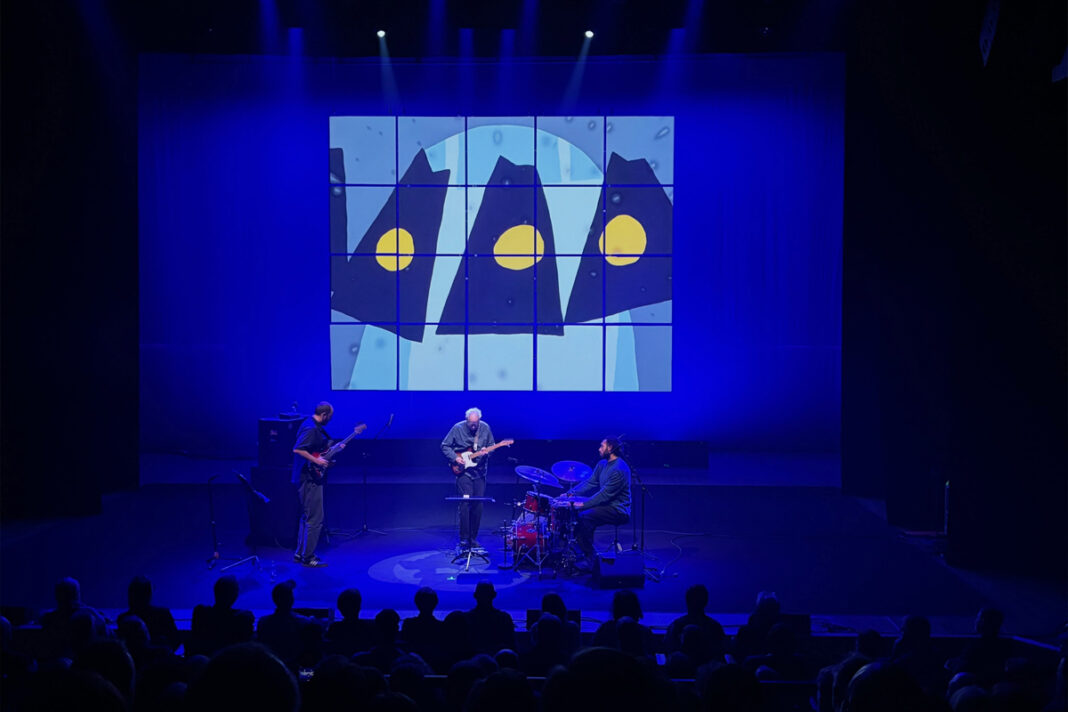
Perhaps the weekend’s headline act was Bill Frisell who brought his trio to Umeå, though not without a hitch. The legendary guitarist is currently touring with the bassist Luke Bergman and drummer Timothy Angulo but it transpired that his guitar and Bergman’s bass had been lost in transit. Mikael Emsing worked with the festival and apparently managed to find suitable replacements, with Frisell plugging his impromptu Telecaster into a reissue of the Fender 65 Deluxe Reverb amp.
Bill Frisell of course has an impeccable tone, spacious or almost cavernous and richly atmospheric. He can nail a ballad or standard and carry a piece of Americana right up to the crest of a hill. But at heart he remains an experimental musician who knows the value of release and restraint and likes to find his way in. This is a relatively newfangled trio that hasn’t appeared as yet on record and has plenty to live up to when compared to his work with Thomas Morgan and Rudy Royston or Tony Scherr and Kenny Wollesen or any of his acclaimed trios of the more distant past. Even in his 75th anniversary year – with the live/studio mix In My Dreams released on Blue Note in February as part of the birthday celebrations – he remains curious to sate that restless appetite or that roving penchant.
So whatever the packed house in Idun might have come to expect, what they received was an unbroken hour and ten minutes of patient exploration which occasionally cohered into recognisable themes. The first twenty minutes or so of the performance were especially curious and tentative, with the percussion calling to mind a rugged hiker slowly but steadily scaling a summit while guitar and bass ambled coyly or gestured playfully in its wake.
Frisell offered moments of sweetness and angularity while at one point his plucks and pulls effected the sound of a rewinding video tape or cassette. A drum solo commenced through a rudimentary martial beat as Angulo slowly built the tempo, showing great control between the dry rattling toms and kicks of his kit. There were pensive and dusky looks, wounded outlaw stances and passages which sounded ardent and twilit as revving and splaying guitar and bass ceded to glacial suspense and it was only after this opening twenty minutes that the trio delivered their first real melody or motif.
The mood then became almost tropical with Bergman’s bass briefly inhabiting a calypso frame, with traces of rockabilly too as the trio hit their stride and got into a groove at around thirty minutes. Frisell played some gnarly licks before pulling over a veil and orchestrating some obscurely tender passages. A closely harmonised exchange between the guitar and bass allowed Angulo’s choppy percussion to exert a toll from underneath as a brackish surf theme closed out the medley.
Such a performances requires a certain amount of patience and stamina from the audience as well as the musicians. It was a gently beguiling, thoroughly absorbing set as Frisell drew upon some of his past trio work, including arrangements of songs like ‘Again’ and ‘Moon River’ from his 2001 album With Dave Holland and Elvin Jones. And he, Bergman and Angulo returned to the stage for a softer encore where wafting overtones and cymbal splashes under heart-red lights painted a honeyed lacquer onto proceedings while suggesting a sense of emotional buoyancy.
Frisell’s set meant that I caught just the tail end of Trio Ramberget and Matti Bye, who seemed to be holding an audience rapt down in Studion. A lovely burbling drone on the double bass and trombone was just crested by the bluesy rasp of a bass clarinet, an outpouring from the ambient trio’s album with the pianist Bye entitled Mirror Variations. So that was a find and something to bear in mind, with Brekky Boy capping the night in Studion, an electronic jazz and beats project purportedly carried out by a ‘former WWE wrestler’ named Taylor Davis.
It’s worth mentioning some of the lead-in or pre-show music which aired during the festival, with ‘Army of Me’ by Björk a great choice as the lights dimmed for the Mats Gustafsson and Kimmo Pohjonen performance and Oren Ambarchi hovering over the buildup to the final concert of the weekend in the Idun theatre by Hawa Kassé Mady Diabeté.
Hawa is the daughter of the great Malian singer and griot Kassé Mady Diabeté and a member of Trio Da Kali. Her album Toumaro which was released last year on One World Records completed a project began by her father prior to his untimely death in 2018. She brought an exceptional band to Umeå comprised of esteemed Malian musicians who have worked with her in the past and carry family legacies of their own.
Her vocals were accompanied by Guimba Kouyaté on the acoustic guitar and Seydou Kouyaté on an electric balafon. Madou Kouyaté – the son of the ngoni master Bassekou Kouyaté and a member of Trio Da Kali – added his distinctive bass lines on the ngoni while Daouda Koné’s setup blended a Tama drum kit with a djembe and congas but especially the rope-tuned cylindrical dunun.
Travel pitfalls had also imperilled their set with the band professedly tired after a long train journey up to the north of Sweden. You wouldn’t have guessed as much without knowing for Hawa and her band delivered probably the most rousing performance of the entire festival despite not taking the stage until almost 11 pm. On their first song the guitar laid down a fine rambling groove occasionally with the arid redolence of Tuareg rock or the desert blues while the congas slapped out a clopping accompaniment and Hawa’s voice, steeped in reverb, became ever more howling and urgent.
Often though it was the bass instruments which impressed through their bounce and heft, especially the dunun with its thudding bass and array of overtones and effects which stretch from a buzzing treble to crisper shoots and bells. Sometimes the balafon hopped an ocean and helped to show the relation between both talking drums and traditional West African gourd-resonated xylophones and the Trinidadian steelpan as funky syncopated grooves with a bright metallic cladding conjured seaside escapades.
The bass of the ngoni also really chomped through the mix but Hawa’s voice remained the star of the show as she tore through vocalisations and exhortations, with stunning changes of register and ululations and ornamentations and moments where the other musicians sung alongside her in passages of call and response. Rollicking grooves and ebullient rhythms swept up the audience which remained and was more than content to see out the night. While in Studion and Äpplet space had been set aside or carved out for dancing, Idun was the only place that saw dancing in the wings and aisles as the thumping beat and surging energy of the music matched the moment and its sense of revelry and release.
Sometimes the acoustic guitar amid all of these bass-heavy pulses crested the music like a trumpet fanfare while the balafon might evoke everything from a marimba to a Fender Rhodes. Hawa could compel her ensemble to storming climaxes through run-on phrases or jabbering vocalese and she could also stop on a dime. The wobbling reverberations of the dunun produced trance-like states with the set closer a more rocking number before Hawa and the band’s encore washed over us like a big babbling sea shanty that swept us all the way out and back again.