


Jakob Bro, Larry Grenadier and Jorge Rossy feat. Charles Lloyd – ‘Osaka’
Jakob Bro is cultivating something pretty special with this latest iteration of Loveland Music, which sparked to life at the beginning of last year after previously issuing many of his own projects. Drawing upon relationships built up over years of collaboration – from his appearance on the Paul Motian Band album Garden of Eden and his own subsequent Balladeering trilogy which starred such luminaries as Motian, Lee Konitz and Bill Frisell to the documentary film Music for Black Pigeons which centred his practice while expanding the frame – Loveland has now emerged as that rare jazz upstart which can mix it with the established names in terms of everything from its pulling power to its conceptual rigour to the stylistic verve and consistency of its album art by Tal R.
Spare solo votives from such figures as Mark Turner and Palle Mikkelborg or Thomas Morgan’s debut as a leader Around You is a Forest which leaned into generative processes have punctuated a steady stream of collaborative work, with Bro leading big bands or all-star ensembles built from the ground up for live engagements or else arranging smaller duets and trios as on あなたに出会うまで / Until I Met You with Midori Takada and Murasaki with Wadada Leo Smith and Marcus Gilmore. BCDELUXE a solo bass clarinet album by Andrew D’Angelo has just been released while From Such A Blue Sky / かくも青き空から a second duet between Takada and Bro is on the way this fall.
Still it’s something of a coup that Bro managed to get the great tenor saxophonist and flautist Charles Lloyd into the recording studio as a featured artist. Typically committed to his work as a bandleader – for Blue Note over the past decade after more than twenty years almost exclusively with ECM – the invite was made to Lloyd from Bro in the winter of 2023 as the guitarist accompanied Lloyd on the European leg of his The Sky Will Still Be There Tomorrow tour.
That album featured a regular Charles Lloyd collaborator in Larry Grenadier on the double bass and Grenadier was also part of the European tour when Bro suggested placing him with his old rhythm partner Jorge Rossy, the two musicians having played together for more than a decade as part of Brad Mehldau’s trio. Grenadier and Rossy have continued to pair up on occasion, notably several years ago in 2022 for Once Around the Room: A Tribute to Paul Motian which was headed by Bro and the saxophonist Joe Lovano.
Bjerge, Strand was captured over a couple of days in December of 2023 at The Village Recording in Copenhagen with Bro on the electric guitar, Lloyd on his tenor saxophone and flutes, Grenadier on the double bass and Rossy on drums. Bro and Lloyd split the compositional duties with ‘Peace Song’ a joint effort and one cover song present on the album in the ‘Yahllah’ of Motian.
On first evidence Bjerge, Strand is no mere courtesy or incidental piece. Lloyd commences the proceedings by blowing a deeply resonant, faintly rasping tone through his saxophone while harmonics from Bro’s guitar unspool like keys and Grenadier on the bass establishes a tugging undertow as if to anchor the composition. Rossy in the meantime abides through some circular scratches from the butt of his sticks plus a few brief taps from his mallets.
The song is misty and vaporous for the first minute and a bit until a splashed cymbal then a more strident or angular blow of the horn begins to develop the theme, still somewhat muted but redolent of more furtive entanglements. The percussion remains spare, the bass lags and staggers, the guitar continues to confine itself to wafting harmonics like diffuse chimes or puffs from a vent and other such noxious vapours and Lloyd is busy navigating all the while, down there commingling or seeping into the street while at the same time keeping one eye open. ‘Osaka’ draws the curtain or opens a vista onto Bjerge, Strand as a thoroughly noirish introduction to the album.

Jess Williamson – ‘High Heels and Blue Jeans’
The swinging ache and ocean rise of ‘Goodbye to All That’ served as our introduction to Jess Williamson’s upcoming album A Mile South of Heaven, nodding to Joan Didion’s famous essay but transposing the setting from New York City to Los Angeles as a basement epiphany compelled the artist to keep on dreaming or at the very least to stay put and extract a little more juice. The swaggering gait and soaring urgency of ‘Tracking the Tropics’ meanwhile amounted to a compulsion to get in one’s car and drive, in the direction of heat or away from something even if the final destination amounted to little more than a tight-fitting dress and a familiar bar come Friday night.
‘High Heels and Blue Jeans’ might suggest a similar kind of sentiment but it takes a while to get there as the slow and embery opening is more in line with a torch song. Williamson sounds shaken and forlorn over a simple guitar accompaniment and the occasional swoon of the pedal steel, before the beat kicks in and with a slight purr or growl she gets stuck right in to the chorus.
‘Come on girls, put your makeup on / Get dressed up, sing ’em a song’ she urges before adding a cinematic perspective as ‘Living it up, feels like the movies / Giving it up in high heels and blue jeans’ lands us on that title image. For the video Williamson invited a bunch of her girlfriends to a small bar in Valentine, Texas – the next town over from Marfa, the place she calls home when not in the City of Angels – and opened up a tab and had a mighty good time.
Yet she can be a probing or even somewhat quizzical or bemused songwriter, capturing the essence of people and places while wondering if they will ever quite yield to her or whether she has stayed too long on the ride. A sense of yearning and melancholy carries through to her vocals for all of their country drawl and lilting sweetness while here on ‘High Heels and Blue Jeans’ there seems a darker underbelly or something ablaze in one reflected corner of the night.
The song opens on a note of resignation as Williamson sighs ‘On with the show’ then sees an endless prairie on fire, its smoke twirling and tipping its hat. ‘You were just like that’ she continues ‘Always a little past my grasp / A year is just four seasons / It’s not enough for me to get your reasons’. So while she might relish a night on the tiles at least some of what’s compelling her to dress up and hit the bar might be a familiar throb and strain of heartache.
Still we can almost hear that wild prairie fire continue to flicker and we get the sense that beyond a fizzling romance or those typical omissions and misunderstandings there might be something more troubling at play. ‘I was seeing red up there’ she begins in the second verse for instance, adding with a hint of accusation or self-commiseration ‘You write a damn good song, who cares? / I was desperate just dancing on the bar’. And almost surreptitiously amid the high spirits of the chorus the singer seems to remember being ‘Scared of you in the back of the bus’.
For all of that when she repeats the titular line she holds on dearly to those highs heels and jeans whose essential blueness seems to fold into the hopefulness of a pristine sky. Self-reliant yet seeking a shared surge of optimism, Williamson says of the song:
Being on tour has its own special way of amplifying whatever else is going on in your life, and this song was inspired by times on the road over the years when things felt hard. There are moments in life, for us women especially, when the only way through a difficult time is to put your makeup on, get dressed up, and carry on. And you do not have to be a person who gets on a stage to know what I’m talking about. I’ve had nights on tour where I was going through something and fighting back tears trying to do my mascara before a show. But I am so grateful and I feel so lucky to get to do this job. So no matter what I’m going through, it’s on with the show.
Mali Obomsawin – ‘Triage’
Like a trickster or shapeshifter the bassist Mali Obomsawin slips easily between popular and jazzier forms. As a composer she can be fierce and incantatory, erecting songs that are defiant and accusatory while leaving the listener in their thrall. A citizen of Odanak First Nation, an Abenaki community located near the mouth of the Saint-François River in Quebec, on Sweet Tooth her debut as a bandleader she blended traditional music and indigenous mythology with contemporary chants and squalls of free improvisation.
In three movements that flickered in disorientating, hallucinatory fashion between past and present she established her bass as a leading instrument while spotlighting a young group made up of Allison Burik on the bass clarinet and alto saxophone, Noah Campbell on soprano, alto and tenor saxophones, Taylor Ho Bynum on the cornet and flugelhorn, Miriam Elhajli on acoustic and electric guitars and Savannah Harris on percussion. They showed a penchant for swampy grooves and deft seventies fusion while some swirling vocalisations, steep crescendos and bone-rattlingly spare rhythms still skewed convention and were more than enough to raise the hairs on the back of one’s neck.
Drawing on the stirring album opener ‘Odana’ from the singing of her cousin Alanis Obomsawin and ceding the frame on the soulful ‘Pedegwajois’ to an archival recording by the Odanak storyteller Theophile Panadis, the bristling heart of Sweet Tooth folded an ancient Wabanaki mourning song into the body of a Catholic hymn, a French Jesuit priest’s setting of the Harrowing of Hell. Commencing through the fife and drum tradition as martial rolls and droning reeds introduced a lilting vocal, ‘Wawasint8da’ built a cacophonous momentum, teetering through the rubbery plucks of the middle section and evoking the great Albert Ayler for its mix of thematic material and keening spiritualism, feverish and recriminatory but incandescent for its capacity to scorch the listener while casting a luminous spell.
Then on Greatest Hits with Magdalena Abrego as Deerlady she mined the indie rock tradition and penetrated to a staggering depth. Obomsawin showed a propensity for keen hooks, scuzzy textures or gauzy vistas on a record full of loping or crudding drums while duelling guitars and layered synthesizers might still evoke brass and winds. Greatest Hits urged comparisons with Elliott Smith and Garbage or the Smashing Pumpkins and even the post-rock landscapes of Slint or Gastr del Sol. Yet the album also offered an expanded notion of shoegaze that stretched all the way from Santo & Johnny to Beach House for instance while a country stomp amid the woodsy spectrality and the maturity of the songwriting equally suggested such names as Linda Ronstadt, Joan Armatrading and Fleetwood Mac.
Last month Mali Obomsawin unveiled her latest project Automatic, part of an exceptional autumn slate on Out Of Your Head Records which also includes new albums by Janel Leppin, Brandon Seabrook and Stephan Crump. The announcement was accompanied by the release of the title composition whose thudding drums, clipped or caked with a bit of static, make space for a voice recording that repeats the lines ‘A visual classic. Automatic sound’.
Automatic will feature an enlarged cast of collaborators with Allison Burik, Noah Campbell, Taylor Ho Bynum and Magdalena Abrego being joined by the acclaimed trumpeter Adam O’Farrill and his brother Zack who takes over the drum kit. Yuma Uesaka adds another voice on the tenor saxophone while Andrew Broder on turntables and electronics will provide a new aspect to Obomsawin’s music. Yet it’s not a steady ensemble as the performers will rove and rotate throughout the record.
On that title piece ‘Automatic’ for example a faint cooing or ululation is interrupted by a throb or breakout of strings before Uesaka’s horn begins to blare at the edge of the din. The combination of spoken word, acoustic instrumentation and electronic processes reminds me of the Books on Thought for Food but a wailing horn pulls us into jazzier territory on this head-nodding, skidding and scudding piece that remains utterly propulsive before ending on a rumbling beat.
‘Triage’ instead opens on the sound of Allison Burik’s bass clarinet, wading in a shallow river with one eye on the horizon. Adam O’Farrill’s trumpet arrives on the scene at the same time as a crackling, cut-up voice and the winds and brass continue to wade or crest against the tide of this barrelling electronic static. By the midway point of the composition Obomsawin’s bass has tumbled into being then a slack spatter of drums finally commence a rhythm. Trumpet blares and drums slap while a low-end whir seems to emanate from some admixture of the bass and bass clarinet, Andrew Broder’s turntables and Magdalena Abrego’s silty guitar. Brassy trills ring out before the piece finally settles with only a distended, alien voice left to provide scant pretence of closure.
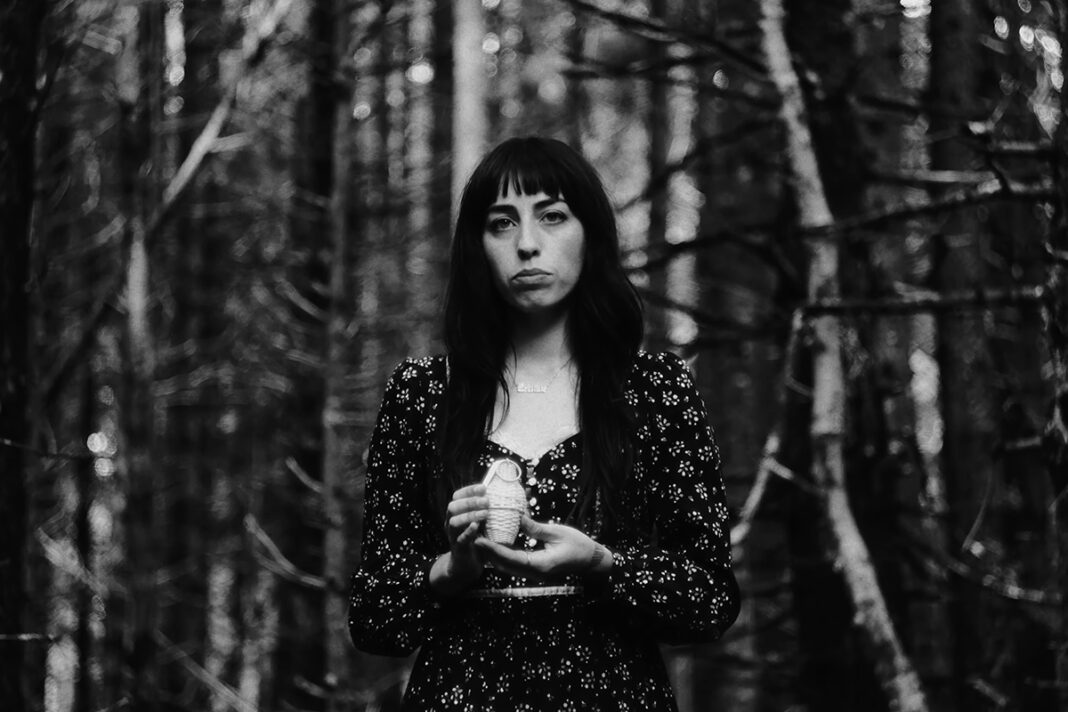
Sonically the video for ‘Triage’ embeds that swarming low-end plus some faint chirruping and rustling sounds to add a minute-long prelude to the song proper. Visually the film as directed by Lokotah Sanborn and Obomsawin has a disquieting, rural horror aesthetic as the bandleader and songwriter is observed walking through a woodland that almost feels like a torture chamber with its web of bare branches protruding like horizontal spikes. She is being watched, somewhat surreally by heads that peer out from behind the trees at unusual angles with the video therefore engaging in a kind of doubling.
In the stump of a tree Obomsawin comes across a woven basket. Odanak First Nation is renowned for its basket weaving which traditionally uses black ash and sweet grass. When Obomsawin lifts the lid of this darker outer basket she finds a smaller pale weaving inside formed in the shape of a hand grenade. She yanks the safety pin just as the beat drops and a dash ensues through a blur of scenery.
A barn or outbuilding would seem to provide some refuge as Obomsawin and another figure clamber in through a window. Yet as the ensemble wails and whirs by the video’s close the bandleader – clad in her own antlers – lies herself down by the lifeless body of a woman in white whose face is covered by the skull of a deer. This short film for ‘Triage’ is beautifully shot in crisply atmospheric black and white and provides a starkly suggestive inroad to the textures and themes of Automatic.
Jasmín – ‘Concrete Summer’
Over the past year the Dutch-Argentinian producer Jasmín has begun to reverberate beyond the clubs of her home base in Amsterdam courtesy of a brief extended play for Hessle Audio and a couple of cuts for fabric Originals, both now operating out of London. Concrete Summer / Skeletal is due out at the beginning of October but the first side offers a totemic example of how to strip techno back to its bare bones, ribcage rattling, while at the same time maintaining body and presence through an uncompromising sensibility which the artist has successfully made her own.
According to their billing ‘Concrete Summer’ and ‘Skeletal’ are ‘shaped by the architecture, tension and atmosphere of cities after dark’. The former welds pummelling kicks and dry, skeletal hits into a stuttering polyrhythm before the trace of a shaker tilts headlong to scratch and fill up like so many grains of sand the cavernous middle ground. ‘Concrete Summer’ retains its nocturnal cladding while tinny and ricocheting rhythms at one point seem redolent of a runaway tram or train. But there is equally something arid about the track even as its saturated neon lights limn the urban landscape or lurch at the listener in the bustling, throbbing night.
Tinashe – ‘Pillow Fight’
Through the staggered one-two punch and hypersleek experimentalism of BB/Ang3l and Quantum Baby an independent Tinashe proved beyond question her mastery of contemporary sensual R&B. Self-assured and sexually forthright but still open to attachment, unfolding sleepless fantasies with fibrous strings positively attached, those albums stretched perhaps as far as one could go in that direction and on Popstar she seems ready to try on other hats.
Still on ‘Pillow Fight’ the final single prior to the release of the album she maintains a now familiar sense of doubleness or duality. Tumbling keys clatter and plunk onto the ground so that soon enough – even almost surreptitiously – they have turned into a jagged and spiky bed on which she may have to lay down and even at some point get some rest. Her sultry and cooing vocals splay over these piano shards plus some low churning sub-bass rumbles and the steady clicks of the beat. And while the invitation is to a night of rough and tumble as she repeats ‘I like to tussle, I wanna wrestle / Undress ya, let’s make a mess’ in the second verse surging adrenaline is juxtaposed with the bonding hormone oxytocin while stunned in the bridge she imagines herself falling, which is to say that such strong feelings rarely stay down for the count.
Kali Malone – ‘Heavy With Fruit’
‘Heavy With Fruit’ the first taste of Kali Malone’s upcoming album Burning Song ferries a tripartite swell courtesy of Lucy Railton on the cello, Stephen O’Malley on bowed acoustic guitar and Malone herself back on the pipe organ. The cello feels sandwiched between the organ and guitar, its strings inherently melodic as the guitar moans with a bit of a wah-wah and a growl to the right of the mix while the organ shunts and ascends in the left channel. ‘Heavy With Fruit’ is a drone piece but there’s an ache from the organ which seems to seek some kind of communication or affirmation, each of the three instruments straining towards the vox humana or human voice.
The entirety of Burning Song was recorded at the historic Thomaskirche in Leipzeg, where Johann Sebastian Bach was cantor from 1723 until his death in 1750. His body has resided beneath the sanctuary since 1950 and in 2000 a Woehl pipe organ was inaugurated at the church to mark the 250th anniversary of his death. Kali Malone is the first artist to have been granted permission to perform contemporary music on this organ, which was designed to resemble the organs most intimate to Bach in everything from appearance to its specifications, pitch and temperament.
The recording of Burning Song took place over two late nights in August of 2025 with the engineer Francesco Donadello placing more than twenty microphones throughout the space and closely upon the instruments. The occasion reunites Malone with Railton and O’Malley with whom she recorded the durational piece Does Spring Hide Its Joy between March and May of 2020, in Berlin during the early stage of the coronavirus pandemic. Does Spring Hide Its Joy ultimately stretched beyond two hours on vinyl and three hours on compact disc, with Railton on the cello and O’Malley on electric guitar as Malone composed with those artists in mind while controlling tuned sine wave oscillators.
Meshell Ndegeocello with Bill Callahan and Chris Thile – ‘With God on Our Side’
Meshell Ndegeocello has slipped limpidly between interpretations, homages and original compositions over her past few releases while concentrating the personal character of her music. Ventriloquism an album of covers ran the gamut of eighties and nineties rhythms from sultry or snow-flurried soul to cascading chart-toppers to freestyle, quiet storm and new jack swing. The Omnichord Real Book her Blue Note debut embraced with sweetness and suppleness her musical roots in the company of a stellar cast of jazz players while No More Water: The Gospel of James Baldwin centred both his words and those of fellow writers like Audre Lorde to coincide with the centennial of Baldwin’s birth.
Synonym is an unconventional series of duets because each song features two singers ‘who identify as the same gender’ meaning that Ndegeocello sometimes wilfully steps back in the mix. The songs covered themselves lean into famous duets. The lead single from Synonym for instance finds Ndegeocello and Cynthia Erivo giving a neo soul, mid-nineties Janet Jackson kind of a twist to ‘I Knew You Were Waiting (For Me)’ the late-eighties Aretha Franklin and George Michael hit. Erivo delivers her portion of the song in a slinky and silvery, almost whispering high pitch with ‘I Knew You Were Waiting (For Me)’ already a throwback to Motown and the classic duets between Tammi Terrell and Marvin Gaye.
Elsewhere on the album Emily King and Lizz Wright followed by Destin Conrad and Moses Sumney will tackle fond duets by Roberta Flack and Donny Hathaway. Ndegeocello will also rework more modern fare such as ‘Always on Time’ by Ja Rule and Ashanti. Topping the billing might well be her renditions of the big shimmering hit songs ‘Islands in the Stream’ and ‘I Got You Babe’, the former with Chaka Khan and the latter with ANOHNI.
There is also room for country and folk natter on Synonym as Ndegeocello and a rotating group of instrumentalists will lay the ground for covers of songs by the duo of George Jones and Tammy Wynette and by Bob Dylan. Less landmarks than lines in the sand, while Meshell will wrestle with Dylan’s somewhat snottily defiant anti-love song ‘It Ain’t Me Babe’ in the company of Madison Cunningham, the album draws to a close through a strapping take on his anti-war song ‘With God on Our Side’ starring Bill Callahan and Chris Thile.
Thile’s wriggling mandolin provides a lovely sun-flecked and slightly elegiac introduction to the song. His strings are accompanied by softly-strummed guitars while a Moog bass begins to stretch out or tear apart the low end. As is his wont Callahan utterly inhabits the song with a sense that it was always his to sing and that he was always meant to sing it. Plainspoken he imbues it with a worn-in quality and a world-weary ache. But it’s the helicopter rotor blade wop-wop-wop of the drum programming that really sends this rendition over the top as ‘With God on Our Side’ quizzically portrays Judas Iscariot and Callahan, Thile, Ndegeocello and company strike a resounding chord while quaveringly anticipating the world to come.