


There continues to be a lively music scene in Umeå, a smallish city in the northeast of Sweden which from a cultural perspective throws punches a few waistbands above its class.
The city boasts a long tradition of classical music and jazz while Burmans Musik which began life in 1910 claims to be the oldest record store in all of Scandinavia. Norrlandsoperan with its own symphony orchestra brings a steady stream of top classical music, opera and dance to the region while a more youthful scene is furnished by the city’s university, arts campus and Midgårdsskolan a high school which specialises in the creative arts. The resulting success of Brännbollsyran – a sports tournament (think softball only you act as your own pitcher) turned major music festival – alongside such long-running events as Umefolk and the Umeå Jazz Festival gives the city today a fine blend of popular and alternative or contemporary and rootsier fare.
Louis Armstrong landed with his familiar grin at a snow-covered Olofsfors airfield and performed at Sporthallen in 1959. The birth of the jazz festival in 1968 then brought name after name to the city from the tenor saxophonist Dexter Gordon – who was present to inaugurate the new festival – to the bandleaders Duke Ellington, Count Basie and Benny Goodman to the singers Sarah Vaughan, Ella Fitzgerald and Blossom Dearie to the blues legends Muddy Waters and B.B. King.
Charles Mingus, Dizzy Gillespie, Sonny Rollins, Pharoah Sanders, Dave Brubeck, Gerry Mulligan and Sun Ra all played at the Umeå Jazz Festival over the next couple of decades, a period capped by the appearance of Miles Davis in 1985. Yet the storied festival continues to attract major artists as it approaches its sixtieth birthday with Dave Holland, Lakecia Benjamin, Sylvie Courvoisier, Melissa Aldana and Mette Rasmussen among those to have featured over the past few years.
Umeå has also played a prominent role in the modern progression of heavy metal with Meshuggah the most famous of a group of local bands which includes Nocturnal Rites, Naglfar and Cult of Luna. Yet for all of that the city is perhaps most associated musically with the Umeå Hardcore scene of the early nineties which was bound up with left-wing politics and the straight edge lifestyle and was spurred on by the success of Refused.
Refused released three albums in the mid-nineties culminating in The Shape of Punk to Come which burnished their legacy after they broke up in 1998. Despite past avowals to the contrary, in 2012 they reunited the band and played at Coachella as part of a global reunion tour that was bookended by dates back on home turf. Two more critically acclaimed studio albums followed before they finally drew the curtain with a trio of concerts at Väven at the end of last year.
But the enduring members of Refused already had another project on the burn with the lead singer Dennis Lyxzén, bassist Magnus Flagge and drummer David Sandström having debuted with the saxophonist Mats Gustafsson as Backengrillen at Umeå Jazz Festival in 2022. Another Umeå native, the boisterous reedman Gustafsson has been at the forefront of free jazz for more than three decades from his earliest adventures with GUSH and the AALY Trio to his role in the Peter Brötzmann Chicago Tentet to more recently acclaimed projects like Fire! and Cosmic Ear.
Gustafsson is perfectly capable of subsuming his voice or playing in a more conventional format – see for instance his terse albeit sometimes tempestuous accompaniment to Joe McPhee’s poetry on I’m Just Say’n or his compositional work on PIVOT last year as part of an exceptional quartet alongside Ken Vandermark, Tomeka Reid and Chad Taylor. Still he often seems happiest squalling unconstrained or barrelling into the red on improvisational tangents that get the pulse racing, while he has scorched borderless terrain – incorporating strains of rock and punk, extreme noise and heavy metal – on a regular basis whether through small collaborations or work by his groups The Thing and The End.
Backengrillen then as an Umeå collective (the place its members call home though they might live in other locales) bill themselves and their music as ‘anti-fascist, anti-racist, freeform death jazz in the memory of Lars Lystedt’. The reference is to a foundational figure in Swedish jazz and the cultural life of Umeå as the trombonist Lystedt was the founder of the Umeå Jazz Festival and steered it for many years following that inaugural edition in 1968. Jazz Under the Midnight Sun a 1963 album by his sextet remains especially cherished while Lystedt made further connections in the jazz world as a longtime correspondent for Downbeat, even continuing to perform on occasion in the years prior to his death in March of 2022 at the ripe old age of 96.
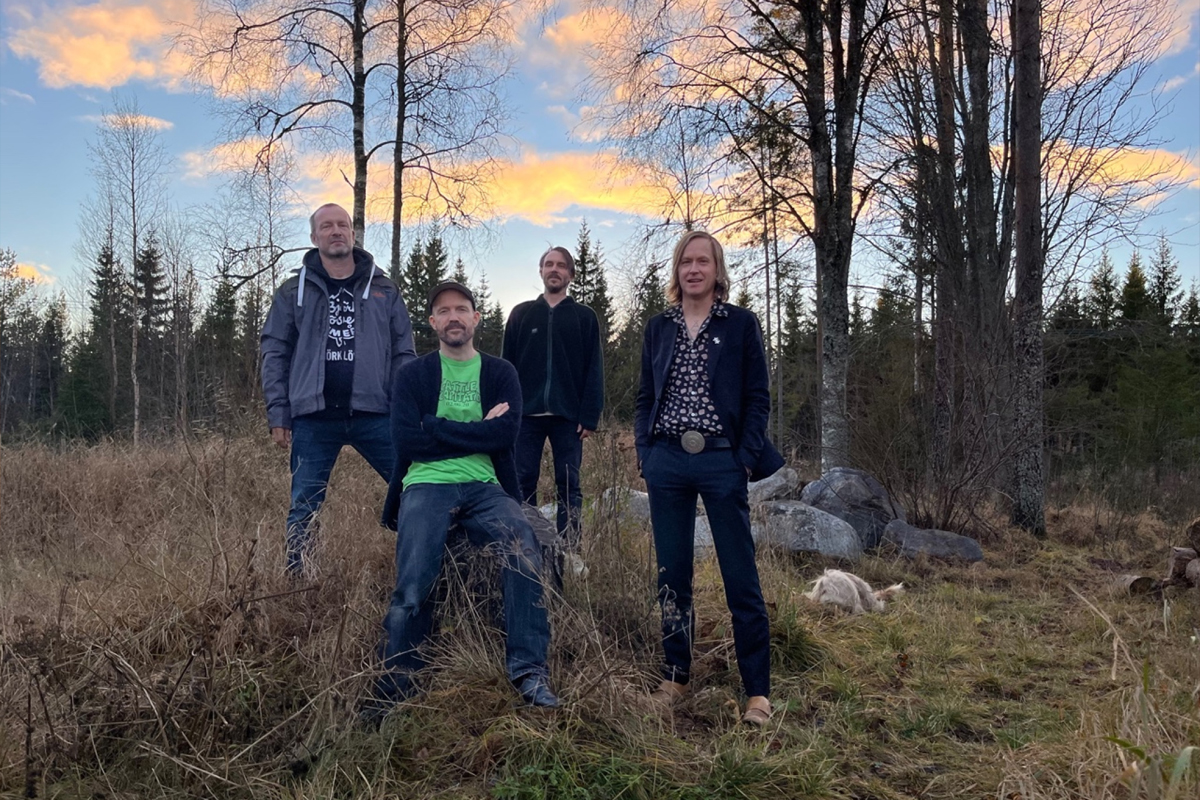
Having set out their ethos and rationale, Backengrillen begin life with a crackle and a groan as wiry static introduces a kind of warbling surf rock motif that blurs the line between Suicide and Santo & Johnny. The musicians are in their familiar roles with Dennis Lyxzén on vocals and effects, Magnus Flagge on the bass guitar and David Sandström on drums and electronics while Gustafsson manipulates his usual array of saxophones and flutes through some live processing.
Drums start to reverberate in the spectral hole forged by the bass and electronics, with this opening salvo ‘A Hate Inferior’ calling to mind the swaggering blues of the Fire! album Testament or the smeared and weather-beaten lo-fi soundscapes of People Skills and Bobby Would. Yet soon enough Backengrillen ratchet everything up a notch. Big crudding drums kick in while the melodic line sounds almost like a theremin, eerie and quavering like a wire filament holding on to the darkness.
We begin to hear some croaking vocalese while Gustafsson joins the low end on what sounds like his stonkingly big and unwieldy bass saxophone. Then a piercing scream establishes the song’s metal chops but even as Lyxzén howls and Gustafsson blows with a bit of a sputter and growl, ‘A Hate Inferior’ remains locked into a bluesy strut that bears a kinship with the John Lee Hooker song ‘Tupelo Blues’ as much as anything.
It’s that electrified take on the Delta blues and as the piece progresses Backengrillen chop up the rhythm into a kind of frame-skipped or staccato series of images. They then cede to the thickest sludge before Gustafsson commences his own swampy air in the manner of a ballad or a dirge, a solo feature that wails like the plight of so many stricken Munchian figures. The band drives to a blowout close and the remnants of ‘A Hate Inferior’ return to that opening figure, with a lulling redolence of ‘Cheree’ by Suicide and ‘Sleep Walk’ by Santo & Johnny.
The limpid plucks which open ‘Dör för långsamt’ call to mind a ngoni or mbira and are joined by the wetness of a flute and Gustafsson’s attendant fingerings, as his brisk huffs and hyperventilating puffs turn into rasping sworls of breathy woodwind. It sounds a bit like someone playing the panpipes while being sucked under the surface of a turbulent body of water.
Thudding drums establish a slow and steady rhythm while the run-along melody of the flute retains its frantic energy. Gustafsson then switches over to the sax whose squawking blasts trace the stomping drum pattern and when Lyxzén’s vocals enter the mix they sound unexpectedly folksy, with ‘Dör för långsamt’ harmonising death metal and folk chant at least until the parts bleed together into more of a psychedelic fusion.
The title means ‘dying too slowly’ but this is la petite mort or a little death as Lyxzén’s giddy ‘oohs’ and ‘aahs’ sound positively orgasmic. Then as it approaches the nine-minute mark ‘Dör för långsamt’ slides on rails, a rollercoaster barrelling headlong and swiping everything on the periphery as it remains thoroughly committed to its tracks. We return to a steady stomp and Lyxzén reiterates the title phrase before one last haunted house ride replete with gargling and screeching.
Backengrillen is a rowdy and noisy and sometimes carnivalesque record but it’s not all balls-to-the-wall noise. Once again it sits somewhere between The Shape of Punk to Come and Gustafsson’s various work with Fire! or The Thing or The End, full of rock and blues inflections with Backengrillen by their own estimation presenting a litany of comparisons as they describe their effort as hardcore jazz ‘inspired by The Cramps, Little Richard, Albert Ayler, Polly Bradfield, Entombed, John Zorn, Misfits, Stooges, Lars Gullin, Can and much more’. Vowing a swift second album ‘less stupid’ but ‘more ugly’, they say:
Backengrillen’s music is a paean to chaos and destruction. The basic idea is to take a death/doom metal, or noiserock riff and play it until it loses meaning and then break it apart like a ravenous cat would a tiny forest mouse. It’s filled to the brim with the self-hatred endemic to the province of Västerbotten from whence the member’s hail. The record was written on a Thursday during their first ever rehearsal, performed live on a Friday and recorded on a Saturday, so what you’re hearing is raw, stupid, gut instinct music played by seasoned purveyors of hardcore punk, metal, free jazz, noise et cetera.
‘Repeater II’ is surely a nod to Fugazi but it absolutely has that lurching Fun House quality, especially the second side of that album and its title piece with Backengrillen paying a more than fine homage to the chomping guitar of Ron Asheton, the grinding rhythm section of Dave Alexander and Scott Asheton plus Steve Mackay’s honking on the tenor saxophone. Instead of Iggy himself though here Lyxzén’s voice sounds a bit more glam, part of a tradition that might extend from say Little Richard to Rob Halford of Judas Priest and Bruce Dickinson of Iron Maiden but feels especially close to David Johansen the frontman of the New York Dolls.
Lyxzén cycles through a list of helpless and forlorn repetitions from mistakes to wars to heartaches, a cycle of doomed history that he urges his way out of through various oohs and ughs and oows. The odd warbling trill completes such exclamations and while the fact of another crashing climax hardly needs to be said, the band do end on an Iggy and the Stooges note of warped climax, all that potent and lusty energy having finally been spent.
The opening moments of the title track are bobbing and plummy in the vein of Angelo Badalamenti’s score for Twin Peaks. The show’s famous theme was performed by the keyboardist Kinny Landrum who used an E-mu Emulator II sampling synthesizer to trigger a guitar sample in the bass register. Here it is Flagge’s bass guitar which commences the piece, replete with some ominous whooshing before Gustafsson’s flute wafts up from the floor. It takes flight in birdlike plumes and flutters, high-pitched and swirling above the monolithic and mud-soaked footsteps of the bass and drums.
So the title tune ‘Backengrillen’ is another swampy march, again in the stygian seam of Bobby Would as Gustafsson now on the saxophone rolls out a theme of Ayleresque yearning above this very different rhythm. Amid more whoops and hollers the band starts the long walk home, with Lyxzén prodding at death as beefy saxophone, thick crudding drums and a wide furrowing bass carry everything in their wake, locked into a fathoms-deep groove. Then over the last thirty seconds they transpose the groove to a synthesizer and the song gets celestial, drifting out into space.
‘Socialism or Barbarism’ the confrontational or clearly demarcated closer returns to the crackling static of the opening song, while here evoking less the wiry hang of stalled data connection than whipping cords of static which threaten or menace as they unfurl. Like a tide washing over a rocky shore, the noise grows sloshing and gravelly with this staticky intro lasting almost three minutes, punctuated by a couple of spare drum rolls then a drone like from a smushed Great Highland bagpipe which tries to squeeze and squelch its way out from underneath.
Then we’re off with the drums and ooowwwh you never thought it’d come to this baby! Because we’re right back in Stooges territory, more staggered but just as swampy and funky. In fact ‘Socialism and Barbarism’ manages to harness all of those albums – the buzzing riffs and amplified primitivism of The Stooges, the overdriven death trip of Raw Power but mostly the unrelenting funk and groove of Fun House – into one closing statement that doubles the gut punch of the drums and sax.
An apparitional organ swells and wails in carnivalesque fashion in the background of the composition as we approach six minutes, such horror theatrics flickering amid the winding obstinacy of the groove. That organ effect sticks around and verges on the shimmers and cries of a pedal steel guitar as Backengrillen summon all of their electronic and live processing might. The atmosphere becomes thick with vapour as though precipitating a storm or cyclone, with a buzzsaw tail before Backengrillen finally cut the power leaving residual heat while promising more bonfires to come.