


Sullivan’s Travels
Hollywood Satire • 90 minutes • United States • 29 December 1941

Director: Preston Sturges • Written by: Preston Sturges • Produced by: Paul Jones • Starring: Joel McCrea, Veronica Lake, Robert Warwick, Jess Lee Brooks, Al Bridge, Jimmy Conlin, Porter Hall, William Demarest, Franklin Pangborn, Eric Blore, Robert Greig, Margaret Hayes • Cinematography: John Seitz • Edited by: Stuart Gilmore • Music by: Leo Shuken, Charles Bradshaw • Costume Designer: Edith Head

John L. Sullivan is the director of such comedy capers as So Long Sarong and Hey Hey in the Hayloft and most famously Ants in Your Plants which as recently as 1939 proved his biggest smash. He has found his lane and the fast-talking studio bigwigs don’t want to mess with it, a sentiment which stretches to his kindly boss and benefactor Mr. LeBrand.
Those comedies were a roaring success at the box office but now Sullivan – chastened by the ease of that success while perceiving a change in the times – wishes to hold a mirror up to the cold hard realities of life. He wants to do something with social significance, to depict such fare as the conflict between capital and labour and to create ‘a picture of dignity, a true canvas of the suffering of humanity’ all with just a slather of sex on the side.
Now many of the producers and executives who made Hollywood really did come from humble beginnings and could rightly portray themselves as outsiders but LeBrand and Mr. Hadrian lay it on a little as they compare backgrounds and wonder whether Sullivan has ever endured any hardship. When he confesses to a wealthy upbringing of boarding school then college they assure him ‘You don’t have to be ashamed of it, Sully. That’s the reason your pictures have been so light’.
Slightly crestfallen and sounding resigned, Sullivan admits ‘I had a lot of nerve wanting to make a picture about human suffering’. ‘You’re a gentleman to admit it, Sully’ responds Mr. LeBrand but the matter’s a long way from over because instead of ceding to the suggestion that he make the Ants in Your Plants of 1941 – perhaps with Bob Hope, Bing Crosby, the Abbott Dancers or Jack Benny – he restates his desire to make the socially conscious O Brother, Where Art Thou?
Sullivan’s plan is to go down to wardrobe and dress himself in rags before beginning to ingratiate himself among the hapless poor. It might take him a week or it might take him a year but he’s going to learn what it feels like to be hopelessly downtrodden. The studio executives and his own house staff – models of the form who include a butler named Burrows and a valet – advise him sternly against this undertaking. The poor are already experts on poverty and are so scarcely entertained by the subject that it is best ‘stayed away from, even for purposes of study. It is to be shunned’.
Sullivan though is insistent and in search of good publicity the executives agree to send him on his way on one condition: that he is followed on his travails by a ‘land yacht’ or lavish bus full of studio employees who will be ready to step in at a moment’s notice to take care of their charge. Slapstick ensues as Sullivan tries to lose his chaperones then struggles to escape from an amorous older lady who has exchanged labour for board. He winds up back in Hollywood where still feigning to be trampish he stumbles across an aspiring young actress who buys him eggs and ham, even though she is thinking of leaving Los Angeles having been truly down on her luck.
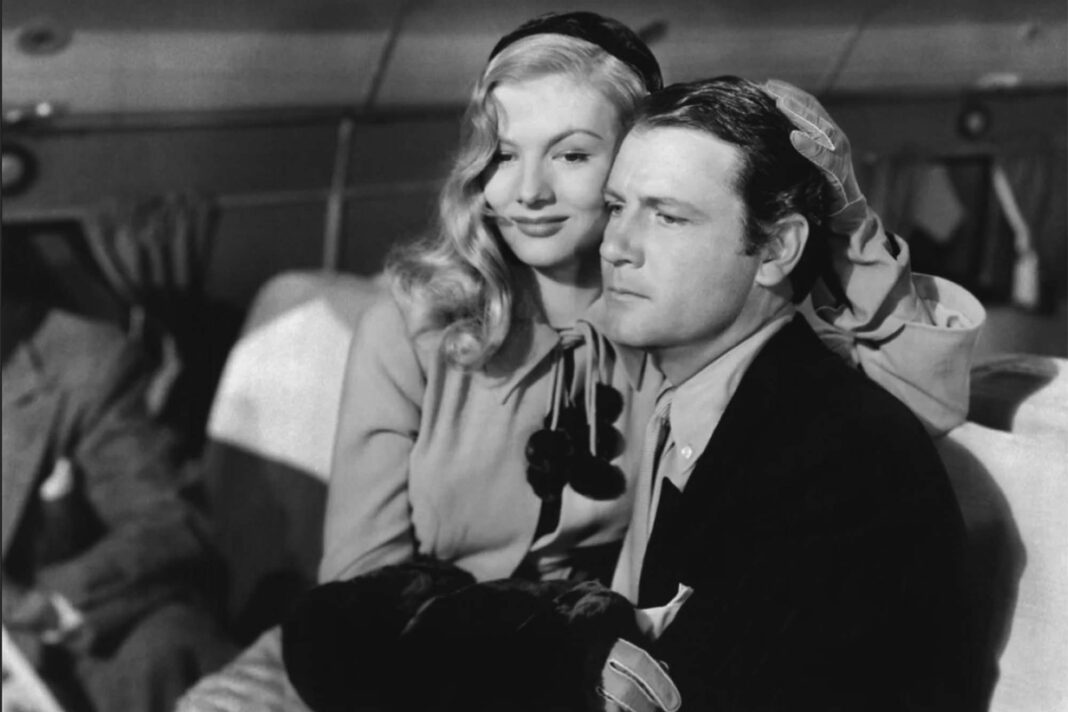
Sullivan’s Travels blends slapstick with high farce but really comes alive when Veronica Lake as this struggling actress lands opposite Joel McCrea as the director Sullivan. Through various mishaps and deceits she learns that he is in fact a successful director and visits his mansion and splashes in the pool before outdoing him for adamancy by insisting that she come along for the ride.
She dresses as a young boy and looks well on it, one of those scrawny waifs with the plucked eyebrows and voluptuous breasts. In this guise she and Sullivan don’t get too far. They hop on a train as hobos but repel their fellow men when Sullivan leads with arch questions like ‘How do you feel about the labour situation?’. Yet by the time they reach Kansas City they have sooted up and attend a labour rally, eat at a soup kitchen and spend a night in a homeless shelter crumpled but cosy between the lifeless bodies which are sprawled on the floor. That’s more than enough for their tastes and inclinations so they head home but another dubious conceit soon lands Sullivan in some real bother.
Preston Sturges made an almost unprecedented leap from screenwriter to filmmaker when he sold the story rights to The Great McGinty to Paramount for $10 on the proviso that he would get to direct the film. He managed to put out both The Great McGinty and Christmas in July in 1940 while The Lady Eve and Sullivan’s Travels arrived the following year.
Sullivan’s Travels lacks some of the sleekness and panache of The Lady Eve which stars Barbara Stanwyck and Henry Fonda at the height of their comic powers and is altogether a sheer delight. A certain bumpiness though seems largely by design. Sullivan’s Travels probably follows the thread of its own conceit rather than having lots on its mind. But it engages in all sorts of narrative twists and pokes at genre in a way that undermines or parodies Hollywood tropes even though the ending of the film presents it all as nothing more than an ode to a good time.
Those early scenes between Sullivan and the studio executives or mansion staff are screwball for their brisk pacing and lines of overlapping dialogue, while the slapstick of a subsequent car chase and his escape from the elderly lady’s home seems to veer upon parody. Even more than in the average slapstick comedy, there is a sense that we are laughing partly at the events and partly at the ludicrous artifice.
There is a more hard-boiled subplot – necessary perhaps for keeping Sullivan and the actress separate but otherwise scarcely worthy of our time – that concerns the machinations of Sullivan’s wife and former business manager. And when the modern couple arrive in Kansas City in their dishevelled attire the scenes there are portrayed with a certain tenderness, an occasion that brings Sullivan and the actress closer together while also attending with some solemnity to the poor’s plight.
A later scene in a train yard plays like a crime drama with a bent for strained realism while Sullivan’s subsequent misdeed feels like pure noir. In all of this Sullivan’s Travels can feel like an uncanny blend between say Bringing Up Baby and His Girl Friday those classic Howard Hawks comedies and La Bête Humaine the great French director Jean Renoir’s bleak macabre.
These steady shifts of register culminate in a scene towards the end of the film which takes place in a black church in the South. At this point Sullivan is part of a chain gang and between the hard labour and bouts of punishment from his vulgar overseer, those scenes in the South conjure a certain nostalgia or at least a sense of becalm as Sullivan is tended for by an old ‘trusty’. The chain gang are welcomed into the church after a preacher played by Jess Lee Brooks delivers an impassioned sermon on the theme of all men being equal in the eyes of God and leads the congregation through a stirring rendition of the spiritual ‘Go Moses Down’.
They are there to watch a film, which turns out to be the Walt Disney animation Playful Pluto. And as the chain gang and congregation alike witness the pratfalls of Pluto who is perpetually getting stuck to an errant piece of flypaper, they howl with laughter as the poignancy of the religious setting gives way to something like communal ribaldry or delight. Yet the closeups of these figures and their unbridled laughter prove decidedly unsettling. There is something almost vicious about it whether that is simply down to the unconstrained energy of the men, their revelling in apparent misfortune or a sense that their giddiness is somehow synonymous with or indifferent to their plight.
Sullivan has been sentenced to six years of hard labour owing to a genuine crime but he is also the victim of a mistaken identity. When he is revealed as the famous director of Ants in Your Plants he is swiftly returned home. He appears to have learned his lesson and concludes with a statement of intent that is restorative so far as his film career while reaching out to the lives and the people he has encountered out there on the road. He says:
There’s a lot to be said for making people laugh. Did you know that’s all some people have? It isn’t much, but it’s better than nothing in this cockeyed caravan.
A noble sentiment in its own way perhaps and no doubt true enough. Sullivan is able to resort to it though from the comfort of his mansion after his billing as a famous film director has given him a free pass. He has managed to shrug off the company of such men and can now go back to cheering them on their own dime as he partakes of his art.
This kind of irony or dual or irreconcilable purpose is native to the films of Preston Sturges. When it comes to Sullivan’s Travels we might remark on the way that Sullivan keeps circling back to Hollywood at first by accident, when comic circumstances repeatedly derail his plan to go out there and experience the cruel remainder of life. By the end of the film however his return to Hollywood becomes first a relief and then a triumph.
We might also wonder why Lake’s actress falls for Sullivan apparently beyond his standing as a famous director. What we know is that the pairing works. Lake is a snappy dame and a blond bombshell and a lithe comic foil for McCrea as Sullivan, who can seem a little one-note but has to marry bumbling naiveté and wide-eyed optimism to a certain complacency and suave. Sullivan’s Travels might meld genres and outlooks but it retains its levity and is carried off with some aplomb.
It is aided by a cast of Sturges regulars and fine character actors, from Jess Lee Brooks in that memorable role as the church preacher to Al Bridge as the ‘mister’ or overseer to little Jimmy Conlin as the trusty. The studio executives and mansion staff are exemplary for their witty repartee, with the butler and valet and their dialogue reminding me of Walter Matthau and George Rose’s relationship as master and valet in Elaine May’s wonderful dark comedy A New Leaf. As a studio middleman William Demarest is the spitting image of Robert Duvall while Sullivan’s Travels was an important film in the career of Anthony Mann, who served as an assistant director under Sturges and was encouraged to embark on his own directorial career.