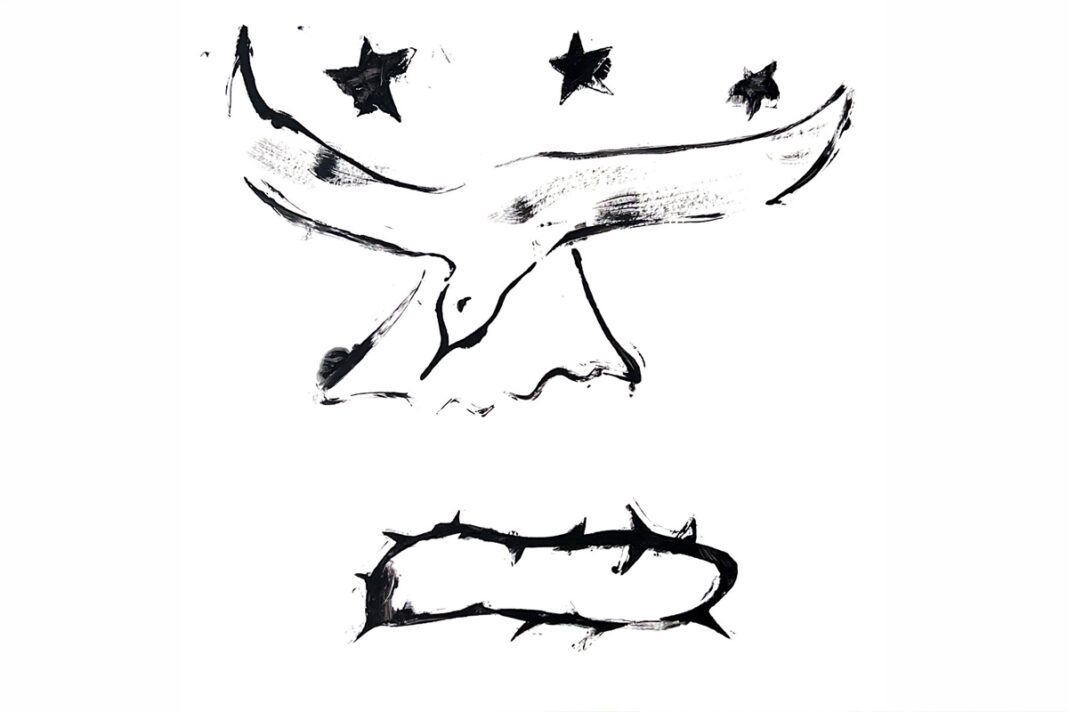




The first song on Slo-Mo Neon Luminate Hoverings by the duo of Mary Halvorson and Ambrose Akinmusire sounds like it could be the last. Akinmusire initiates a bugle call on his trumpet, a funereal albeit slightly smeared air which retains more than a vestige of martial clarity while sounding decidedly crestfallen. As he reaches a lofty and stirring peak Halvorson’s guitar comes in, pooling beneath the wails of his horn, her strings full and plangent like the keys of a piano.
There is the odd glitch as though the duo were somehow resetting the scene and the sound is elegiac but fond as they take their own separate pathways. It is as though he were standing there graveside playing his own take on Taps while she was out for a stroll, passing by under a canopy of trees as the scene imparts a gentle sorrow. There is then on this album opener ‘Prelude in the Ash’ a sense of tenderness through separateness.
Halvorson and Akinmusire are two of the biggest names in contemporary jazz and as bandleaders would seem to take quite different approaches. With her Amaryllis sextet for instance – from Amaryllis and Belladonna to the billowing Cloudward to the flittering or spectral gesture of About Ghosts – she readily embraces flamenco toques and Latinate rhythms, blues jukes and post-bop and can even broach the Dixieland and swing traditions yet the angular math rock spiel of her guitar allows her to navigate with some fixity and confidence her own domain.
She takes circuitous routes but tends to find her way back and steadily produces nagging, wriggling earworms. On a duo effort like Bone Bells with her frequent collaborator Sylvie Courvoisier – where both the guitar and piano can conjure all sorts of percussive textures – a self-consciously blinkered approach through that staggered circuitous gait can lead to comic effects which segue into moments of lyrical tenderness.
Akinmusire on the other hand can seem more in flux as both the director and recipient of a broad stream of influences. On his records Origami Harvest and honey from a winter stone where string quartets and keys play off synthesizers, vocal features and live-wire percussionists his work tends to wear its socially conscious heart on its sleeve and might skip between aspects of funk and soul, hip hop and deejay culture or strains of classical and electronic music that were rooted in minimalist repetition.
The Imagined Savior is Far Easier to Paint was his sprawling opus while Owl Song with Bill Frisell and Herlin Riley was all about carving out space in a manner that was silvery and vetivery and sat more readily within the context of chamber music. What holds it all together beyond the judiciousness of his selections is the close ensemble listening which characterises even those fuller releases and the velvety tone of his trumpet which posits Akinmusire as a successor to a spiritual tradition.
If anyone was inclined to expect a major showdown or some kind of fireworks from this tantalising encounter between the two jazz stars instead Halvorson and Akinmusire subvert expectations and opt for something far cannier. The musicians met at Halvorson’s apartment in Brooklyn and began practising together periodically as far back as 2009 though their public appearances have been confined to a couple of outings. Akinmusire and the keyboardist Craig Taborn made up a trio with Halvorson during her residency at Roulette in 2016 while the trumpeter was subsequently part of her Code Girl ensemble alongside Michael Formanek on the bass, Tomas Fujiwara on drums and Amirtha Kidambi on vocals.
They made two previous attempts at recording an album before Slo-Mo Neon Luminate Hoverings struck it third time lucky. ‘This Vivid’ finds Akinmusire playing muffled and sputtering trumpet fanfares beneath the organesque chords and peals of Halvorson’s guitar. Some whistling emanates from the trumpeter’s mouth before he unleashes a barrage of vocals which are transmogrified by means of a delay pedal.
Halvorson’s use of delay has become one of the signatures of her work. At the turn of last year she and Akinmusire rehearsed the music that would come to appear on Slo-Mo Neon Luminate Hoverings prior to a performance at John Zorn’s experimental venue The Stone in Greenwich Village. That performance took place on 9 January and the duo headed into the studio the next day to set down this album but at those rehearsals the guitarist had passed over to Akinmusire a DL4 MkII, a newly upgraded version of the popular Line 6 delay pedal.
He puts that pedal to stunning if unconventional use on ‘This Vivid’ as he echoes a series of squawking howls, canine barks, whoops and rasping cries of delight while Halvorson’s undulating arpeggios provide the musical bed. His vocals eventually get chopped and looped into a glitching repetition that almost sounds like a wailing siren. As that fades out we are left with a simple ostinato pattern on the guitar, as Halvorson plays a scalar run then a passage of mistier chords with some warp and bend while Akinmusire sighs and sputters and muffles his lines like billowing padding around her. She says:
Ambrose was interested in trying a Line 6. I gave him one five minutes before the rehearsal and was amazed how quickly he was able to do incredible shit on it . . . in literally five minutes. I’ve never seen someone pick up a pedeal and them immediately do something with it that felt like, ‘Oh, this is a sound’ as opposed to just tinkering, you know? It felt like he was making music on it right away, and then also doing things that surprised me, like the vocalizing really surprised me. I wasn’t expecting that, and it was awesome.
Akinmusire for his part rejoinders:
But I’ve been watching you, I’ve been watching Bill and other people use it for a long time. I approached it as if it were its own musician. I played and it would process the sound and then I would choose to react to that or not. The people like Mary that I love to listen to who use delay, I like being able to hear the process of the texture that’s being built. With some people, when they use it, you don’t really hear it. But with Mary, she’ll play a line and then she’ll react to that line and then react to that. It’s really cool to hear how something is being built. So I kind of stole that.
‘Nice to meet you again for the first time’ showcases the guitarist’s use of delay as her wandering and noodling, almost tinny or rubbery line gets thoroughly drenched by echo. The effect is of Halvorson playing opposite herself, like a mirror mime act of the kind immortalised in the musical comedy Duck Soup by the Marx Brothers.
She stops and starts, almost daring the echo or delay to make the first move, then as she plays a few flamenco licks or toques Akinmusire squawks and skronks noisily until the duo meet and meld in the middle. Now guitar and trumpet pull off that same mirror mime act. At times they sound like a couple of clowns stuffing balloon animals back into their big trick bag.
Soon they depart with Halvorson ambling away while Akinmusire flutters and scampers and trills down the sidewalk. After a few furtive over-the-shoulder glances they begin the process again or at least are sorely tempted, but they do finally give up and go their own separate ways almost with an air of vexation as the trumpeter growls or blows raspberries while Halvorson’s usually upbeat or self-contained tread sounds more forlorn or despondent. ‘Nice to meet you again for the first time’ is then a kind of spattered or sputtering sibling of the Cy Coleman and Carolyn Leigh standard ‘I Walk a Little Faster’.
On ‘Soundcheck’ the trumpeter plays a series of short and muffled fanfares which start to repeat and iterate almost on their own terms thanks to the delay, with the changes and oscillations giving the piece a playful or saturated quality. With its gospel or spiritual evocations it sounds like an Albert Ayler theme constructed out of clay or a primary colours sketch of his ‘Truth is Marching In’.
These short iterative phrases echo and resound to build a looping chorus as Akinmusire begins to stretch out on his horn, putting together longer runs over the shorter pulses. By the time Halvorson’s wiry plucks drop in just beyond the halfway point of the composition the buildup of layers feels gaseous or even portentous. The guitar tings like tines and is once more briefly redolent of flamenco before Akinmusire exits masked by his own mist and Halvorson commences a spare passage of hammer-ons and pull-offs and bends plus other nubby textures. In the final moments of ‘Soundcheck’ the transmission breaks down into a series of blips and beeps and staticky, slurping distortions.
‘Watersmoke’ also has a vague spiritual bent whose opening melody recalls at least to my mind the stately carol ‘Once in Royal David’s City’. This kind of cloistered hymnal refrain blends with more martial airs like the winds of a fife and drum corps. Now with a tinge of pastoralism Akinmusire plays sustained tones over Halvorson’s tender notes and squelching or bubbling effects. The guitar wriggles and bubbles all toil and trouble then softens again to sound a bit like a lap steel or perhaps even a sarod the sweetly sympathetic Hindustani classical string instrument before the song ends on a yearning, beseeching cry from Akinmusire’s trumpet.
‘Tangled Pretty’ begins life as a fine ballad. Amid high pitches an orchestral surge swells up in the background of the piece, full of brass as Akinmusire’s cries become more stark and solitary. Meanwhile the guitar ambles from underneath and maintains something of that ballad sentiment even through Halvorson’s characteristic circuitousness. The trumpet soars and swoops, shivers and trills, trails and aches. Then towards the tail end a harmonic pattern on the guitar calls briefly to mind the Smashing Pumpkins fan favourite ‘Set the Ray to Jerry’ as disassembled wedding bells (which also sound like ice cream jingles or an old dialup modem) usher the duo under an archway into a tangled sunset.
‘Ofo’ amplifies that sound and turns it into a repeating figure. The song seems like an evening stroll between friends. I think say of Adolph Deutsch’s jazzy score for The Apartment and its mid-century ennui, those slower-paced songs that feel bluesy and soulful. More than a bit bluesy in fact as ‘Ofo’ begins to evoke the ripe balladry of the saxophonist Frank Morgan before splintering in the latter stages.
That burbling motif from the Smashing Pumpkins track ‘Set the Ray to Jerry’ might also be discerned at least among fans of the band in the ostinato that opens the penultimate ‘Blood & Sand’. Akinmusire blows with shifting clarity as though he were watching the sun rise in what sounds like a warm rippling paean to the morning. In fact it seems as though Halvorson is trying her hand at a series of nineties grunge or alternative rock themes, paying homage to that teen spirit as Akinmusire seeks something of his own volition.
Yet so texturally they meet, his muffled tone melding around halfway with Halvorson’s wiry, rubbery hammers, pulls and pinches. He unleashes a few cries and a wheezing sound suggests the air going out of a balloon before the trumpeter cedes the frame of the composition. Obstinately the guitar carries on with Halvorson again making compelling use of her pedals as she conjures an impression of melting vinyl. Akinmusire returns for some muted fanfares before the close on a piece that sounds warped and woozy, playful and lilting and feels stretchy or pliable in the ears of the listener.
There is so much lovely stuff on Slo-Mo Neon Luminate Hoverings whose title captures the texture and sheen and faintly luminous rhapsody of proceedings. That amiable mood is bound to the duo’s penchant here for light experimentation. The album closer is the title track and here both musicians use delay to establish a droning sea of accompaniment. Very tender and fond, it touches upon the elegy of the opener and its bugle calls or soft fanfares but here the effect is of a gentle caress rather than something final or declamatory. Together the duo of Halvorson and Akinmusire sound quietly sanguine as their music remains encompassing and affecting.