


From the very outset, much of Craig Taborn’s defining work as a bandleader has come with a trio. After a handful of outings with the saxophonist James Carter’s band while still at university, his leader debut called quite simply Craig Taborn Trio was a proleptic exploration of his emerging interests which he put together in some spare studio time with his bandmates Jaribu Shahid and Tani Tabbal, shifting between driving numbers and free flights of fancy, with a keen sense of swing as he tackled deep cuts by John Coltrane, Horace Silver and Ornette Coleman.
Roughly a decade separated his next couple of entanglements with the form, as Light Made Lighter in 2001 saw him team up with the bassist Chris Lightcap and his old college buddy Gerald Cleaver, the drummer who during a shared stint at the University of Michigan had formed a band with Taborn called the Tracey Science Quartet. Chants in 2013 with Thomas Morgan on the double bass and Cleaver on drums finally captured this particular version of the trio, which by this juncture had been a working band for a period of about seven or eight years.
In the meantime a quartet album Junk Magic with Aaron Stewart, Mat Maneri and Dave King plus a solo debut for ECM in the form of Avenging Angel had shown the scope and elasticity of the keyboardist’s practice, which stretches from bebop and hard bop to the clusters and runs of Cecil Taylor, incorporates everything from calypso grooves to skittering electronic minimalism and continues to swing even where the atmosphere turns pensive or gaseous.
In recent years Taborn has upped the tempo. Beyond a series of duets with such luminaries as Mats Gustafsson, Kris Davis, Ikue Mori and Vijay Iyer, an acclaimed quartet album Daylight Ghosts with Chris Speed, Chris Lightcap and Dave King, another solo outing through Shadow Plays this time in a concert setting and a belated Junk Magic reunion of sorts, the keyboardist has also engaged in a wide swathe and rapid flurry of trio recordings. There was a session with Christian McBride and Tyshawn Sorey for John Zorn’s epic Book of Angels series, the electronic excursion Golden Valley Is Now, the slugs and howls of Weird of Mouth together with Mette Rasmussen and Ches Smith who squalled in the manner of free improvisation and the thrilling confluence of Trio of Bloom from last autumn where Taborn fell in alongside Nels Cline and the rising drummer Marcus Gilmore.
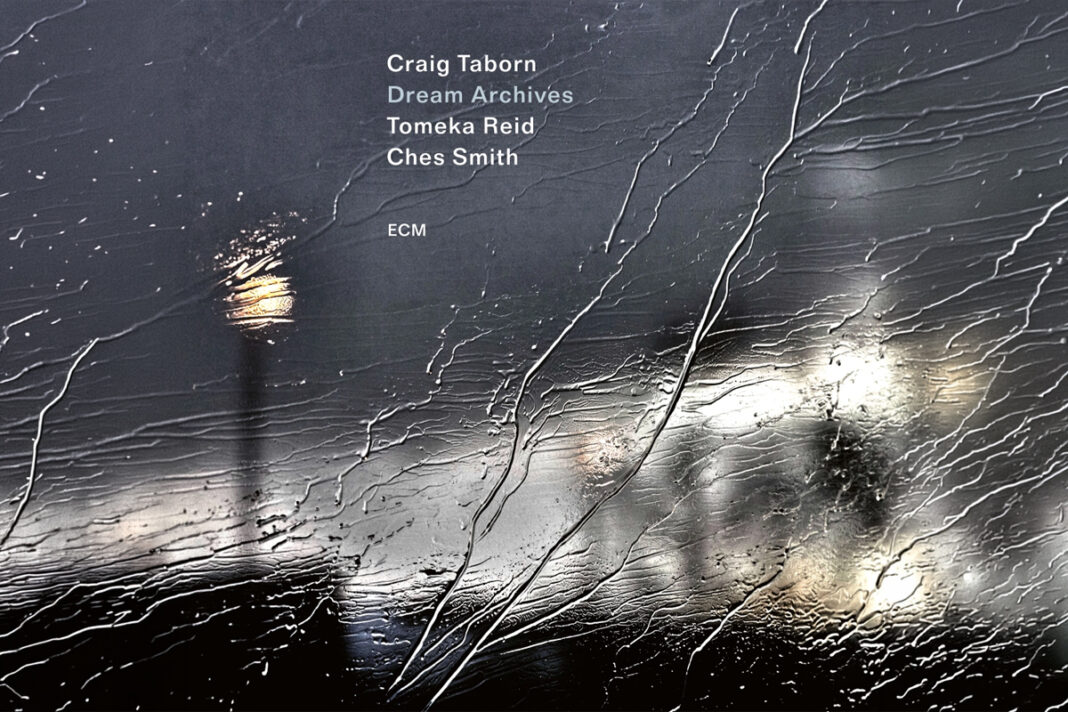
For his latest effort on ECM the acclaimed keyboardist has established a new trio with Tomeka Reid marking her debut for the label on the cello while Ches Smith plays drums and vibes plus other percussions and cajoles his work by means of electronics. Taborn and Smith had collaborated on several occasions prior to their extemporisations as Weird of Mouth, notably on Smith’s trio album The Bell which also featured Mat Maneri, together with Dave Holland and Evan Parker on Uncharted Territories and on another ECM trio project Sun of Goldfinger, where the core group of David Torn, Tim Berne and Smith were joined by Taborn on keys and electronics, a couple of guitarists and a string quartet for the album’s sprawling and kaleidoscopic centrepiece.
After a spell on the road with Maneri and Taborn, for his Pyroclastic Records album Interpret It Well in the spring of 2022 the drummer and bandleader Smith also found a way to incorporate Bill Frisell into the mix whose blooming loops and decorations gelled seamlessly with the ensemble. On the other hand the relationship between Taborn and Reid or for that matter Reid and Smith is more green, with the keyboardist and cellist having appeared on stage together as part of Rob Mazurek’s psychedelic and prismatic big band Exploding Star Orchestra.
Yet the new album Dream Archives not only suggests a shared consciousness or the capacity to similarly inhabit vehicles of the past. Because from the opening moments the chemistry between the trio feels arcane and layered in the manner of something like a palimpsest beyond conventional notions of rhythmic flow or lucid entanglement.
On the opener ‘Coordinates for the Absent’ some tentative keys and ominous though elegantly rendered buzzing from the cello draw us deep. Wiry vibrations like from a jaw harp and moments of crashing percussive emphasis stir the atmosphere, which might be introspective or abstract but never lies dormant. By means of electronic processing, Taborn imbues his keys with a long decay and the environment in the middle of the piece becomes murky and amorphous, with notes of pathos amid a general air of restraint. Vibes explore the murk and a resonance of church bells along with the loops of a slide whistle fringe or hover over the scene as the music begins to sound like a staging ground for abstruse gestures and shapes.
Reid’s cello returns with her vibrato adding more of that sense of foreboding as the trio collectively prepare to turn the page. ‘Feeding Maps to the Fire’ is more energetic from the outset but no less anxious as Reid’s short bows are matched by Taborn’s antsy keys. The cellist makes use of tremolos and produces harmonics by playing closer to the bridge, switching between these sharp tones and some droning lower pitches as again the prevailing mood becomes pendent until Smith’s rattlestick percussion spurs the crew from underneath. Plunking keys, shrill whistling electronics and the rubbing and creaking of the strings give way to more expressive piano runs and drum rolls, with the remainder of the composition sounding like a fire sputtering out and then catching up the wind as its embers swirl back to life blazing and rippling with warmth.
A graceful ostinato on the keys introduces ‘When Kabuya Dances’ the Geri Allen special. Mostly faithful to the original with moments of enigmatic drift, the dance mixes lithe restraint with a kind of headlong character, as though each note or each moment was leaning into the next. Smith picks up an Afro-Cuban rhythm which compels everything about the piece to flourish and blossom, with a jiving bass line tweaking its hips beneath a carousing melody. Cascading cymbals and light-stepping hats add to the engagement as Taborn too shows off his rhythmic dexterity, his manner on the keys light in terms of style or temperament but with a pretty robust physical presence. ‘When Kabuya Dances’ is a joyous tune that here takes on an almost martial stridency before wafting out of view.
Dream Archives gives itself over in this middle section to a couple of interpretations as the Geri Allen dance is followed by the Paul Motian favourite ‘Mumbo Jumbo’. The song was a live staple for the drummer in the nineties, appearing on Motian in Tokyo his live album with Joe Lovano and Bill Frisell and his followers have continued to pay homage to that tradition. ‘Mumbo Jumbo’ featured for instance on Frisell’s duo album Epistrophy with Thomas Morgan, captured live at the Village Vanguard and released on ECM Records in 2019, while last year Lovano also headed up a Vanguard set – comprising Jakob Bro on the guitar, dual drummers in Jorge Rossy and Joey Baron and a Cerberean bass lineup with Morgan and Larry Grenadier over the upright while Anders Christensen wielded the electric – that kissed off with the Motian composition.
Here on Dream Archives that complication takes on a spectral countenance as ‘Mumbo Jumbo’ opens through dry cymbals, tinkling chimes and shimmers or skulking shadows of cello. The piano offers something more tangible though in slightly groping or woozy fashion as it attempts to lay out the song’s motif. For a while this rendition of ‘Mumbo Jumbo’ remains amiably incoherent, with that sense of familiarity that refuses to entirely cohere but the song becomes more restless and agitated amid frighted strings and as the vibes wash lullingly over the piece. The trio finally strap themselves onto their shared raft and ride some big tumbling waves before drifting faultlessly out at sea.
The title tune swiftly opposes vibes and strings. Reid plays pizzicato while Smith festoons his mallet strikes with some chimes and other rattling or descending percussions, as though we were witnessing a game of snakes and ladders in reverse as the music abounds in coiled ascents and rapid descents. Then after a couple of minutes a low drone like cracked bedrock begins to teem with all sorts of curious but shifty electronics. ‘Dream Archive’ here becomes vaguely neolithic, or perhaps better to say it blends a sense of ritual and our shared agricultural past with new age or futuristic electronics.
It is far out music. And what dreams are these, we may ask? Does the title suggest an archive of all dreams or types of dream, or one and the same dream which keeps reiterating? The odd garbled electronic communication is swallowed up by the swooning of Reid’s cello and the low rumbling of Smith’s drums. And just after the seven-minute mark the trio unite for a more lyrical if plaintive moment but scrambling sticks and sprawling keys plus a few coiled or whirring strings build the tension again before a crinkled exit.
Finally the closer ‘Enchant’ is unlike anything else on Dream Archives, opening in a luminous haze. Reid plays a languorous melody with hopeful and hearty accents as the vibraphone joins in. From the misty background ambiance to some dotted chimes and bells, ‘Enchant’ seems to be suffused with a pastoral aspect and burnished with that little bit of hopefulness. Yet stray transmissions and the slightest modulations of an electronic undergrowth or undercurrent possess the capacity to subtly transform the setting.
‘Enchant’ steadily takes in other climates, latent rainforests and barren tropics. Spare piano and cymbal washes are briefly invigorated by the blood of the strings. The collective sentiment is somewhat downcast but full of tenderness. Then the final third of the composition teases a commingling of the elements – perhaps a pungent cello solo or a elegant passage of the keys – only to stay relatively muted at least until the percussion pads out a rhythm and Taborn, Reid and Smith together as dream weavers engage in one last pendulous swing.