


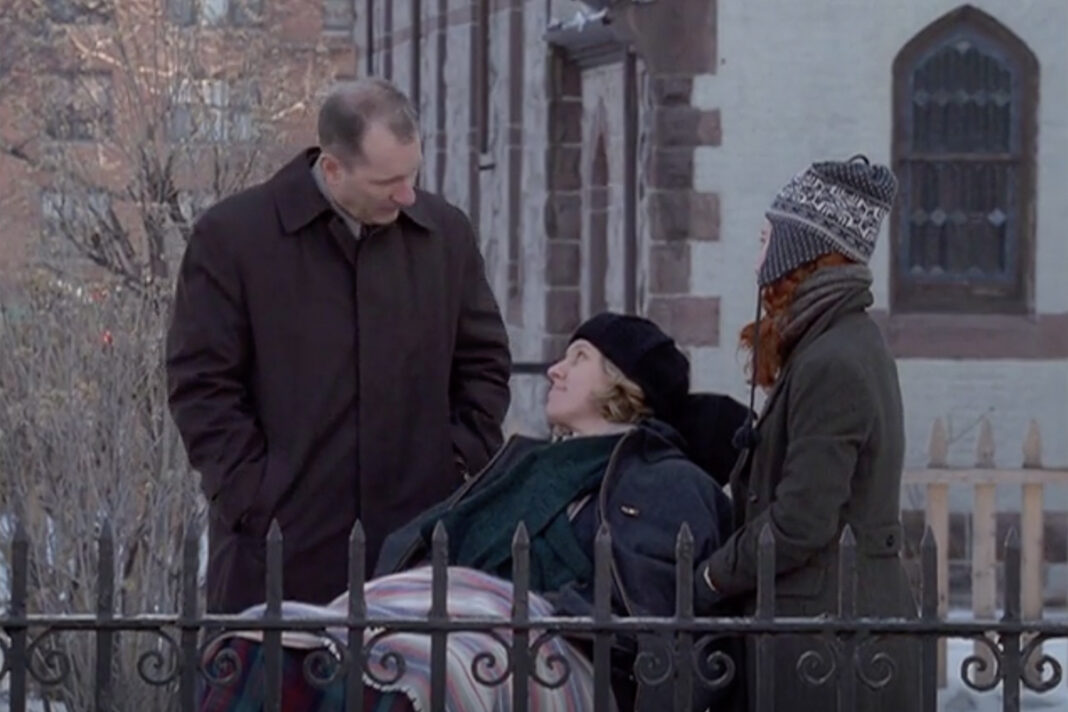
The opening scene (or cold open) of the third episode of Big Apple introduces a new character and a new situation which deepens our understanding of detective Michael Mooney as played by Ed O’Neill. He is visiting his sister Lois who is in a wheelchair and we come to learn has amyotrophic lateral sclerosis which is commonly referred to as ALS or Lou Gehrig’s disease.
Covered with blankets, she sits in the corner of her yard by the wrought iron railings which separate her yard from the street. Her home is overlooked by a church with its pointed-arch windows, exposed masonry in the quoins and surrounds and pitched roof that no doubt spans nave and pews. The area looks like Queens for its mixture of mid-rise apartments and lower-density buildings; from the other direction we can see a wintery scene with rowhouses at either side of the street.
Lois is being cared for by a young woman and exchanges morning greetings with those passing by in the street. One neighbour stops to apologise as he believes that his son may have been bothering Lois for cookies on yesterday’s walk home from school. Lois assures him that the opposite was the case. ‘We ambushed them’ she proclaims and her carer confirms that they had been handing out cookies from the doorstep before Lois wishes the boy Miguel good luck with his impending geography test.
Lois is portrayed by Brooke Smith, who was perhaps best known at this juncture for her film roles in The Silence of the Lambs and Vanya on 42nd Street. Lois is witty and alert and shows high spirits but also displays some of the signs of dysarthria, as she has a slight trouble in arranging her mouth to form words, which practically means that she speaks more slowly and elongates her words with a slight moistness or ‘muh’ sound forged by the long closing and parting of her lips.
In the vast majority of cases ALS can be classified as limb-onset which begins with weakness in the arms or legs or bulbar-onset which involves difficulties speaking and swallowing. Lois anyway appears to be at an advanced stage of the disease and suffers from both.
Mooney starts to bring up something about a blender which he noticed soaking in the sink but Lois smothers the subject and says she saw Donnie Brasco last night on television. Gesturing to past conversations, Mooney jokes about his recent assignment with the Federal Bureau of Investigation and Lois jokes that he looks a lot like Johnny Depp.
Then his pager beeps and he has to get going. Tramping back over the snow, he steps inside and glances at Lois through the window. She is still chatting to her carer in the yard as Mooney watches her for a moment before swallowing his concern and hurrying on out the front door.

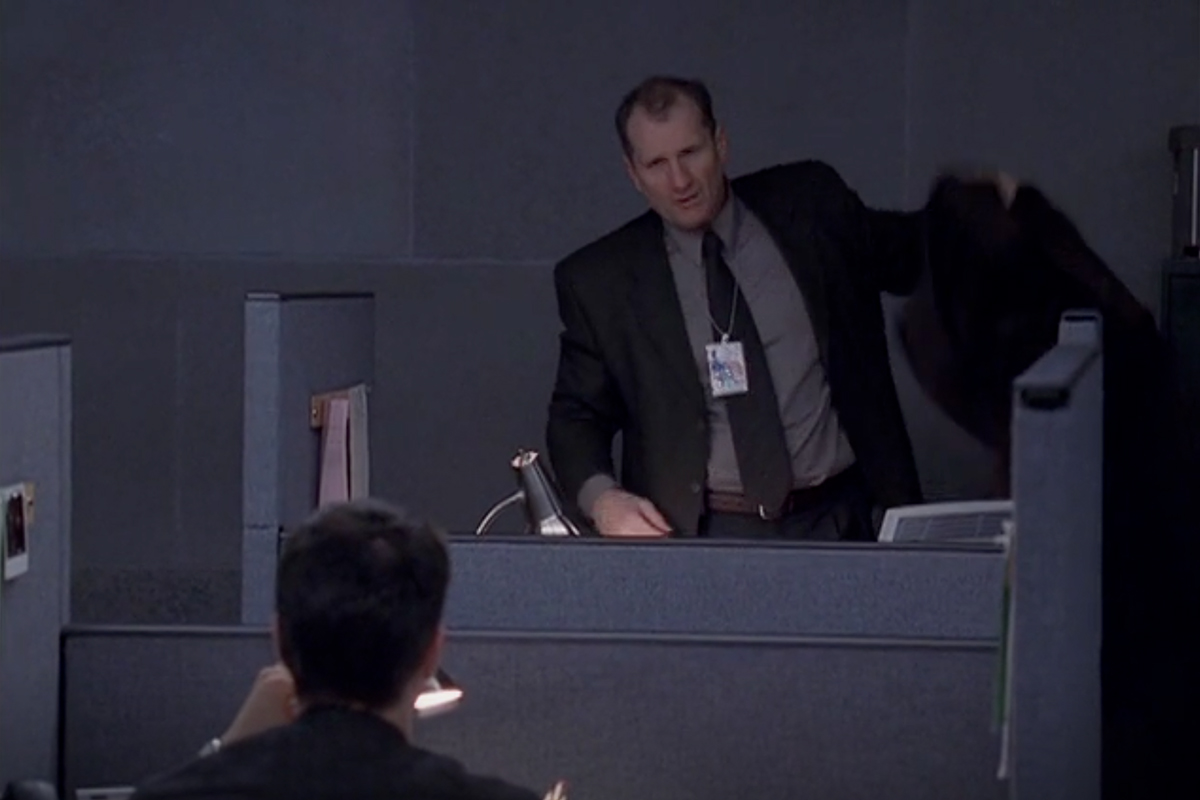
All day at the office Mooney is preoccupied with his sister even as he almost absentmindedly gets drawn further into the case which is at the centre of Big Apple, the murder of a stripper who was found in a swanky Park Avenue apartment which seems to implicate not only Russian mobsters but members of the city’s elite.
A man named Howard Klein (played by Frank Pellegrino) has been in the detective’s crosshairs. He claims to have taken the stripper Vickie Tompkins back to his swanky penthouse apartment and to have had sex with her the night before her body was found there. He explains that he uses the apartment precisely for these kinds of rendezvous and that he left after intercourse only to find her mutilated body upon his return.
Klein was the one who made the 9-1-1 call and Mooney does not appear to regard him as a prime suspect though he’s certain that he has something or someone to hide. Mooney and his partner Vincent Trout are on the case and have been roped in to a task force with the FBI, who are conducting an ongoing investigation into the Russian mob and do not want this murder investigation to interfere with their work.
Separately we understand that some of the senior figures in the FBI office – agents Will Preecher and Ted Olsen as played by David Strathairn and Glynn Turman – are conducting a covert investigation into one of Klein’s powerful associates. It is possible that without the detectives knowing it, they are chasing the same person and are on course to help the FBI agents catch their man.
For the time being however another cop at the station has cottoned on to the fact that Mooney would appreciate a more in-depth conversation with Howard Klein. To this end the cop seems to have found and cornered the man in a Korean massage parlour and planted heroin on his body as cause for bringing him in. Mooney and his agitated lieutenant easily see through the cop Ollie Stenzel’s overly elaborate story but Mooney realises he might still be able to lean on Klein or curry his favour by making a show of clearing his name.
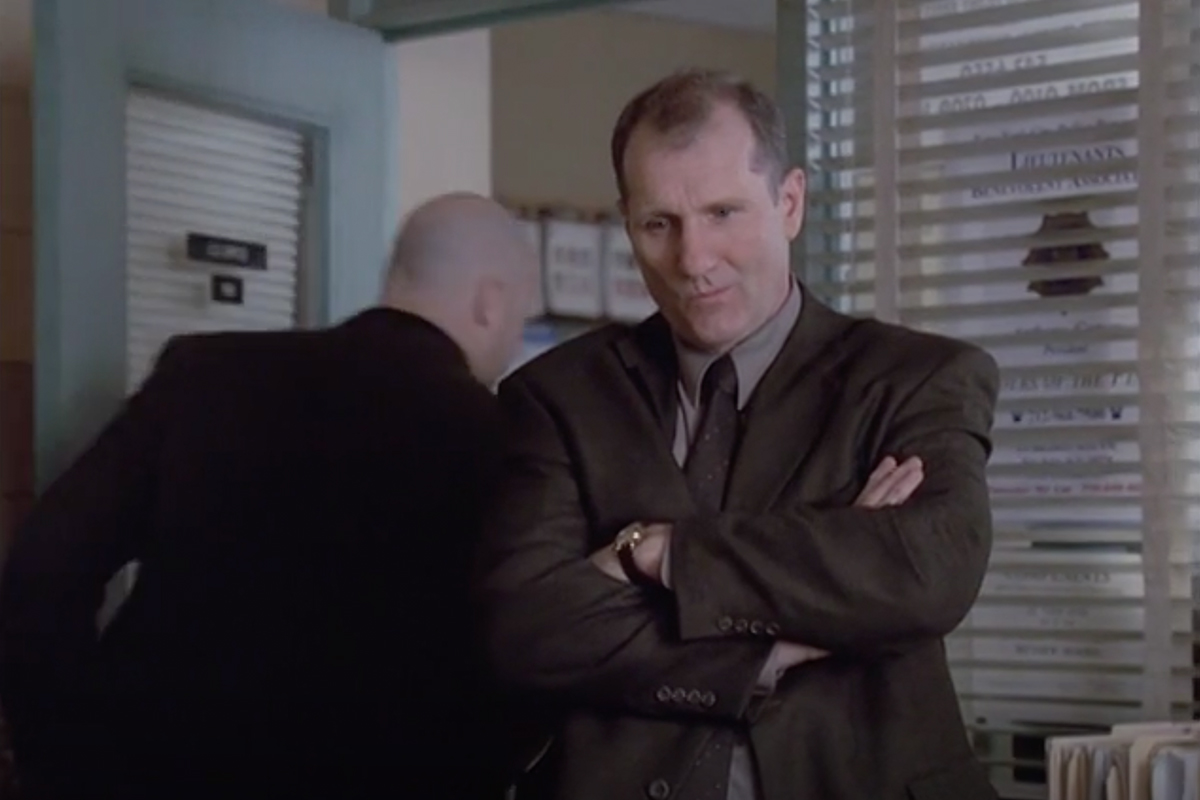
That’s what happens. Mooney and his lieutenant know that Klein has no case to answer and that Stenzel planted the heroin but Mooney pretends to have gone to bat for Klein while warning him that his role in this ongoing murder investigation might leave him a target out on the street. Klein says he has a place outside of Greenwich where he can go to lay low and think through his options. He leaves the police station with a new sense of wariness and Mooney tells Stenzel to put the heroin back where he found it while being discreet.
It is at the police station that we learn of Lois’s diagnosis. Sitting opposite each other at their desk, his partner Trout (a more wide-eyed Jeffrey Pierce) tries to talk shop but instead asks a visibly distracted Mooney what’s on his mind. ‘Concerned about my sister, you know?’ he replies. ‘That’s all. She’s definitely failing. Miserable Lou Gehrig’s disease.’
His own agitation over the behaviour of Stenzel – who believes he has done Mooney a favour by bringing Klein in – gives him an avenue to let loose and display the true nature of his concern. Now that Klein has been released, Mooney has a face-to-face with Stenzel and gently chastises him while telling him to return the heroin to whichever property room he took it from. ‘And this thing you did for me, which forever from this moment you didn’t do, don’t do it again’ he concludes, before going off on more of a tangent:
See cause sometimes when we think we’re helping someone, all we’re doing is hurting them. Hurting ’em because we’re making wrong assumptions about what’s in their best interest, being blind to their needs, selfishly doing things to make us feel good, so we don’t have to face any certain painful truths. Important lessons to learn in life, no matter how much it hurts. No matter how much! Get outta here.
And later at their personal desks as Trout reveals an important tidbit regarding the potential provenance of Klein’s watch, Mooney is still framing his thoughts about his sister’s deteriorating health through his ostensible anxiety over Stenzel’s behaviour as he says ‘Postponing the inevitable, Vincent, that’s all I’m doing with this Ollie Stenzel’.
Vincent Trout is putting in more of the legwork at least today as he checks through building records and some of Howard Klein’s boardroom connections while Mooney deals with Stenzel and dwells on the health of his sister. But it is Mooney, having forged a personal connection, who calls Klein up later in the day when Trout has linked him to a boardroom colleague named Lawrence Stark.
All day long Mooney has been babbling about this blender that he gave to his sister, getting himself into a bit of a twist. As he picks up the phone and waits for Klein to answer he tells Trout his partner ‘I got her this blender, it’s got this high speed liquify. I’m concerned she’s not getting the use’. He gets Klein’s answering machine and tells him to call back because they need his ‘John Hancock’ or signature for the property they handled and returned earlier in the day.
Then Mooney pushes back on his chair, rises wearily and slips an arm under his overcoat. With a shrug and a sigh he says ‘Vincent, I’ll leave it to you, huh? Maybe stop by say hello, get her on the right wavelength’. He pats Trout on the back and they say their goodbyes before Mooney closes with a maxim as pointing for emphasis he says ‘Cannot fool with nutrition’.
We never get to see this blender but it’s s been on his mind since the morning, when he raised it to Lois and then to her carer Rosemary who seemed pretty vexed. ‘That high liquify, is that helping?’ he asked only for Rosemary to respond with an exasperated ‘Oh, for heaven’s sake’. ‘Is something wrong?’ he repeats with the sense of ‘Is it something I said?’ but we might well guess that this isn’t the first time he has raised the nagging issue of the blender.
Big Apple was created by David Milch, the animating force behind the first seven seasons of NYPD Blue and future Deadwood master builder, together with Anthony Yerkovich the creator of Miami Vice. There is in the show a certain sleekness, a noirishness and pulpiness in its portrayal of a criminal underworld with seedy links to high society that seems right within Yerkovich’s wheelhouse. Yet the combination of textures, the comedy of manners that sometimes veers towards the slapstick, the distinctive dialogue with its inversions and digressions and extenders, the sentiment in the show and its very way of constructing a scene all seem quintessentially Milch.
In fact as it further looses the procedural shackles Big Apple – which shot a mere eight episodes and aired only six before being cancelled by CBS in the spring of 2001 – seems like the missing link between NYPD Blue and Milch’s next series Deadwood. And one of the aspects of Milch’s writing that Deadwood would really bring to fruition concerns his use of the item as symbol or object of transference.
There are many examples in Deadwood, from the sheriff’s badge finally retrieved and worn by Seth Bullock to the gold which is the reason for the camp’s enterprise to Al Swearengen’s private conversations with a decapitated Native American head. Even the newspaper in the nascent town of Deadwood is symbolic rather than literal in so far as it seems less about recording and disseminating the news than about an ultimately communal assertion that this is now the kind of place where the news ought to be made and printed and kept. A newspaper registers at root the existence of a community while also affording its makers the happy routines of news gathering and the printing press.
Most famous though are the canned peaches which soon become requisite at any meeting between the senior figures in town. The peaches turn the haphazard town meeting – impromptu, at the whim of circumstance, entailing by way of disagreement a potential threat – into a shared ritual, more civil and decorous certainly but more than that a site of intrapersonal bonding and shared expectation. The peaches imply that there is something in common and something to be shared even where conflict and rancour might raise their heads.
The blender in Big Apple is different from the canned peaches in Deadwood in so far as the blender is neither luxury nor set dressing but might seem to have a substantial use. After all if Lois does have trouble swallowing owing to her late stage Lou Gehrig’s disease then anything that makes nutrition easier for her might count as a major help.
That’s not really how Lois sees it though nor her carer Rosemary and it is perhaps not really how the disease works. Lou Gehrig’s or ALS is classed as a terminal neurodegenerative disease. There is no cure and the disease progresses until all capacity is lost. The blender then exists as much as anything as a way for Mooney to transfer his grief and helplessness over his sister’s illness into something tangible over which he might exert a modicum of control. It entails a bonding ritual as it gives him something to discuss with Lois (and with Rosemary) that is not overtly about her prognosis.
A few looks and glances in the cold open already made it plain, but in the final scene of the third episode of Big Apple we see once more how Lois is broadly accepting of her disease while Michael Mooney is barely keeping it together as he flails and fusses against the inevitable.
Having left the police station for Lois’s place he arrives to find Rosemary reading to his sister. ‘He told me earthy stories about animals and birds. He was the kind of writer who emerges from nature like an uncut stone, with the freshness of the forest and an irresistible vitality’ she goes on. The lines are from Pablo Neruda’s memoir and a passage in the chapter ‘Spain in My Heart’ where he pays ode to the Spanish poet Miguel Hernández.
A goatherd and farmhand who was largely self-educated, Hérnandez was imprisoned for fighting and campaigning on the Republican side during the Spanish Civil War and died of tuberculosis while in still custody at the age of 31. In addition to the sonnets and elegies of his earlier collections like El rayo que no cesa, the songs and ballads which Hernández wrote while in prison – some in letters to his wife, some even on scraps of toilet paper – helped cement his posthumous fame.
Mooney interrupts the evening reading session, entering Lois’s room with his hands raised and his palms out in a conciliatory gesture as his sister smiles on from her chair. Lois tells Rosemary to go home; her other carer Tracy is late and Mooney can stay until Tracy arrives.
The relationship he has with his sister portrays Mooney in a gentler and more wavering kind of light. As a detective he has so far seemed forward and headstrong, almost deceptively smart as the FBI agent Jimmy Flynn (played by Titus Welliver) notes at the end of the first episode but barreling forth in a way that intends to stir things up and put other people’s noses out of joint.
He is quick-talking and has a steely blue gaze and he can seem confiding and is always ready with a conciliatory pat on one’s shoulder or arm. But he is equally ready with a put-down when he thinks such is apposite while his signature pose is one of hands on hips, his suit jacket flapping open as if to say ‘I’m here and I’m not going anywhere, so let’s get on and crack this case’.
With his sister though he seems to recognise some of the limitations to this approach. He doesn’t necessarily have an alternative but he is more careful with what he says, more tentative and palpably concerned with rubbing her carers the wrong way.
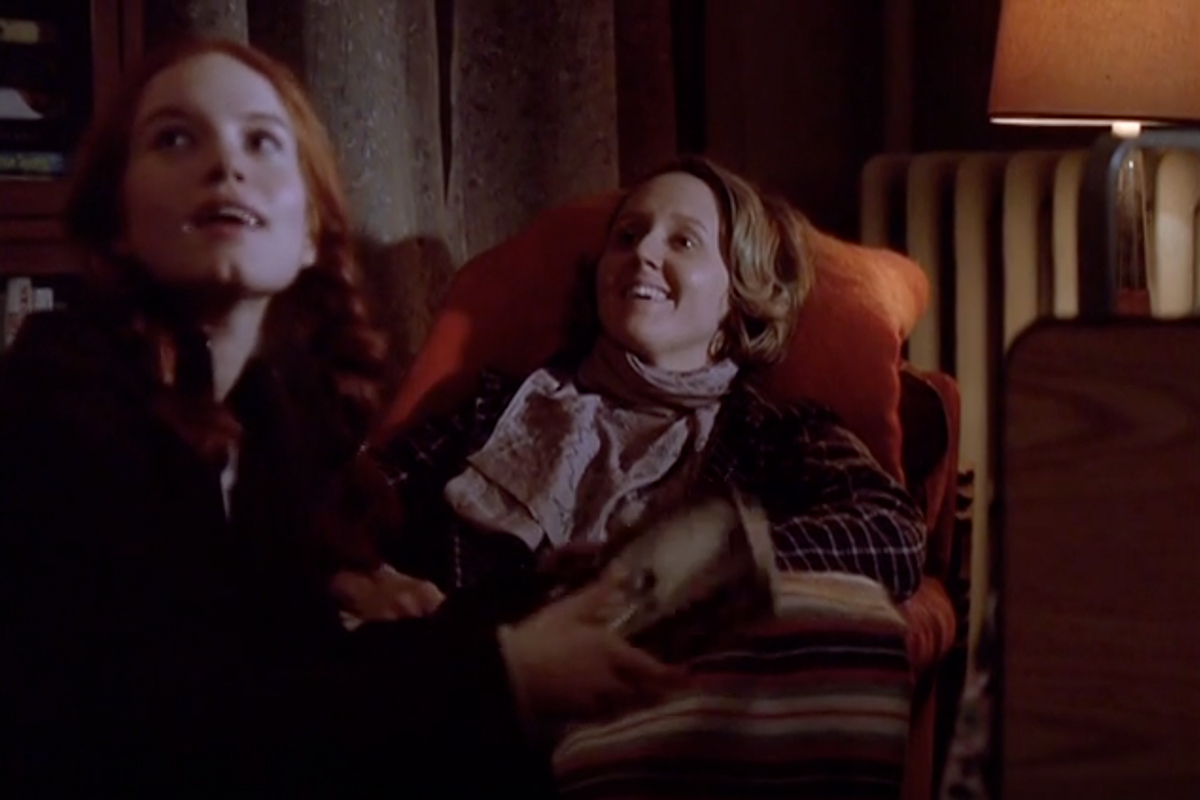
That’s true even though he is paying them for their time, perhaps only a token gesture but something all the same. Yet he says that each of them volunteered of their own accord to help with her care. ‘Lives you’ve changed teaching. That’s what I hope you appreciate. All these girls coming back here to help you’ he says as he perches himself next to his sister’s chair.
‘Lives you’ve changed teaching’. That’s a Milchean sentence for its inversion or ellipses and its capacity to open up worlds of memory and meaning. The implication is that Lois was a teacher prior to her illness and some of her old students are coming round to help manage her care. And of course this spell of her illness is going to be a learning period too. Milch in his autobiography Life’s Work: A Memoir of Storytelling and Self-Destruction broaches this particular scene and says:
My prejudice as a writer was always to stick with the quotidian, the nuts and bolts, the daily stuff of life. It was probably out of fear, out of not trusting deeper emotions. That’s a kind of savage way, a primitive way of working. The scenes with Mike and Lois, they started to bring this whole other sense of feeling to the show. If you stick with the characters and their situations, the natural impulse of those characters’ spirits, over the course of time, is going to lead them into what is other than quotidian.
The same impulse towards emotion and meaning yet at the same time to avert our gaze or stick to our daily means prompts Mooney after this touching tribute to his sister to stand up and grope for the damned blender once again. ‘Hey, did you get any use out of that blender today sis?’ he wonders. ‘I see the blender’s been put away. Did you use it at all?’
Harder truths might come in the slipstream of tenderness and distraction or vexation. ‘It’s hours feeding me, Michael’ his sister explains. ‘That’s not your concern’ he responds but ‘I’m the one trying to eat’ she says. He starts to gently scold or at least to outline the tough realities as they appear to him. Without making the effort to eat she is going to end up with a feeding tube in her stomach, he says, and besides the girls who come round are willing to put in the time. They want to be here.
‘Comes a time I’m not gonna want to struggle to eat’ she explains. At this point Mooney has mustered the loquaciousness and rhetorical thrust which characterises his work as a detective. He’s outlining roles and responsibilities, laws and consequences as he states his piece:
Well that’s the equivalent of saying you want a feeding tube stuck in you, sis. Unpleasant as that is that’s the reality of what you’re saying, because that’s the only other alternative. Because, because people can’t live without nutrition. If you don’t eat, then you’ve gotta have a feeding tube. Or else you can’t stay alive.
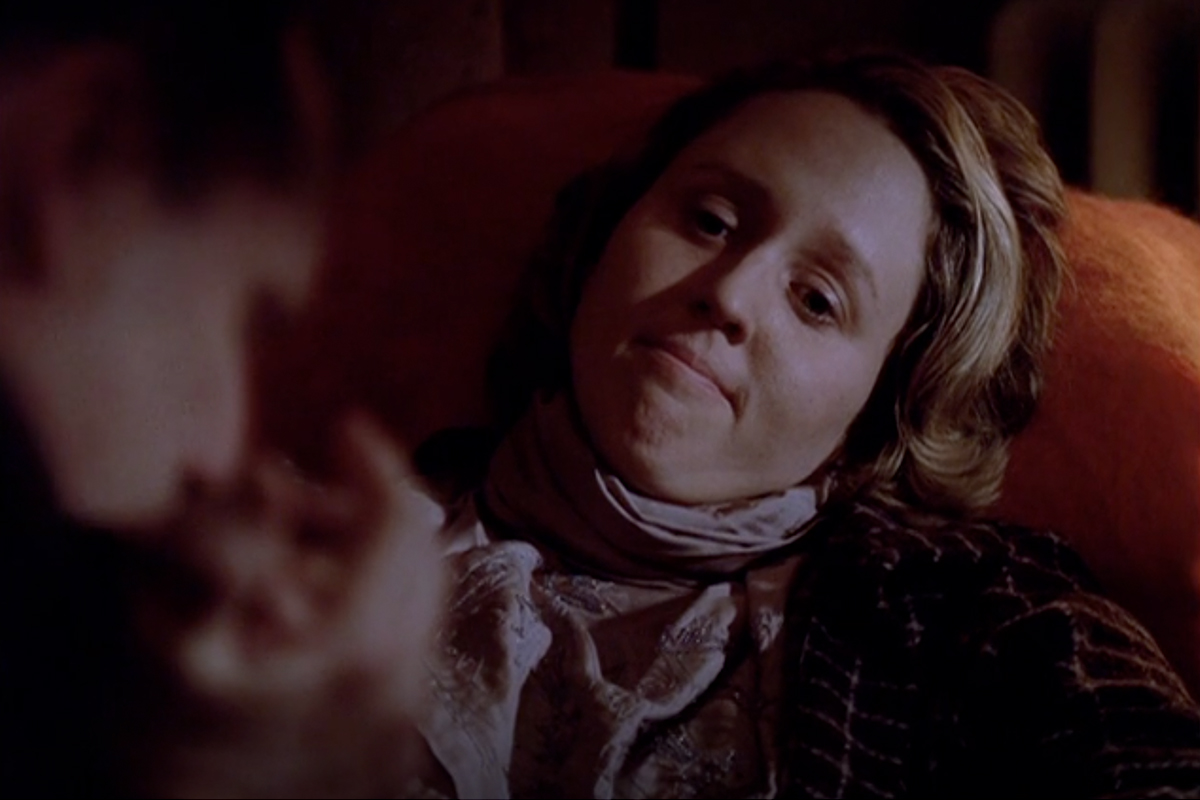
‘Come’s a time’ Lois says. They take a beat and Mooney says ‘Anyways, how about I play something for you’. He pulls out a harmonica and she smiles and gives him an enthusiastic nod of the head as he begins to play. Her cheeks swell with that throb of concern and emotion as the camera slowly pulls out of the room and away.
Once again, we neither see nor learn of Lois until this third episode of Big Apple titled ‘No Good Deed’, in which the opening scene lasts two and the closing scene three minutes. In these two scenes with their short spans of time the relevant cast and crew manage to conjure a whole life for Lois, one we believe to have been lived well. Her disease is portrayed with detail and understanding and all of the affection that invariably derives from that.
Meanwhile these scenes centre Michael Mooney’s world outside of his profession, recontextualising his aggravations and flareups but also those compassions and kindnesses of which we understand he is capable. We emerge with a much fuller sense of the person and of the world of the show.
Big Apple pays only surface heed to genre, going in for the kind of mashup or absurdity or doubleness which only precious few shows can successfully admit. It mixes together noirish or rain-soaked crime drama with a more pervasive and unsettled sense of mystery and undercuts this narrative thread with a penchant for folksy personal dynamics and comedy hijinks. That is all the stuff of life it says with a certain perversity or a pulpiness and melodrama that might remind one not only of Milch’s own oeuvre but of other rare and stylised fare like the David Lynch and Mark Frost collaboration Twin Peaks.
It leans against dramatic or cinematic conventions or strips out their parts and in both instances sees what can stand, often finding the drama stronger in the face of such headwinds. The camera pulling away through the door as Michael Mooney plays the harmonica for his dying sister might seem like a conventional device, though the scene was also a product of serendipity as Ed O’Neill really plays.
His playing music is a final salve and expression at the end of a day full of worries and anxieties and small acts of care, even at the workplace. The logical contortions including those around the blender that have led us to this point, some trenchant dialogue full of Milchisms and the subtlety of O’Neill and Brooke Smith’s performances – where fond though circuitous conversation is punctuated by weighty and portentous looks plus words of meaning – altogether makes for one of television’s most memorable and touching scenes.

Big Apple remains unavailable on streaming services but all eight episodes – including the six aired by CBS in the spring of 2001 and two more that were filmed but unaired – can currently be watched over at the Internet Archive.