


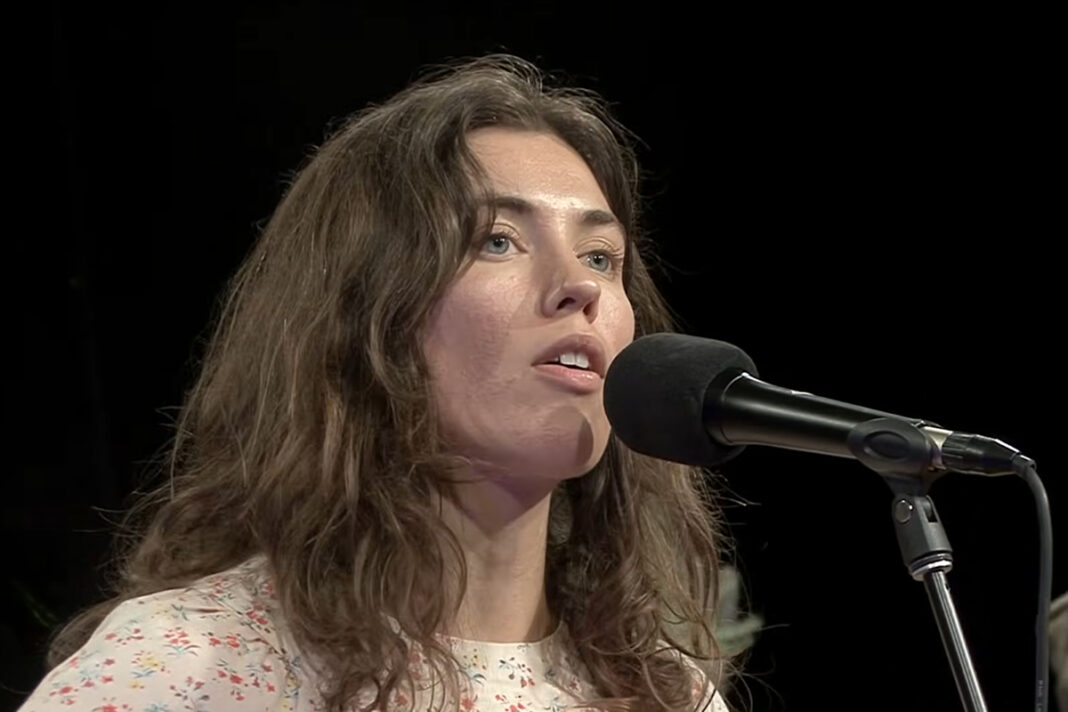
Mad Dogs the debut album by Grace Rogers is a stonking and rambling record that seems to put folk music through a blender while retaining an affinity for the mores and accents of the tradition. It moves with a rock and roll swagger while its penchant for storytelling remains closely attuned to the specifics of people and place, suffuses folkish frames with scuzzy garage rock distortions and funk or honky-tonk licks and seems perturbed by the state of the world but can shrug some of that off to embrace the moment, with a performative flourish that can appear almost uncannily self-assured.
The artist has lineage as her great grandfather Charlie Rogers played guitar for the Kentucky String Ticklers, who recorded for Gennett during the depression years. Founded in Richmond, Indiana with a studio in Manhattan, the label would capture some of the earliest work by such foundational jazz figures as Jelly Roll Morton, Louis Armstrong and Bix Beiderbecke plus music by blues and country artists including Blind Lemon Jefferson, Charley Patton and Gene Autry. Songs by the Kentucky String Ticklers can still be found on compilations of Kentucky mountain or fiddle music gathered up from the twenties and thirties.
Rogers herself studied the fiddle from childhood later adding to her arsenal the banjo and guitar and for a decade she played mostly in traditional contexts, performing solo or with small groups. But for Mad Dogs the native of Bath County, Kentucky put together a group of her musical friends and glanced at the tradition askew or stepped into another realm that has more in common with the perspectives and genre-breaching influences of outsider folk and anyway really knows how to rock and roll.
Wielding an Ibanez S Classic that her father – also a musician – bought for her on Facebook Marketplace on Mad Dogs she doubles up on the electric guitar with Ian Gordon, whose noodling or jangling lines dovetail and trace as in other instances one plays the melody while the other contributes to a writhing rhythm. The bass as played by Chris Cupp might offer padding support or something more funky and squidgy while Fiona Palensky on drums can slap out a beat or splash cymbals whose capillary waves seem to form water lilies, serving as a springboard for the rest of the band.
After a lovely lilting opening through ‘Divine Safety in God’, a vernal hymnal, ‘Tranquility’ proves a sloshing, gently rollicking song that shows the band’s penchant for cascading tempo shifts and groovy repetitions. ‘Downstream’ is more sludgy and broaches prog or metal while in the second half of the album ‘God’s Green Earth’ and ‘Peachie’ are more conventionally folksy, the former full of tripping whimsy and the latter more earthy, as the patient watchful quality of the songwriting comes to the fore while Cupp takes a rasping turn on bowed cello.
Rogers maintains a conversational style while she is able to push the pace or crest the wave of a rhythm and she can hold onto a note to poignant or even psychedelic effect. Palensky adds to the sometimes slightly wistful but anyhow companionly manner through her vocal harmonies. The lyrics on Mad Dogs might take in dubious social media types (‘I wanted to be that genre of man / On Instagram’) or backyard frolics (‘whip-poor-will whip-poor-willing away’) and while the song structures sometimes evoke the ramshackle quality of Michael Hurley the focus on a specific cast of outsider artists and roving accomplices reminds me of Jolie Holland’s solo debut Catalpa.
‘Peachie’ for instance offers a fond summation of the lives and temperaments of the Magoffin County fiddler Peachy Howard and the singer’s honky-tonk piano playing Aunt Zone. And we might presume that they and Rogers share an ethos when the latter in ‘Peachie’ sighs the refrain ‘When I am gone / What will they find at the bottom of my well / But all of the songs it took / To get me through this hell’.
‘Smoke ‘Em’ tumbles forth amid the fumes of alcohol and cigarettes but a strung-out Rogers does manage to keep her wits about her as she and the band swarm and splash down on ‘Westport’. The song brings Mad Dogs to a stirring close as the singer glances back upon old figures and relationships while gazing out over the unreflecting Ohio River.
Mad Dogs came out last year and received a measure of press, listed fourteenth on Pitchfork’s list of the best thirty rock albums of 2025. Sometimes though one’s way in to a work of art might prove indirect while reinterpretations, live renditions and other contextual factors can shed new light on the core or pith of an experience.
Grace Rogers and her band performed a lengthy set for Red Barn Radio last week on 2 September. The show is partnered with WEKU the public radio station out of Richmond, Kentucky and focuses on ‘old time and bluegrass’ musicians from the commonwealth and its neighbouring states. With its own performance venue, Rogers opened the 25th season of the show by playing songs from Mad Dogs plus some new compositions.
And while the title track ‘Mad Dogs’ was already a favourite the rendition of the song on Red Barn Radio has turned it into one those special pieces of music which is sure to slosh around in my brain and be returned to periodically over the weeks, months and no doubt years to come. Rogers and her band play it live with a certain slackness especially on the vocal side which only seems to enhance its coiled rhythms, as though they were loosing the reins while staying bound to the harness.
Or some suitable canine analogy for ‘Mad Dogs’ at the heart of the album does pertain to some rowdy beasts ascertained as such by the Kentucky fiddler Buddy Thomas. Born in Lewis County at the northeastern tip of the state, Thomas died in 1974 at the age of just 39 but left behind a legacy for his playing nourished by the release of Kitty Puss a couple of years later on the American roots label Rounder Records. The Field Recorders’ Collective buttressed his reputation in 2015 with a grab bag of his music as recuperated from the collection of Dave Spilkia and Ray Alden.
The liner notes for Kitty Puss include an autobiography in which Thomas recounts a tough upbringing, as he begins the anecdotal account by saying ‘We growed up real poor, so poor that even the poor folks said we were poor. There were ten in our family and we had to raise most everything we ate and work in logwoods and stuff like that’. One passage explicitly concerns mad dogs, with a characteristic sense of fervour and credulity:
Sometimes of a night the old-timers would come visit and I’d lie in bed and hear them tell stories about killing bears and haunted houses and stuff like that. And they used to talk about all these mad dogs that were going through our country. This one guy got bit and seven years later he got to feeling funny. He told his wife to take the children to her daddy’s, he believed he was going mad. And he made her tie him to the bedposts. She slipped back to look in the window and he was biting himself and the blood was just a-running from his arms. He got loose that night and they found him dead later, with all the meat chewed off his bones. A mad dog came through our country and bit a black-and tanner of mine. Its eyes got real green and it’d eat up cardboard boxes like they were bread, so my dad had to shoot it. My mother would get so nervous over the mad dogs that she slapped planks over all the windows. There for a long time we’d hardly get out of the house. They used to say that the only thing that could cure it was a madstone. They would put that on the bite and it would draw out the rabies.
Other anecdotes involve attempts on his life, woodland shootouts, spectral pranks and japes and the consumption of moonshine gallons at a time plus other hard-drinking escapades. Thomas also portrays his early turns at the banjo before he picked up the fiddle and began to learn how to play, inspired in large part by his mother who used to whistle the tunes once performed on the fiddle by his grandfather Jimmie Richmond.
For the most part banjo and fiddle are evoked on Mad Dogs by its other string instruments. But the album’s title song takes Thomas’s colourful account and homes in on an image, where those dogs running wild with their green eyes and maddening bite – a poison which can apparently lay dormant for years in the bloodstream – become a symbol for both an agitated state of mind and for a makeshift or untrammelled artistic vocation.
‘Take this train to the end of the line, I’ve been in the pits / Underwater, underworld, oh I’ve been in the pits, babe’ the song begins with those vocables or interjections and exhortations like ‘oh’ and ‘babe’ certainly more emphatic in this live rendition. On record the song is propulsive but the vocal maintains a light and sweet cadence, as though Rogers were merely cresting the rhythm, whereas here her voice sounds pleasantly slack and crude and therefore more gnarly and textured. There are more flat tones in her delivery and when she hangs on to the last word or syllable of a line the note is not merely sustained but might offer a piquant change of pitch.
In other words Rogers is blurring the line, whether by urging the momentum of the song or through changes of tone or by quite literally blurring or smearing the melody, all of which adds to the audible interest. The song already stands out but it gains a bit of character and roughness. That suits its lyrics which suggest earthly despondency while limning a kind of outsider apocalypse as Rogers continues ‘I’ve been down and I’ve been by but never quite like this / You see there’s fear amongst my brethren all the freaks will disappear / And dark will crumble into clay all lying and insincere’.
‘Prostrate on the floor I cannot stand these city lights / Take me home, oh take me home, I’m going home tonight’ goes the pre-chorus, introducing a tinge of urbanity whose bright lights do serve to illuminate or reflect back into the wilderness. And then the chorus itself comes to a head as an attractive admixture of anguish and acceptance, Rogers repeating ‘My bitterness, frustration, mad dogs in these hills / All my bitterness, frustration, I go where God wills’. The push and pull only to eventually cede to some restless, shapeshifting providence mirrors lyrically the song’s impetuous momentum.
In the second verse Rogers pays a visit and delivers an ode to Buddy Thomas who ‘made his shine to fiddle on alone’ and to her uncle Brett who ‘decorates the trees / With sparkling waters cans, they shake and shimmer in the breeze’. Her headspace becomes mapped onto physical terrain and begins to disperse as it blends with the populace, with Brett working on a book called ‘People I have knowed at one time, feral and untamed’ while the figure of an old man selling trash by the lake proves a final salve, an ode to doing or at least to a certain persistence.
My favourite line though from ‘Mad Dogs’ bridges out of the chorus. Musically and lyrically the ‘bitterness’ and ‘frustration’ which Rogers compares to ‘mad dogs in these hills’ finds a sense of resolution through the vagaries of God’s will. Yet the band with their wriggling guitar lines and quickening percussion take just a momentary pause or lull in which to embrace that gesture, before winding everything back up and going again.
They whir and writhe and recommence a groove that steers towards dance rock, though of a kind that calls to mind say Iggy and the Stooges rather than post-disco or indie rock varieties. And with an air of nonchalance – like a passing thought or a process so plain that it admits only blithe acceptance – Rogers sings ‘All my trouble runs like liquor through a still’ suggesting that like distilled spirits her troubles are not merely being concentrated but purified, taking on new and potent subtleties of flavour the more she feels and dwells.