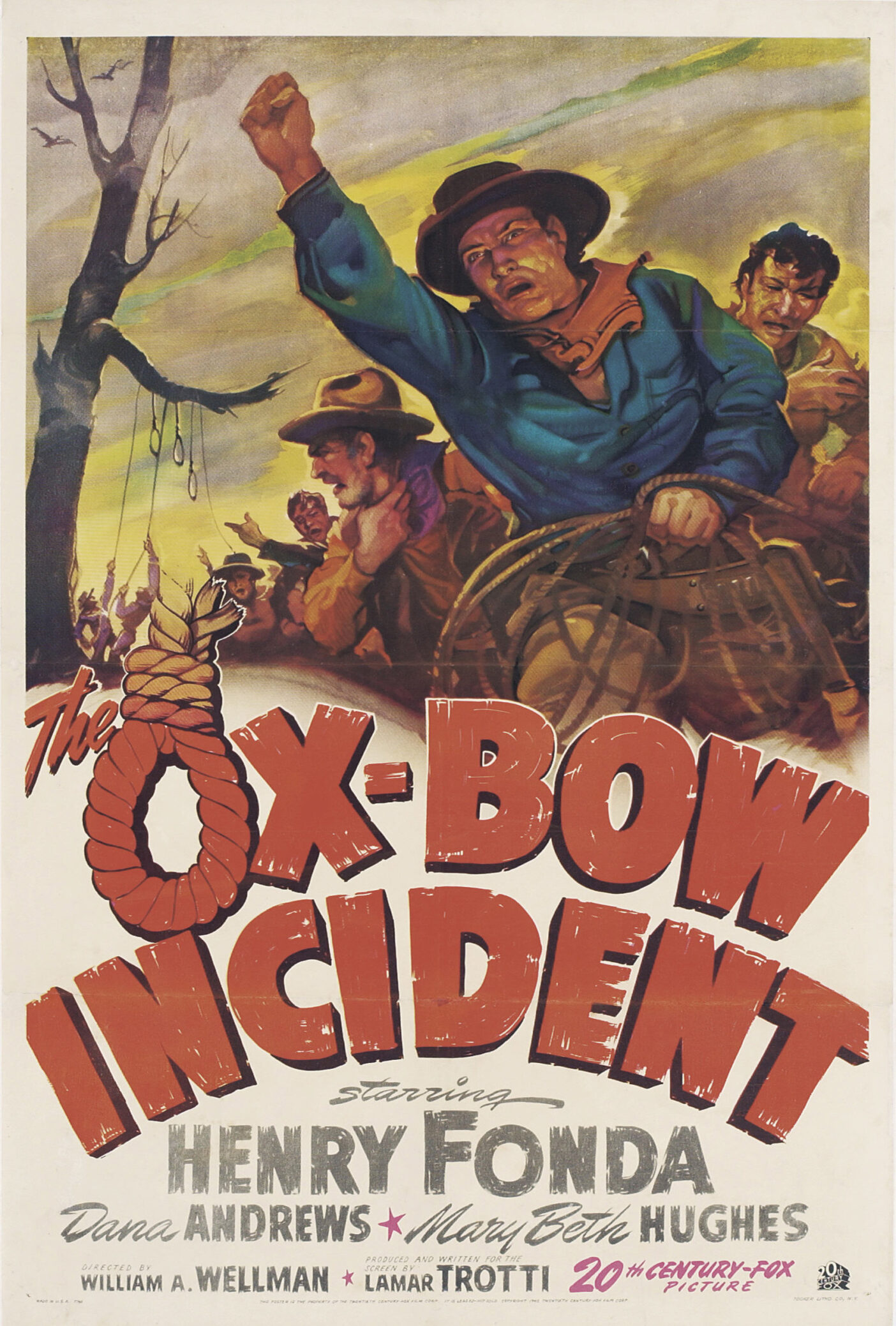



The Ox-Bow Incident
Psychological Western • 75 minutes • United States • 8 May 1943

Director: William A. Wellman • Written by: Lamar Trotti • Based on: The Ox-Bow Incident by Walter Van Tilburg Clark • Produced by: Lamar Trotti • Starring: Henry Fonda, Dana Andrews, Frank Conroy, Harry Davenport, Leigh Whipper, Harry Morgan, Marc Lawrence, William Eythe, Anthony Quinn, Mary Beth Hughes • Cinematography: Arthur C. Miller • Edited by: Allen McNeil • Music by: Cyril J. Mockridge

A couple of cowboys named Art and Gil return to the frontier town of Bridger’s Wells, a place where they seem like peripheral figures. They are known only so far as to be disdained, a couple of young cowpokes who aren’t fully part of the town and cause quarrels thanks to Gil’s combative temperament. He is pining after an old flame by the name of Rose Mapen, but when he learns from the barkeep at Darby’s Saloon that she left for San Francisco at the start of spring, he starts downing whiskey and bridles at the suggestion that he and Art might be implicated in a recent spate of cattle rustling.
When a local buck called Jeff Farnley appears to repeat the accusation, Gil knocks him to the ground with a swinging left hook and begins to quite literally stomp Jeff’s brains out. Using the bar and an adjacent wall for support, he rears up and delivers a double stomp to his downed opponent then lands another few blows with his fists until the bartender Darby puts a stop to the one-sided affair, smashing a bottle over the back of Gil’s head which knocks him unconscious. Art takes it all in his stride, cheerily explaining to the fellow bar dwellers that whenever Gil’s spirits are low, he looks for a fight then feels fine again afterwards. He douses his friend with water to revive him and shares a laugh outside with the dazed but happy Gil, who is played by Henry Fonda in one of his most attractive performances.
Gil is still shaking off the blow to the back of his head when more commotion breaks out inside Darby’s Saloon. A young man, an innocent or yokel, has arrived with news that the rancher Larry Kinkaid has been killed, shot through the head with his body found eight miles from his ranch in the southeast corner of the valley. Led by Farnley who was close friends with Kinkaid, the bar dwellers and other denizens of the town immediately form a posse to go and hunt down the murderers. It’s a ragtag group with various claims to authority.
Farnley has the youthful pluck and fervour of his friendship with Kinkaid while in the absence of the sheriff, his brusque deputy Butch vows to swear in and legitimise the posse. There is a man with a black hat and a rhetorical flourish who reminds me of Doc Cochran from Deadwood, at least for his physical appearance, a couple of drunks and roughs epitomised by the grinning Monty and the town matriarch Ma who supports while implicitly showing the limits of the gathered men’s penchant for violence.
Already there are a handful of conscientious objectors. Arthur Davies the ageing proprietor of a town store pleads with the posse to hold their horses, to wait so as to learn all the facts and to seek lawful justice. Sparks a slender black man who whittles his wood and turns out to have a robust voice but is mockingly referred to as a priest seems like a pacifist. He saw his own brother lynched as a child and still has dreams about it. The town judge admonishes the gathering posse for preparing to set out on a path of lawlessness. And the young but somewhat timid Gerald Tetley in his stiffened three-piece suit tells his overbearing father – a civil war veteran who styles himself a major – that he is not going to join the posse only to be overruled as Tetley senior expresses the hope that all other efforts having failed, the expedition will finally make a man out of his son.
There has been talk of the suspects having a five-hour start on the posse and heading south from Kinkaid’s ranch in a dash for the Mexican border. But as the posse gathers in the main thoroughfare outside Darby’s Saloon, it is Major Tetley who corrals the troops by revealing that a local labourer named Poncho saw the guilty party instead heading east through a steep pass in the mountains. Poncho in halting English explains that he saw three men moving along the pass with a herd of cattle bearing Kinkaid’s mark. That’s enough to persuade any waverers and the deputy sheriff Butch gets the posse members to take an oath, with an anguished Davies now helpless to stop them.
This is the long, almost continuous twenty-minute opening to The Ox-Bow Incident and in it we have garnered a sense of distance or space, as though the surrounding ranches are some way from the town and Darby’s Saloon as well as from each other. We come to learn that the town’s real sheriff is already down at Kinkaid’s ranch but too far away to be communicable or expected back with any degree of certainty. Yet when the posse set out from Bridger’s Wells on what seems like an arduous journey, it does not take them very long to reach the pass nor to track down the apparent suspects in Kinkaid’s fateful murder.
The Ox-Bow Incident feels both spare and compressed. There is little fat to the narrative and pleasantly little time is spent on conventional subplotting. Under the chill of night as they near their destination, the posse spot a stagecoach which after a brief and chaotic chase turns out to contain Gil’s former flame Rose, who now goes by Swanson as she has just married. Mr. Swanson brokers a kind of peace with Gil while asserting his rightful place, and says that he or any of the men from Bridger’s Wells would be welcome to visit them at their new home in San Francisco. In another film we’d expect this entanglement to resurface at some point but here it just fades out, perhaps a future travail for Gil or probably they will never cross paths again.
That’s not the only time that The Ox-Bow Incident stops short or takes a devious course in a way that bucks cinematic convention. Given their opening sprawl in Darby’s Saloon, you might expect the two young studs Gil and Jeff to go at it again before perhaps coming to a tenuous understanding. Instead the actor Marc Lawrence as Jeff takes a backseat with Major Tetley leading the posse, and beyond the framing sequences in town at the saloon even Fonda as Gil is more of a background character, shown through sullen or searching reaction shots and only commenting on the action belatedly, when he feels really pressed. Gil and Jeff are not therefore the poles of the film. And when three suspects are apprehended and condemned, a Mexican named Juan who turns out to be a man of culture tries to escape but makes his way back to the camp, rather than being killed as we might expect in a reckless display that deepens the predicament of his companions.
So on the one hand the film never strays much from its story, but instead redoubles its efforts to keep the men focused on their task and on their place within the collective. This formal and narrative spareness as well as a thematic score by Cyril J. Mockridge – yearning fare which mixes folk and spiritual traditions and uses an instrumental version of the cowboy song ‘Red River Valley’ three times as a poignant motif – calls to mind or seems to find an echo of sorts in High Noon, with its steadfast marshal and plaintive ballad which outlines the crux of his thinking. High Noon – released almost ten years later in 1952 – and The Ox-Bow Incident share these formal similarities while being almost mirror opposites, as there the community generally knows what is right but bucks responsibility whereas here ceding to the majority the community rushes headlong into wrong action.
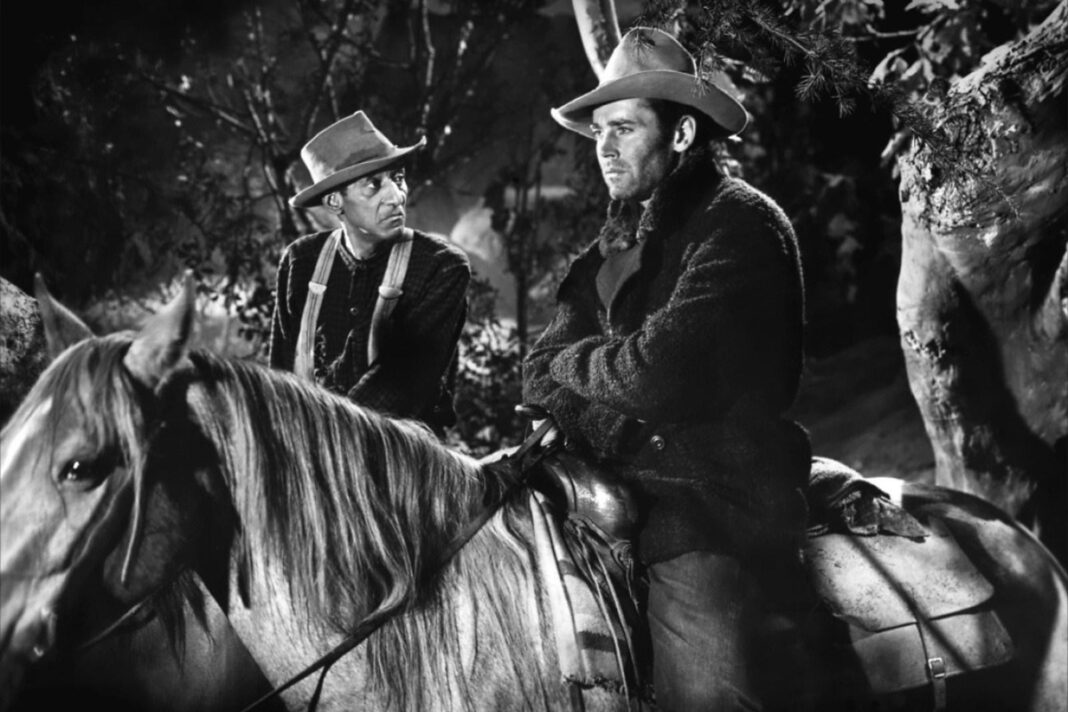
At a particularly lyrical moment in the film, Sparks brings his horse a little closer to Gil’s in the cold night and laments their sorry business. Spurning the offer of whiskey, as they wonder whether God is displeased or merely disinterested in the events at hand Sparks borrows a line from Shakespeare and says ‘He mocks the sparrow’s fall’. It is here that Sparks recalls the lynching of his brother, noting that that the perpetrators were never found. Gil can muster no response to that but takes a couple of shots of whiskey himself, saying that the liquor ‘feels like fire creeping the short grass. I guess I’ll just let her spread a little while’.
That’s a fine description of several phenomena which serve to define the events of the film. If anger and revenge seem like explosive impulses, they are fuelled by the slower-burning desire which grows in all of us for some kind of tangible justice. Viewing the slow-moving and arcane court process with contempt, it is that desire as much as anger or self-preservation which compels the townspeople to almost uniformly join the posse. And once lit that fire can quickly spread out of all control, with everything in its twisting path going up in flames.
Yet pangs of conscience are also like kindling as they grow from small lights to become all consuming or else continue to just sit there, flickering steadily away. One of the most compelling scenes in The Ox-Bow Incident occurs when the posse has apprehended the three men and condemned them to a hanging. Led by Sparks and Davies, several men peel themselves off from the main group and bundle together to cast their vote for court justice, believing that the men should be returned to town and afforded a proper trial. Set to cooing voices, the cherubic weeping of strings and then more portentous orchestrations Gil and Art swap sides and the young Gerald Tetley finally stands against his father.
But it is not quite a domino effect. As the accused Donald Martin – who claims to have two young children and denies rustling cattle, saying that he bought them legitimately and now awaits the bill of sale – looks on with perhaps scant hope but a sense of affinity and dignity pooling in his eyes, the director William A. Wellman and cinematographer Arthur C. Miller snuff out this small flame by panning across the Bruegelesque faces of their steadfast opponents, who outnumber the advocates by a score of several to one.
If the narrative then is lean and neatly styled, maintaining its focus between extended framing sequences and linking their sentiments by way of ‘Red River Valley’ as a musical theme, on the other hand some of the same impetus makes The Ox-Bow Incident feel bustling or jostling and compact. The film was shot mostly on backlots and soundstages at Twentieth Century Fox, with publicity at the time suggesting that the Ox-Bow pass setting was the largest ever constructed by the studio, but especially by the standards of later Westerns (like John Ford’s epics which stretched across Monument Valley) it feels a little hemmed-in. The posse mass beneath the hanging branch of a tree as they descend into the pass and always appears to be standing at close quarters. Their supposedly lengthy journeys between town and the pass seem short and uneventful or are elided completely.
In many ways The Ox-Bow Incident is a decidedly modern feature for its narrative leanness and the way in which it delves into the psychology not only of a few protagonists but of the group. Today it is regarded as one of the first psychological Westerns, a concept that would bleed into the later revisionist genre (a bleed exemplified by High Noon). Yet the apparent use of soundstages dates the film as does the sheer profusion of its characters, an almost comic assemblage of types.
There’s the righteous sheriff and his crude deputy, an honourable if highfalutin judge, the frail but virtuous merchant, a plainspoken barkeep, a self-aggrandising major and his timid or emasculated son, feisty young bucks, a crew of roughs and drunks, a tough matriarch who seems to show more constancy and self-reliance than many of the men in the posse, a conscientious black man with self-assurance and a knack for spirituals, a wily but intelligent and suave Mexican and the apparently virtuous condemned man. The main character in the film – more by billing than his centrality to the events – is a drifter who is nagged at by those pangs of conscience rather than someone who is guided by a clear sense of duty or right and he duly has a close friend and a love interest who is already in the wind.
In a revisionist film from a decade or two later many of these types would be compressed into just a few characters, each with their own psychological complexity. But what you lose there is the sense of clamour and sprawl, the complexity or intractability of many voices, the sense of a tug of war in the lively marketplace. The abundance of faces in The Ox-Bow Incident is crucial for its depiction of group dynamics and communal violence, where shared upset and apparent consensus can sweep up notions of truth and justice and carry the majority astray. In the end however even where common spaces remain each person must sit with the light of their conscience, whether it whips and buffets in the dark or strengthens to become a hot blue flame.
Like say High Noon or other formally spare moral fables in the manner of Bad Day at Black Rock or 12 Angry Men, this standup film The Ox-Bow Incident makes great use of a short runtime as it gets things done in just 75 minutes. Some of the staging and some of the supporting performances can seem a little blocky, at least as the viewer grows accustomed to the film.
But the excellent Fonda is boyish and restless, impulsive without being altogether rash, communicating a restive flickering probing through his eyes. The renowned character actor Harry Davenport gives an impassioned performance as Davies while Anthony Quinn is captivating as Juan and Dana Andrews – who is here the spitting image of Harry Styles, only with more charm to his demeanour – as Martin embodies that inner turmoil while breathing an air of realism into the film. Leigh Whipper as Sparks delivers a portrayal that might linger in one’s memory. That’s because of his calm and equipoise, not showing any of the usual skittishness in a film that never even in the eyes of others treats him solely as a figure of fun, and because of the two spirituals he sings at apposite moments, ‘Great Camp Meeting in the Promised Land’ and ‘Lonesome Valley’, gently chiding and hardly conciliatory but touching and pious enough to bring a lump to the collective throat.