


I first came across the music of the bass clarinetist Jeff Anderle several years ago owing to his ensembles Splinter Reeds, a west coast reed quintet which focuses on contemporary composition, and Sqwonk, a San Francisco-based bass clarinet duo which remains rooted in the classical tradition while drawing upon everything from free improvisation to heavy metal to klezmer, the blues and folk. In particular I was captivated by Dark Currents, the third full-length by the Splinter Reeds quintet, and its cascading opening piece Tall Grass which was written especially for the ensemble by the acclaimed composer and Bang on a Can co-founder Michael Gordon.
Anderle continues to embody his own diverse interests. His solo album Branching Patterns evinced a taste for electroacoustic experimentation and the kind of looping or iterative beatmaking which might find its way into minimalist contexts or popular music in the vein of electronica and indie folk, while his old band Edmund Welles was a unique compositional outfit comprised of four bass clarinetists, whose style was described as ‘heavy chamber music’ for the way in which they welded together aspects of classical precision and jazz interplay within the context of a thick and driving heavy metal sound. He builds his own ultra-long bass clarinets out of PVC pipe and has collaborated with such musicians as Catherine Lamb, Theresa Wong, George Cory Todd and Oxbow.
Now the bass clarinetist has put together two chamber ensembles in a bid to interpret afresh the work of the esteemed post-minimalist composer Marc Mellits. Anderle has engaged with Mellits before, with the composer writing the eight short movements of Splinter for the then newly formed Splinter Reeds quintet in 2014, a piece which subsequently opened Got Stung their debut album. Mellits for his part is perfectly adept at slotting together the shifting rhythms and motifs of Reichian minimalism but his styling feels more dramatic and colourful and perhaps in a way more lived-in, with flourishes of rock and funk helping to make him one of the most performed and recorded of the post-minimalists. He can emphasise a wide range of instruments and his music sounds like it would be fun to play.
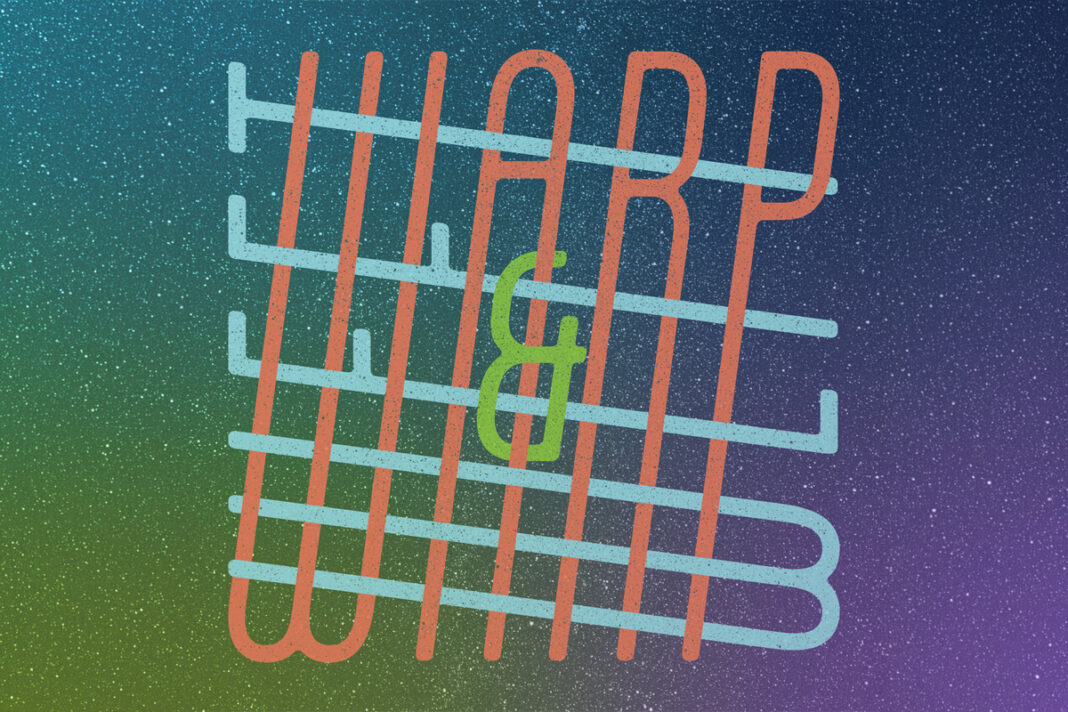
Mellits wrote Tight Sweater for cello, marimba and piano in 2005 with the composition serving as the title piece for an album of his music by the Real Quiet ensemble the following year. Tugging on this musical thread Warp & Weft opens with a take on Tight Sweater where Anderle takes the low end on his bass clarinet and is joined by Haruka Fujii on the marimba and Kate Campbell on the piano.
Its six movements are certainly supple rhythmically and snug in terms of the relations between the instruments but the piece also has a rapier quality, cleaving the air in a way that is lively or keen. In the opening moments of part one ‘Exposed Zipper’ a dashing marimba figure is cradled lightly by the piano before the bass clarinet comes in almost as a percussive texture, chopping into the propulsive and headlong rhythm.
As it begins to cleave more closely to those wooden bars and keys, we get a sense of directional unity with gradations of character and temperament, as though each of the parts were moving towards the same ultimate destination but through different climates or atmospheres or with differing mindsets. In the notes to Warp & Weft the movement is described as a ‘motoric, interlocking figure’ and it does call to mind the somehow liminal or enigmatic and open-ended aspect of ‘Europe Endless’ and the title from Kraftwerk’s totem Trans-Europe Express.
On the second part ‘Trans Fatty Acid’s Rain’ the bass clarinet waddles rhythmically against the pulse and shimmy of the piano and the ice skater’s glide of the marimba. The cadence fades in and out of focus with the keys and percussion playing moto perpetuo or in perpetual motion, in a way that indeed reminds me of A Charlie Brown Christmas and its jazz score by Vince Guaraldi, especially say the song ‘Linus and Lucy’ with its boogie-woogie ostinato and brushwork all over the snare.
But on the other hand ‘Mara’s Lullaby’ is tender and spare, or even a touch portentous with its repeating piano figure and wispy clarinet. As the music progresses the alternating eighth note pattern from the piano grows livelier and the bass clarinet seems imbued with more plaintive and pastoral airs, the outward sweep of the single-reed instrument juxtaposing with the inwardness or circuitousness of the keys until the movement finally recedes into the corners or the curtains of the room.
‘Pickle Trousers’ opens like a frantic march with martial overtones, stiff and overbearing even as the gathered instruments careen or teeter bow-legged across the screen. Briefly the movement becomes courtly and genteel, until an incessant piano figure and more strident tones from the clarinet add a sense of urgency and even tumult, an imperative roiled from underneath. The toy soldier levity of the close eases us into the drama of ‘Evil Yellow Penguin’, which is introduced through the limpid dynamism of the marimba then accompanied by the piano and some belches or bellows from the bass. There is a dark gravity to this movement that still befits the comic title, like skidding out over the Arctic under aurora borealis and that thin blanket of night.
‘Mechanically Separated Chicken Parts’ maintains the drama through warmer climes, once again opened by the excellent Fujii on the marimba with the percussion and the clarinet playing off against one another like foiled counterparts. At times when the rhythm stabilises and that swampy low end is joined by a driving piano – say just after the two-minute mark – the music approaches a rag or reminds me of the fiery Nina Simone civil rights classic ‘Mississippi Goddam’. Yet the movement, which sees out Tight Sweater, never stays in one place for too long, maintaining the impetuous energy while subtly shifting its pattern over and again in the second half.
It is of course the bass which provides jazz with much of its elasticity, a quality which both Mellits as a composer and Anderle as a performer possess in buckets and spades. The notes for Warp & Weft suggest that while Mellits readily creates such repetitious or iterative motifs as would be at home in a Steve Reich composition, in his hands such phrases ‘become elastic, stretching and compressing like putty’ which is to say that we as listeners are to Mellits the composer ‘just like putty in the hands of a boy like you’.
His piece Titan was put together in 2018 for bass clarinet, two violins, a viola and a cello. Drawing liberally from the features of Saturn and its largest moon, he describes the role of the bass clarinet in the composition as one of an anchor or indeed of a ‘titan’ in its own right, circled by a retinue of hazy and golden rings. The presence of liquid hydrocarbons in the atmosphere of Titan creates surface features markedly similar to those on Earth including a network of seas, rivers and lakes plus attendant cycles of rain. Mellits finds a musical echo in these circulations of the weather and names several of the movements on Titan after related phenomena, sensing a kind of joy in the shared features and hidden potentialities of the moon despite its frigid terrain.
Anderle calls upon the Friction Quartet to aid his bass clarinet in depicting all of this extraterrestrial vapour with the quartet featuring Otis Harriel and Kevin Rogers on violins, Mitso Floor on the viola and Doug Machiz on cello. With its squelchy three-note motif and arco strings, ‘Saturn’ the opening movement has a suspended verticality and also something of a vertiginous quality as the bowing gathers pace, the musicians shifting between détaché strokes and brief legato passages.
Summoning the first of Titan’s numerous lakes, on ‘Vänern Kivu Hammer’ the strings of the Friction Quartet steadily emerge from behind Anderle’s bass, with a fleeting pastoral interlude sandwiched between sections of heightened drama, while the stately but languorous ‘Harada’ has a sighing character which conjures the breathy tenderness and gently surging sentiment of Wagner’s symphonic poem the Siegfried Idyll. On this lovely rendition of the movement Anderle’s bass clarinet carries just that little bit of fuzz before fading to a sombre close.
Swelling fiddles open ‘Hyperion Choroid’ before the bass clarinet jumps in to suggest the climax to a television gameshow or a silver screen portrayal of the space race. As baroque strings throng and recede the bass provides a pointillist counterpoint, enough to keep the Friction Quartet tethered but providing a bit of bounce for some spirited forays before everyone returns in the gilded afterglow of evening to settle down at home base.
‘Liquid Methane Rain’ is more downcast, its groaning harmonies giving way to more placid clearings where pizzicato cello plucks against the low end of the bass. There is a sense of recuperation here which seems to revive or outlast the languid or the enervated or downbeat. Then with ‘Dispersed Retina’ we are off to the races led out by the clarinet, a lively romp through the gaseous terrain until limpid pizzicato strings suggest hidden labyrinths and deft patterns made up of geometric shapes.
‘Velvet Kickbox Hydroxy’ sounds like a redux of some of the swinging clarinet themes we have heard previously on both Titan and Tight Sweater, a thick groove whose cleaving meter and lurching undertow is now held aloft by gossamer strings before Warp & Weft dashes to an endpoint with typical wit and verve and grace, offering up one last delight through the sashaying ‘Phoebe & Janus’ as Anderle issues honks of approval from the upturned bell of his bass.