


The first image wrought by Alex Zhang Hungtai’s new double album Orion/Mother is of somebody blaring away on their horn from the shrunken corner of a forge or foundry. You can almost feel the heat and see the contrast of those glowing billets or molten liquids – in their brilliant whites or burning oranges and dulling reds – with the cool blue of the trumpeteer who issues a lonesome cry amid the shunting and the clanging of iron and steel.
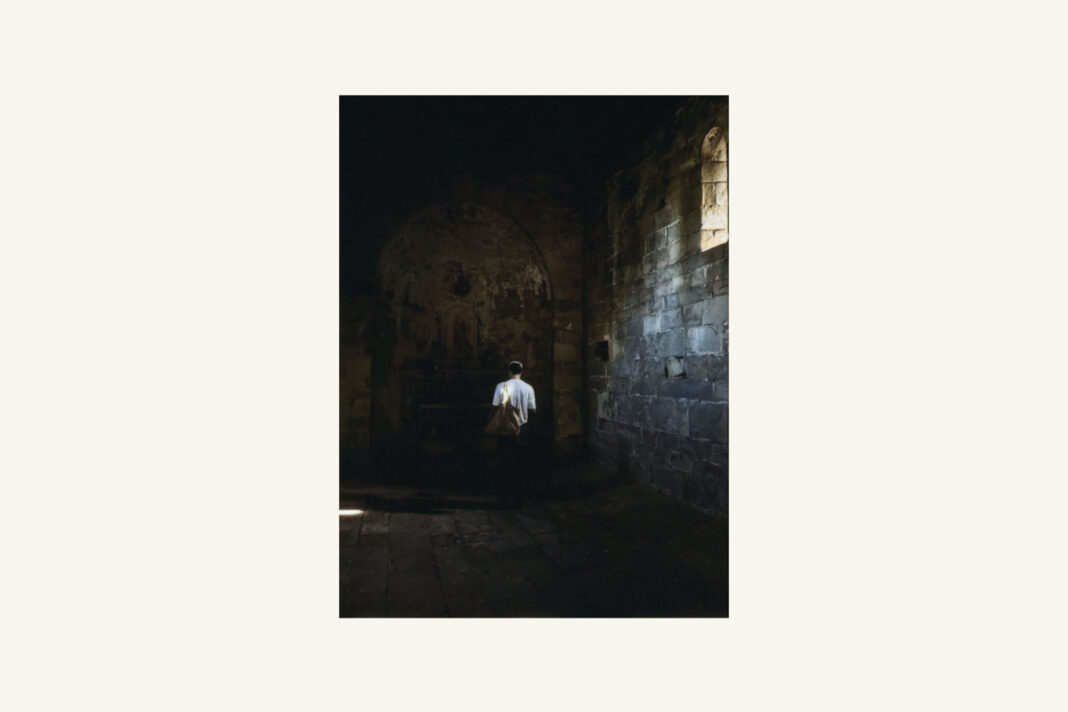
Those were the images and almost tangible textures and temperatures which sparked in my mind over the first three tracks – ‘Sidewinder’, ‘Nataraja’ and ‘Shadow Integration’ – before I had taken the time to glance at the album cover. That cover photograph, framed by a thick white border, shows the artist in some kind of dank cloisters or other monastic setting, in a white T-shirt with a tan messenger bag, head slightly bowed and facing the wall.
It’s an image which solidifies those first impressions while offering a pensive juxtaposition to some of the noise and industry of the record. In fact Orion/Mother is a manifestation of that kind of contrast or synthesis in so far as it appears to capture something highly personal and in a way both meditative and turbulent or recalcitrant while also inhabiting more of a collaborative process, or at least gesturing towards the spirit and some of the remnants of collaboration.
Zhang hunkered down at a rehearsal space in the middle of a long New York winter and began to repurpose some old material, improvising on his trumpet over chopped samples from rehearsal sessions he had made years earlier with a group of leading New York improvisers, a group that included the flautist Laura Cocks, clarinetist Madison Greenstone and cellist Lester St. Louis, the multi-instrumentalist Che Chen who here played percussion and the Korean gong experimentalist Leo Chang, the noise artist Kwami Winfield and last but not least the tap dancer Melissa Almaguer.
That’s a heady collection of artists and mediums. Cocks released her stirring solo album FATHM last year on Out Of Your Head Records and Relative Pitch with Greenstone collaborating with Sarah Hennies, Nate Wooley and Horse Lords following her own similarly-minded clarinet expression Resonance Studies in Ecstatic Consciousness. The cellist St. Louis has meanwhile been part of jaimie branch’s beloved Fly or Die ensemble, Amirtha Kidambi’s Elder Ones, the poemsong trio sinonó and the quartet Wrens and has held sessions with the likes of Jerome Deupree, Sylvie Courvoisier and Nicole Glover.
Che Chen has performed in various guises in numerous duets but is probably best known as the guitarist for 75 Dollar Bill. While the experimental practise of Leo Chang involves the broader electrification of traditional Korean genres and instruments his speciality lies in the amplification of gongs, adding transducers and resonating the percussion instruments by means of his voice, microphone feedback and other processed audio inputs. Kwami Winfield’s indiscriminate palette takes in everything from the trumpet to recycled trash but from these old rehearsal sessions they are credited specifically with electronics and circuit bending.
And the presence of Melissa Almaguer elaborates a history of entwinement between tap dancing and recorded music, a legacy which stretches back to Bill Robinson, John W. Bubbles and the Nicholas Brothers and takes in Savion Glover whose footsteps featured on tracks by Prince, Abbey Lincoln and Talib Kweli, with the album Gol Variations offering another twist on the tradition, as the dancer Janne Eraker united with the fiddle player Vegar Vårdal and bassist Roger Arntzen for an album released under the monicker One Small Step in late 2022 on Clean Feed.
Yet it is Zhang who really comes into his own on Orion/Mother as the Taiwanese-Canadian musician who once went by Dirty Beaches swings another turn in the long journey which has taken him from early sample-based productions through freeform assemblages to the compressed or refracted quality of some of his latest work. Gauzy ambiances and scuzzy rock gestures with a taste for the cinematic or carnivalesque have given way to piano quietude, lurching nocturnes and the charged introspection of his entanglements with the horn.
A prevailing sense of fracture or displacement vies with his own wilfulness and chance-taking. Most recently he duetted with Tashi Dorji on the live album Where There Is No Bridge You Build Your Own from Roulette Intermedium and released Dras on the prestigious Shelter Press, an album of droning and digitally processed saxophone which glints menacingly but succours the spirit and was culled by Zhang from recordings he made inside of Saint Joseph’s Oratory in Montreal.
Sometimes on Orion/Mother a faint music hall melody or the street airs of an organ grinder seem to bleed through the walls, as on the title piece ‘Orion’ a track otherwise made up of what would seem to me to be air sounds, those of breath pushing drily through wind or brass. Yet the album notes – which divide the record neatly into two halves, the first five tracks from ‘Sidewinder’ to ‘Tannhäuser Gate’ comprising Orion and the next five from ‘Kali’ to ‘Tuğçe’ concluding Mother – indicate that ‘Orion’ is a trio performance consisting of no wind instrument but the recordings and improvisations of Kwami Winfield via electronics and circuit bending with Melissa Almaguer tap dancing and Zhang himself utilising Ableton and a drum machine.
The result anyway beyond those vaporous traces of melody is one of squeaking and shunting sounds, as though furniture was being humped and dragged across the floor, with barrages of percussion buffeting the listener and barreling through the space of the recording much in the manner of air blown roughly through a woodwind or brass instrument, short puffs and hollow gusts which almost cohere as a whistle before ‘Orion’ draws to a close.
This all occurs amid much general clatter and is presumably the effect of the tap dancer Almaguer in combination with the assorted electronics, with ‘Orion’ therefore fascinatingly going to show how Zhang’s process blurs the usual distinctions and delineations of collaboration and materiality for the sake of textures which might be confrontational but are certainly knotty and gnarled.
Elsewhere the percussive effects, electronic treatments and use of extended techniques on winds and brass suggest trains chugging down old tracks but in a kind of inverted or upside down fashion, a parallel world as we remain confined to our metalworks, less Stranger Things than an inversion of Eraserhead where we inhabit the room of the man with the levers and share in what we can of his murky planetary purview.
‘Tannhäuser Gate’ writhes and squirms like electric discharge against the gaping blackness of the surrounds, a maw that might consume as much as it spits out. The title offers another frame of reference for the album and posits ‘Orion’ too within the dystopian realm of the film Blade Runner, drawing upon the iconic ‘tears in rain’ monologue where the actor Rutger Hauer as the replicant leader Roy Batty utters these glimmering last words before death:
I’ve seen things you people wouldn’t believe. Attack ships on fire off the shoulder of Orion. I watched C-beams glitter in the dark near the Tannhäuser Gate. All those moments will be lost in time, like tears in rain. Time to die.
Yet as the solo piece ‘Tannhäuser Gate’ cedes to ‘Kali’ and the Mother side of the album, the atmosphere shifts somewhat. Instead of a sense of metallurgy or of being at the whim of some artisanal demiurge, a liturgical solemnity begins to vie with a more overt eeriness and queasiness redolent now of the funhouse. The long ‘Kali’ features the trio of Cocks on the flute, Greenstone on the clarinet and Zhang on his alto saxophone from those old rehearsal sessions with Zhang triggering the samples and extemporising over them on the trumpet.
The woozy melodies and keening drones that result sound at times like they might emerge from a Wurlitzer or accordion. Harrowing may be too strong but there is something in that vein about ‘Kali’ even as it features some of the most melodic passages on all of Orion/Mother. Those melodies billow like the waves on dark and choppy seas and the drones surge as though from the horn of a stranded ship. Some circular breathing seems to emanate from the winds and as ‘Kali’ progresses it becomes more of a shanty even as sung finally by a cacophony of sea creatures, with wailing selkies and the growls, rasps and whistles of dolphins and seals, sea lions and walruses congealing or crying out as Zhang skirts or clads the motley congregation in shrugging bells.
It is distinctive stuff from an artist playing on the margins of jazz and sounds like nothing other than perhaps some of the solo experiments of Rob Mazurek. The second title track ‘Mother’ features shrouded vocals from Zhang and rhythms which tend in a traditional African direction, as Lester St. Louis wields his cello to sound like a djembe drum and even at times a mbira or ngoni. ‘Mother’ is a shamanistic array of voice with coiled winds and strings while ‘Earth Orbit’ sets a thick electronic atmosphere in the foreground of some forlorn and distant cries from the trumpet. While the title suggests a daring mission of great velocity, down below dense, towering cumulonimbus clouds begin to bear generative thunderheads.
A shimmer of cymbals and the squeal of electronics and trumpet present a different sort of air pressure on ‘American Burial’. The bugle call Taps and an aerial salute in the missing man formation signal that a military funeral of some standing is taking place. Many-gun salutes come later as the rite begins to feel and sound more ominous, with rain falling in sheets and the whole edifice which is this supposedly ennobling occasion now creaking and collapsing into itself.
Then on the climax ‘Tuğçe’ the spatter of rain and crackles of thunder are still present but they sound farther off as a clarion rings out, a vaulting and crystalline and impervious peal of brassily high-pitched brightness. The rain peters out and the landscape dries off and the prevailing texture becomes more gravelly. Maybe our furtive or genuflecting artisan has turned into a surveyor, inspecting the damage or peeking out in their poncho to batten down the hatches for another onslaught as Zhang through it all prevails, just a wind out there blowing someplace.