


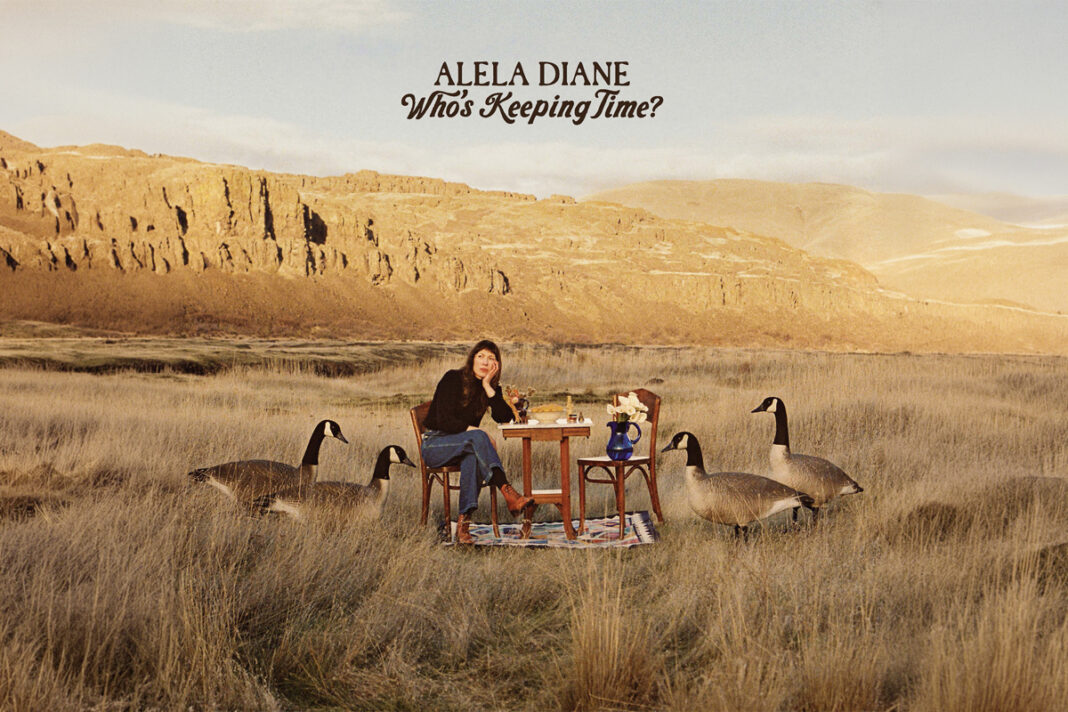
Alela Diane’s new album Who’s Keeping Time? finds the singer-songwriter and her ample band moving with a newfound sense of vigour and confidence. Hearty and headstrong, her music possesses a brisk or firm stomp and also swoons easily.
Growing up in her own words among the ‘winding rivers and golden hillsides’ of Nevada City, on the western slopes of the Sierra Nevada in northern California, the fledgeling folk singer moved to San Francisco at the age of nineteen and for a couple of decades now has been based in Portland. The opening song on Who’s Keeping Time? finds her homeward bound as over rambling guitar lines, wistful accents and slapping drums she offers an evocative summation of what she passes by down the road.
‘Golden hills / Along the highway / Quiet yearning / Marigold’ she begins, singing with a glistening liquidity and limpid clarity, ‘Muted memory / Dancing pictures / California, I’ve returned’. It turns out to be a brief visit as she stumbles over half-remembered faces and dwells upon the people she left behind. No sooner had we started out than we are on the backend of the circuit, as from the gilded butteriness of the opening verse we now find ourselves in starker terms looking out over a ‘Winding river / Headlights blinding / In the blackness / Before dawn / I summon angels / On the backroads / California, I am gone’.
If home is where the hearth is, it was back in Portland that Diane began to put together a stonking lineup as she sought out some of her fellow musicians and joined paths with others by chance. One spur was a tribute concert for her dear friend Michael Hurley, the outsider folk icon and longtime Oregon denizen whose death last year at the age of 83 prompted fond odes from the pens of such artists as Kassi Valazza and Jolie Holland plus no doubt many more.
After a conversation with a florist on the verdancy of the season, Diane wrote ‘Spring Is a Fine Time’ in memory of Hurley who appears via a voice recording in the first few moments of the song, praising Diane for a great show before broaching the mysteries of the wild west. Another confluence was the growth of her daughters, no longer waking her in the night and now at an age to allow Diane too to explore.
Working with the producer and instrumentalist Sam Weber, the group of musicians Diane wound up putting together for Who’s Keeping Time? includes Danny Austin-Manning on drums and percussion, Sebastian Owens on the upright bass and less conventional but always alluring bass clarinet and Weber himself on guitars, piano and Mellotron with a wider circle providing further textures and accents. Kati Claborn contributed clarinet, banjo and dulcimer plus backing vocals, Peter Lalish added more guitar, Luke Ydstie played the high-strung guitar plus lap steel and Wurlitzer while additional backing vocals came courtesy of her fellow Portland songwriters AC Sapphire and Anna Tivel.
The core band cosied up in the attic of Diane’s old Victorian home, a writing space turned makeshift recording studio, hauling their gear up three flights of stairs where surrounded by skylights and antique quilts, old dolls and photographs, sound baffles and the purring of Diane’s cat Maggie they managed to put down as many as fifteen songs in just a handful of days. Within ten days the record was complete, with Weber and Lalish finishing up the mixing and post-production.
Musically this robust collective remains well rooted in the tradition. Many of the songs inhabit that swaying or head-nodding boom chick pattern. Here alternating bass notes or the kicks of a bass drum serve to emphasise the strong beats 1 and 3 of the bar while chord strums in the treble strings or snare hits provide a kind of secondary stress on the weak beats or backbeats. What results is a kind of rocking motion or pendular rhythm. Sometimes instead of a simple strum in the treble strings, bass notes on the strong beats may be accompanied by more of a continuous rhythm in the treble. And sometimes the pattern can hew closer to the Carter scratch whereby a melody, which might be haunting or spare, is maintained by the bass strings while the treble strings are strummed with rhythmic energy.
On Who’s Keeping Time? the tandem of Owens on bass and Austin-Manning on drums works to really tie down that rhythmic pattern. They allow the guitars and occasionally also the banjo to assume more of a noodling, rambling and open-ended character, as thrumming or pendent or even slightly circuitous but anyway continuous figures fill the spaces between bass notes or a thumping mother heartbeat. That juxtaposition of determinacy and drift is accentuated by a rich palette of other instruments, which includes warm and homespun but at times somewhat portentous whistling, fine airs from the clarinet and bass clarinet, the woozy and keening swells and bends of the Mellotron and Wurlitzer and lap steel plus some emphatic or supportive accompaniment from the piano.
In sum the stellar ensemble of Who’s Keeping Time? possess a strong sense of swing as they populate that terrain somewhere in the vicinity of folk and bluegrass and classic Americana. Some of the bandleader Diane’s first billings were alongside Joanna Newsom, another Nevada County native, while between her solo albums About Farewell and Cusp she duetted with the frequent Newsom collaborator Ryan Francesconi. But here as she opts for a fuller sound, among contemporaries Diane sits closer to the likes of Valazza and Holland for their perceptive take on old forms, the latter especially as her whistling adds a cooing spectrality to that redolent opener ‘California’.
Diane has a sterling country voice, with just a trace of a lilt or drawl though every word is clearly enunciated and she can go from bold and brassy or even somewhat foreboding to tempered, soft and plaintive over the course of a single line. That’s the case on ‘In My Own Time’ which shifts between stately leisure and a certain forlornness as the singer makes space for herself and treats time like a spendthrift. The song has a distinctive old-school sensibility, the subject acting and observing, passive and receptive or taking charge and making mend, with a fine-fettled violin solo helping to fix the placid but longing atmosphere.
‘Dusty Roses’ is another standout, with a bit of twang or skronk from one of the guitars cragging up against the noodling pensive rhythm. Once again Diane conjures a sense of ceaseless monotony and perpetual yearning, weaving it all together through an unbroken musical thread.
Then on ‘Could Be’ the vibe is slinky and shrugging, tender and moonlit by that little sliver of silver that shimmers through a diaphanous curtain after slanting down through the window pane. She tries on numerous guises – from mother to lover, the blue depths to the starriest of nights, guiding lighthouse to sloshing waves – and asks someone to ‘Hold me without warning / Love me like the morning’ anyway as she draws out those verbs with a mixture of languorousness and desire.
The Michael Hurley tribute ‘Spring is a Fine Time’ carries a folksy sway with more whistling from the bandleader, a real head-nodder that also features the wading and waddling sounds of the bass clarinet. And the interplay of deft fingerpicked guitar with the fraying strums of the banjo on ‘Wide Open Spaces’ suggests precisely that.
The song is a real heart-churner, with a graceful fingerpicked opening before the shuffling drum beat comes in. It is a kind of ode to Diane’s brother that fixes shared moments with fondness, recognises differences and is even wary of a certain distance or estrangement while at the same time proving conciliatory in its own gentle way.
‘He works hard / Fixing small town cars / Could always take a thing apart, and / Put it back together perfect’ she sings in a lovely flowing tone, with the words and lines straying over the bars of the beat, offering then an irony and a question as she continues ‘Came out older / Three years younger / We share our humor / But couldn’t be more different / Brother, could we?’
‘We both love wide open spaces / We both love wide open spaces / And that’s enough’ repeats the wide spanning vista of the chorus. In fact whereas the verse captures the intimacy of Diane’s sentiment, in tone and phrasing the chorus flattens it out a little into the sheer vastness of all that surrounds. Guitar distortions after the second verse might emphasise some of the friction and vitality of the relationship and there is some decaying fiddle too as Diane offers a final evocation, of she and her brother as children ‘fighting in the backseat’ until her mother orders them out of the car for the long walk home.
Diane’s vocals are accompanied on the chorus with ‘Wide Open Spaces’ one of the several tracks on Who’s Keeping Time? which holds on to that swaying boom chick emphasis. ‘Piss, Coffee, Blood or Wine?’ serves as a change of pace, less the question proffered by the title than a diagnosis of the state of the nation which finds it to be full of bile or taking the proverbial yellowish waste. And on ‘To Be Kind’ the author writes from the perspective of a mother to her dark storm cloud of a child, a slow dance, a lamplight song and a soft velvety entreaty which stresses firmly amid a fit of pique ‘I need you to be kind to me’.
Then the penultimate track ‘Fragile as a Flame’ resides in a caring vocal, with some lofty pitches and a kind of soft-padding manner that reminds me a little of Beach House. Instead of a series of snapshots it is one of those songs that distills discrete or everyday moments into ample feelings, deeply cherished but which only something like music can sustain.
Addressed to a person and the changes which flicker and pass like seasons ‘in me and in you’, Diane appears to summon or share a certain sympathy with a murder of crows, who caw and circle the sky like they are holding onto a grudge, and sits ‘At the kitchen table / Braiding your hair / Watching the window at sunrise again’.
An orchestral sweep of strings prefigures the last verse, in which Diane stretches out lovingly that ‘echo of laughter’ before a final whisper carries us into an ‘Endless Waltz’ both bittersweet and soft-laced. The album closer is described as a love letter to Diane’s grandparents and while it captures something of an enduring love and a life well spent, over a bassy undertow and brushed cymbals with accompaniment from the piano and lap steel the sentiment is curious, mixing together an almost Stygian or Orphean descent into the underworld with the sweetly gilded taste of drifting off into an endless sunset.