


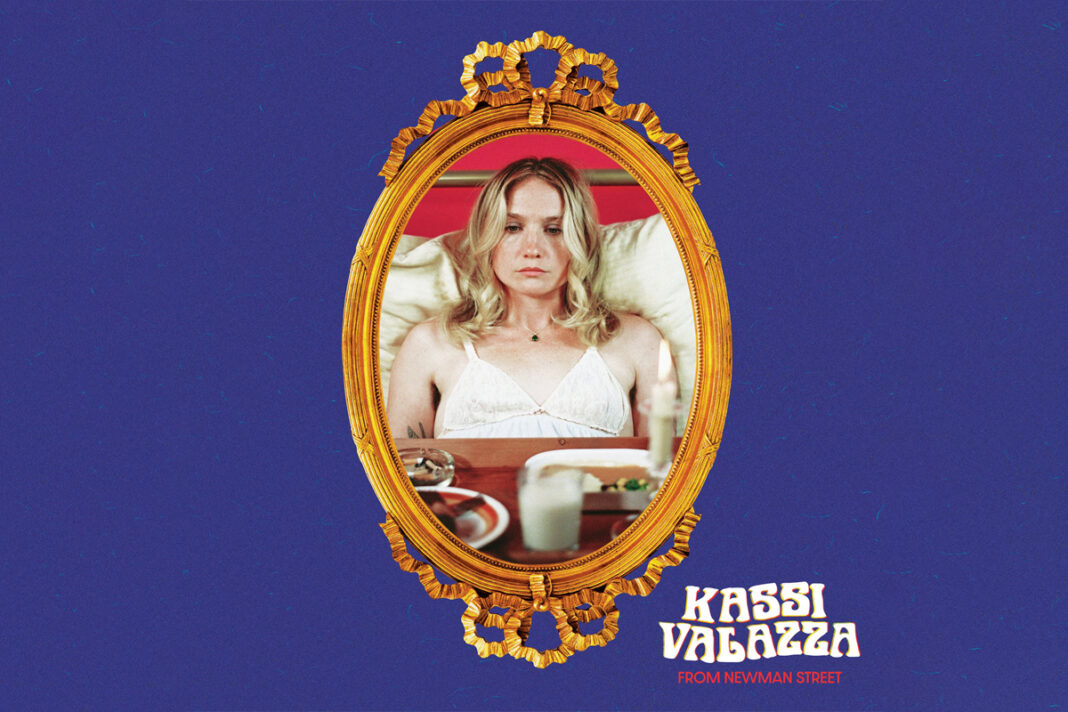
With a full band behind her Kassi Valazza still manages to sound solitary and spare on her stunning new album From Newman Street. There is a sense of clarity and perspicacity to her singing and songwriting even as she seems no less than any of us susceptible to the keening and relentless churn of the surrounding world. Her purview might contain all kinds of stresses and portents but the defining image is of someone capable of weathering the storm and standing on their own two feet.
Still she has ample support on From Newman Street as over the brisk course of its ten tracks Lewi Longmire plays guitars and fiddle, Erik Clampitt glides and plucks at the pedal steel, Sydney Nash plays bass and acoustic guitars plus vibes and organ, Tobias Berblinger orchestrates a woozy Rhodes and Mellotron and Ned Folkerth maintains a steady beat on percussion with backing vocals courtesy of Casey Jane Reece-Kaigler and Camille Wind Weatherford of the Lostines.
Valazza – who sings while alternating between the standard acoustic and twelve-string guitar – also has the capacity to conjure a wide swathe of country and folk music. Sandy Denny and Fairport Convention are frequent sites of comparison, with Denny’s classic song ‘Who Knows Where the Time Goes?’ a touchstone for its fleeing birds and existential disavowal of keeping count. Valazza also shares a certain tonality with Karen Dalton but without the drawling Oklahoma languorousness, some of the bristling quality of early Bob Dylan and both the canniness and chromaticism of Joni Mitchell allied with Vashti Bunyan’s gemstone naturalism or pollen-like drift.
There is even something of contemporary artists like Jolie Holland when it comes to the idiosyncrasies of her lyrics and phrasing and for the way she seems to emerge from within the tradition as something entirely modern or new, like a bathysphere bobbing on the choppy surface of an ocean or a lone tree in the middle of a forest clear. Her voice is so crisp and bracing that by a logic of opposites it can almost sound on the cusp of being fractured or brittle, her words clearly articulated while their tones and inflections carry hints of heartache and anxiety and doubt. Indeed at times it can seem as though Valazza is almost chiding her audience by virtue of her scrupulousness, while she summons the sixties idyll of Laurel Canyon but exposes the soupy undertow which always tugged and flowed from beneath.
From Newman Street comes barrelling out of the gates with a determined and headstrong albeit restless force of momentum. ‘Better Highways’ carries a certain portent, the sense of being outcast if not quite from life’s feast then from the major thoroughfares and cultivated graces of polite society in the direction of something more nebulous and untrammelled. Rhythm guitar, a throbbing bass and percussion which steadily incorporates shakers combine to create a chugging propulsion with bent accents from the keys and pedal steel as Valazza strides the periphery, an exile on main street.
‘I was born to better highways / Calling cards and busy streets / Betting on the ancient markings / Where the rich and wealthy meet’ she begins, as if to conjure a lapsed age and old forms of soothsaying, taking a higher pitch as the second verse provides the juxtaposition, ‘Now I watch the sun move sideways / Sleeping on my cotton sheets / Listening to the wild honking / Of the sulking winter geese’.
She has called these her Michael Hurley lines after the outsider folk icon, whose ‘Wildgeeses’ she covered at the close of Kassi Valazza Knows Nothing and who she toured and collaborated with prior to his death last month at the age of 83. Suggesting her own penchant for blurring the line as an apparently conscientious or writerly approach to composition vies with a desire for the rugged and defiant and carefree, she portrays herself waiting by her window, ‘singing like a person talking / Careless words with careless means’.
‘Better Highways’ then is a song about change and vacillation in so far as uncertainty may be one with a person’s nature or even with the course of life itself. Wherever constancy is ascertained, ‘Death will remind you’ so the song repeats.
And if the wafting coda hints that romance may be the theme, still ‘Better Highways’ is one of those songs that seems to entail a kind of doubling or dubious shifts of perspective, with the verse ‘I was born to see things my way / You were wild, but never free / Spending all your late nights choking / Down the urge you had to speak’ seeming to switch from immediate self-reflection to a second-person address whereas in fact Valazza may be turning over the ways in which she speaks to herself. ‘Remembering how it was / When you fell in love’ then could just as easily be taken to refer to a moment of worldly rapture as to an old relationship or romantic fling.
‘Birds Fly’ makes chirping and swallowing bird song out of the shifting pitches of the pedal steel before Valazza delivers a drowsy, fentanyl-laced blues while the pedal steel guitar and Mellotron combine to lovely glimmering effect on the wistful yet evasive ‘Shadow of Lately’. On the other hand ‘Time Is Round’ seems more settled as the singer far from lamenting her fading dreams of youth declares herself ‘evergreen’ and with a certain fondness recites as a kind of mantra ‘I feel like an old woman these days’. The musical backing steers between Laurel Canyon airs and a Roy Orbison shuffle, that blend of chamber pop with aspects of rockabilly, jump blues and western swing.
In these songs on From Newman Street a fundamental constancy of character rubs up against slippery intentions and the interminable revisions of one’s surrounds. The woozy and languid ‘Roll On’ cedes ground in this regard as the singer moves on from an old flame, with growing conviction and just a touch of tartness as she lightly chides ‘So you put all your lovin’ / Into gifts that you bring / You learn how to sidestep / You’ll learn how to sing’.
Then as we crest the second side of the album, ‘Your Heart’s a Tin Box’ is an upbeat number that manages to compress country fare like Johnny Cash’s celebrated take on the Billy Edd Wheeler and Jerry Leiber tune ‘Jackson’, Joni Mitchell’s environmental anthem ‘Big Yellow Taxi’ with its breezy condemnation of a ‘paved paradise’ and the road song ‘Good Intentions Paving Co.’ from Joanna Newsom’s sprawling triple album Have One on Me into one cheery lament.
For all of the hard miles and disorienting air travel, life on tour doesn’t pay the bills, a move to New Orleans hasn’t solved anything while romance seems too much like a game of you give and they take (even when a partner’s movements in the silky twilight might ‘unfold’ you ‘like a flower’). So in the end Valazza wishes that her heart was more like a tin box, doling out trinkets in lieu of real affection, the artist hunkering in her doorway and gathering up more than she has to give.
‘Small Things’ with its big sad strums and cosmic churn concerns the absurdity of the world and a few promising impressions. ‘Market Street Savior’ maintains the watchful aspect while musically proving more of a psychedelic or sun-flecked stomper. Valazza says that the song was at least partly inspired by San Francisco and it sounds like it.
‘Weight of the Wheel’ the penultimate track and lead single from the album seems to offer a more impish or quizzical vocal over the swoons of the pedal steel, a mucking together of resignation and acceptance. The singer lays a dizzy head down on her pillow, swims beneath the swarming ceiling fan and engages in another form of revealing if not reproachful self-address as she notes ‘You were always the same / Predictable in all your pain / Disguised as poetry it lands / But you’re feeling loathsome, feeling bad’.
Art and songwriting then may serve to create a handy distance without proving a swaddle or salve. But as she and her bandmates return to their shifting chorus – a steady sway framed by the lines ‘It’s feeling like some kind of a fight to let go / It’s the weight of the wheel falling down, or so I’m told / It’s the feeling like some kind of a fight to outgrow / The way I fear slowing down before I’m old’ – Valazza and the ensemble exhale as one piece.
It’s a gilded country tune and the group sound like such a sterling collective here that it only enhances the effect as we turn to the stark and spare ‘From Newman Street’. The title track and album closer feels like an old folk standard remoulded to suit the character and circumstances of the singer, who stares forlornly out of the window as she potters absentmindedly at the kitchen sink.
Valazza performs the track solo, accompanying her voice on the guitar as she asks ‘What do you do when you’re alone’ rhetorically and answers ‘Washing the dishes / Singing the same songs’ in a folding in to routine. There is a stirring sentiment, even expressed through the partition of quotation as she avows ‘”Still my love grows / Still my love grows”‘. Yet loving this person in particular is described by now as an ‘old ache’, tantamount to ‘a soft drumming rising in my sink’ before like a wisp it circles up and drifts right on out the door.
The brevity and the position of the song on the album calls to mind other equally stark and musically unadorned record closers like ‘Slim Slow Slider’ by Van Morrison from Astral Weeks, a song which shares much the same sense of alienation and loneliness, a kind of choppiness or strandedness as the singer looks on, their ardour stifled and their subject at some remove from a world that seems to have slipped unaccountably beyond their grasp.
At the same time it is laden with such emotion and charged with a certain portentousness that may still bode ill or well. The titular Newman Street might be populated with people and places we don’t know but the mere evocation of the locale flaps like a rainbow-coloured ribbon against an otherwise neutral palette. The final verse of the song is a kind of greeting card flung out (almost ‘Boots of Spanish Leather’ style) over the open sea, a wish-you-well which scarcely expects a response as the singer tides herself over and passes sedimentary time, content for the moment just to keep her comportment.