


In February of 1800 the great Prussian explorer Alexander von Humboldt headed inland from the coast of present day Venezuela with his travelling companion, the French botanist Aimé Bonpland. Their quest was to explore the course of the Orinoco River and its tributaries and to solve the long-rumoured question of a connection between the Orinoco and the Amazon.
In fact the Casiquiare Canal – which does link the Orinoco and the Amazon and is one of the world’s few lasting natural river bifurcations, since most of the time split streams rejoin or one channel wins the bulk of the flow while the other soon dries up – had already been discovered decades earlier by a couple of Jesuit missionaries and a Spanish naval officer. But the team of Humboldt and Bonpland confirmed that connection as they followed the canal down into the Rio Negro and mapped the area, studying its flora and fauna while taking stock of the culture as their journey was aided by indigenous groups who interpreted for them the surrounds.
Regarded as one of the pioneering figures in the disciplines of geography and ecology, Humboldt subsequently lent his name to dozens of cities and towns, geographical features, parks, universities and schools both in his native Germany and across the Americas. His name was even given to a couple of asteroids and a lunar mare, those dark basaltic plains which mark our moon.
He reportedly stirred Napoleon’s jealousy while Simón Bolívar hailed his discoveries and Thomas Jefferson called him the greatest scientist of the age. Yet one of his most curious relations is an anecdote from the time he spent exploring the Orinoco River, wherein he encountered an old parrot said to speak the last remnants of an extinct language. Basing his account on the explanation of his interpreters and portraying a conflict between two tribes, in his collected Views of Nature the famous explorer wrote:
There is a legend among the Guarequena Indians that relates that the courageous people of Atures, pursued by cannibalistic Caribs, saved themselves on the cliffs of the cataracts – a sad place to settle, where the persecuted tribe and with them their language died out. In the most inaccessible parts of the raudal there are similar tombs; it is indeed possible that the last of the Atures people did not die out until recently. For in Maypures (a curious fact), there lives an old parrot, of which the natives maintain that no one can understand him because he is speaking the language of the Atures people.
Frank Menchaca and Anar Badalov – the intrepid duo of sonic explorers who make up Hourloupe, a name derived from Jean Dubuffet’s iterative and ever-expanding mixed-media cycle – drop like a pair of furtive scientists or living historians or even perhaps Orphean travellers into discrete but evocative landscapes in a bid to reanimate the workings of the past.
Their opening trilogy based on the theme of our ‘hidden night city’ breathed life into bronze age settlements and Egyptian mummies, New Orleans crypts and Moorish reflecting pools. Three Nights in the Wawayanda took a snippet from a late-nineteenth-century newspaper society column about a rabbit trek in formal attire as the basis for a staggered treatise on cohabitation and our leery relationship with the natural world.
Opera of the War scoured the charred remains of a ruined theatre and conceived a new work to be held ‘outside, in the plaza, studded by glass from shattered brasseries’ – an ode to creativity which moved through chance trysts before culminating in a clangorous iron din. And their last album Levitating Fields seemed to harness many of these concerns into pure atmosphere even as they embraced song structures and the shape of the blues, while retaining their knack for indelible imagery, as though old yellow-stained photographs were stirring to life splotches and all.
In my review of Levitating Fields there was the suggestion that Hourloupe seem to echo or call out to a wide range of fellow artists more through assonance or sibilance or susurrance than through conventional modes of influence or stylistic posturing. It’s that whispering repetition of similar sounds replete with their internal rhythms, more akin to Mikhael Bakhtin’s concept of dialogism where communication right down to the individual word is constantly engaged in a transformative encounter or kind of wrangling with both the future and the past.
Even every evocation seems to incur a doubling or suggest a forked path in the road. The combination of loops and ostinatos against whirring basslines and steady rhythms, woozy synthesizers and the aching bends of pedal or lap steel and pooling or blackened guitar chords might call to mind the leather and nitrate of David Lynch’s music (next to collaborators from Chrystabell back through Angelo Badalamenti and Julee Cruise) or the limpidity and blue shade of Loren Connors, the slackness or decrepitude of Modest Mouse or Nicole Dollanganger who sing through a poetic but marginalised voice or the lurching electronics of Suicide and the dub minimalism of Moritz von Oswald’s projects.
There is a strong literary bent which stretches from Edgar Allan Poe to Shirley Jackson to the illuminated listlessness and close detail of the Southern Gothic tradition after Flannery O’Connor, while ‘Cathedral Bones’ and ‘110 Olduvai’ from Levitating Fields drew respectively from the Serbian American poet Charles Simic and the shifting narrative voices of Haruki Murakami. And while musically Badalov offers all sorts of folk refractions or post-rock and industrial textures, perhaps most of all conduited through Menchaca’s voice I hear say Lou Reed for that mixture of knowing and soothing and something of the jazz musician Allen Lowe, a one-man archive who yanks forth the past with some rigour and a sense of immediacy without quite shaking its period specificity or that melancholy tinge.
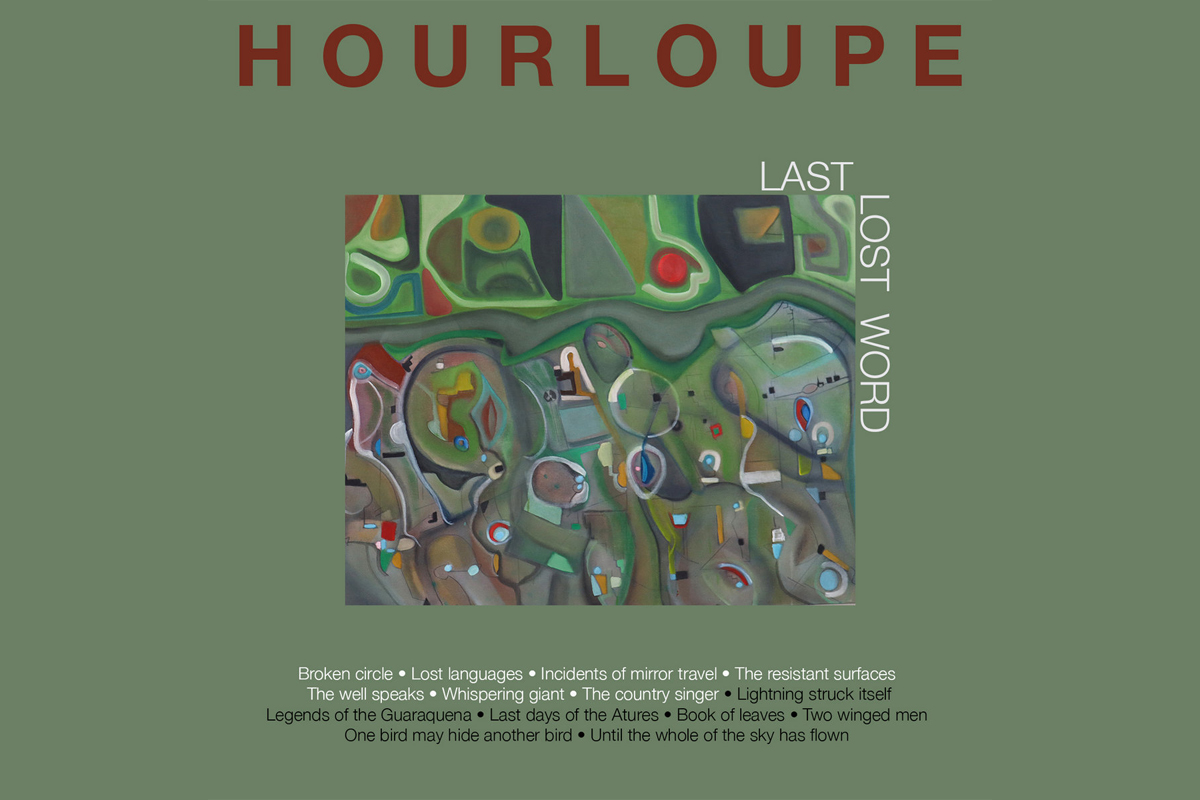
Their new album Last Lost Word takes that ripe fable from the Humboldt expedition about an old parrot speaking the last remnant of an Atures tongue and uses it to conjure a certain landscape, one which in Humboldtian fashion seems to bleed together observed reality and psychological interiority while perched above tropical grasslands, lush rainforest and foamy rapids on those Ataruipe cliffs with their preserved skeletons and steep granite rocks. This almost Borgesian legend suits their aspect as a kind of shimmering reside, sole bearers of a singular message or custom even as many voices seem to emanate from their squawking tongue.
Last Lost Word opens through plucked strings of a lute-like baroque character, passing through a wall of dialup and static to be swiftly subsumed by whorls of synth. When the drums kick in the song, which is entitled ‘Broken circle’, becomes a slow and somewhat gravity-defying groove almost like a chopped and screwed take on kosmische.
Menchaca meanwhile with his placid and watchful tone, like a reflecting pool surfacing mots of old wisdom, begins to recite lyrics which are part of his retelling of the legend, a short story which accompanies the release and sees a cult form in a small riverside town around the curious utterances of the mysterious talking bird. The cult will make the pilgrimage to see the bird, which ‘seemed to prefer a single tree and even a specific branch, at the edge of the river’ – phrasing redolent of Borges and his story ‘Funes the Memorious’ for instance, who invents an original system of numbering based on his own ‘discomfort at the fact that the famous thirty-three gauchos of Uruguayan history should require two signs and two words, in place of a single word and a single sign. He then applied this absurd principle to the other numbers’.
The cult will grope against the alleged arbitrariness of the relationship between the signifier and the signified and will trade beliefs before a moment of rupture, at which the pursued members mass along the outcroppings and perilous precipices of the nearby cliffs. But for now Menchaca in ‘Broken circle’ merely recounts some of the words which the cult supposed the bird to have spoken, flat-toned sounds which they took to mean:
The snake is a dragon, the power of the universe. The subject of violence and veneration. The snake is a dragon. Time is a curve, broken by a demon from the circle surrounding a star.
Murmuring pan flute, cradlesong keys and whopping, ricocheting percussion trace out the margins of the short instrumental ‘Lost languages’. Menchaca and Badalov have cited Oneohtrix Point Never and Laurie Anderson as two of the sonic influences on Last Lost Word, with the combination of textures and elements on ‘Lost languages’ certainly in their wheelhouse as the instrumental reminds me especially of Amelia and its heightened atmosphere, an emergent whir of electroacoustics which might suggest latent destinies, nebulous horizons and crossed wires as Anderson through letters and reconstructions relives the great aviator Earheart’s fateful last flight.
‘Incidents of mirror travel’ sounds industrial or monolithic in the vein of some kind of space odyssey and ‘The resistant surfaces’ unveils a new trick in the duo’s arsenal as pitch-shifted vocals leave us stranded in that zone. Beyond the sense of heavy machinery or science fiction the motorik rhythm here tilts propulsively in the direction of drum and bass. Menchaca’s pitched-low spoken word seems to lose some of its raspiness while attaining a deep barrelling clarity as he explains that the cult’s web of beliefs ‘refused to form a doxology’. Instead, he continues, ‘”Protect us from all anxiety as we wait in joyful hope” was their prayer of anticipation, but it masked an unfolding estrangement that is often the precondition of violence’ – a ritualised form of the distanciation which might explain much of our present political and social landscape.
Shifting away from their explicit retelling of the narrative, on ‘The well speaks’ an Afro-Cuban rhythm on hand drums skates through the industrial ooze. Then in a coda to the song we seem to enter the heart of the reactor amid muffled sirens and a staticky sludge. ‘Whispering giant’ refines the texture or cleans up the environment, which now feels like more of a decompression chamber: more limpid as that dripping patter from the ceiling to the floor sounds watery rather than sludgy, meditative rather than queasy, with the final wails more in the manner of the rubbed rods of a Cristal Baschet.
Splashes and scrapes give way to a driving rhythm on ‘The country singer’, a head-bopper as Menchaca liltingly repeats the lines ‘Soon a man will master fire / and we will live in our houseboat / till the retinal scan locks us in the turnstile / and the wind will be born’. There’s a bit of Blade Runner or My Bloody Valentine in the instrumental ‘Lightning struck itself’ while ‘Legends of the Guaraquena’ – as Menchaca condemns this ‘sad place to settle’ – reminds me of the Smashing Pumpkins on their gothic-industrial turn Adore.

‘Last days of the Atures’ recounts precisely that as Menchaca returns to the text of his short story. Set over a chugging, shaker-like rhythm and a coiling marimba pattern, the composition is profoundly affecting as the mellowness or euphoniousness of that semblance of mallet percussion harmonises with Menchaca’s dulcet voice while contrasting with the prior tracks. ‘They did not confuse those days on the cliff with any accomplishments other than survival’ he begins and ‘It is never clear that anyone grows accustomed to the erasure of history, but if a tribe could be considered to manage such an experience it was they’.
They hallucinate a vast and transparent geometric giant, ‘his navel like a whorl of empty space from the decommissioned stars proposed long ago by their cosmologies. In his hands he carried a book fashioned of leaves from an enormous tree they had never seen. They saw him often’. And at the intersection of rail-bound Kraftwerkian sequencing and helical or shimmering, hip-writhing dance music Menchaca and Badalov grind to a halt. On an album that finds the duo expanding their palette and exploring new textures or shadings, ‘Last days of the Atures’ sounds like classic Hourloupe.
‘Book of leaves’ folds and layers pan pipes and reedy sustained tones from a pipe organ with wiry percussive reverberations. It’s like a whittling of reeds or a threshing ritual with a recurring low end on something like the bass clarinet. The instrumental evokes the Werner Herzog film Aguirre for its apparently dense landscape, riverbound journey and echoes of Popol Vuh – Klaus Kinski in that picture taking the part of a famed Spanish conquistador who led a group of men down the Amazon River in search of El Dorado, the mythical city of gold.
Gently oscillating synths and a soothing, reconciliatory atmosphere permeate ‘Two winged men’ with the muffled chimes of a glockenspiel crystallising the episode before the chintzy peals of a horn suggest a climax or fanfare of sorts. But the incessant drumbeat of ‘One bird may hide another bird’ carries us back deep into the heart of the rainforest, with the staticky caws of a synthetic vox humana stuttering into Menchaca’s bracingly plainspoken word as he recites:
Sometimes a large realization comes as the consequence of the smallest of notions. A bird stepping from the shadow of another bird thought to stand alone in front of it and taking wing. A bird stepping and taking wing until the whole of the sky goes into flight. Until the whole of the sky has flown.
So we have witnessed a magic trick, a prestige while being left to wonder what it is that we have witnessed, a doubling that soon encompasses the whole of the sky or the troubling repetition of a disappearing act. Anyway the dance-rock shimmy and that stray and solemn final sentence transforms into the furtive synths and gritty washes of ‘Until the whole of the sky has flown’ which is the album’s final track.
Grit and other detritus sweeps over the mix until our senses are startled by an audacious and clamorous rapping at the door. We are no longer in a forest nor a clearing but feel ourselves transported as part of some collective undertaking, whether communal or imposed on orders from above. There is more of that dance-rock styling, more industrial cladding and the globulation of a lightbulb which hums and flickers before receding from view.
From the musty pages of a nineteenth-century naturalist, Hourloupe have taken us to daring, solitary precipices and we have listened to that distant chatter before they’ve returned us to the present day. But while that experience can be chastening or discomfiting, as we stand there in the vacuum we might hear an old recurring rhythm or feel something rubbing in the hollow of the palm of our hand. We always wind up bringing something back.