

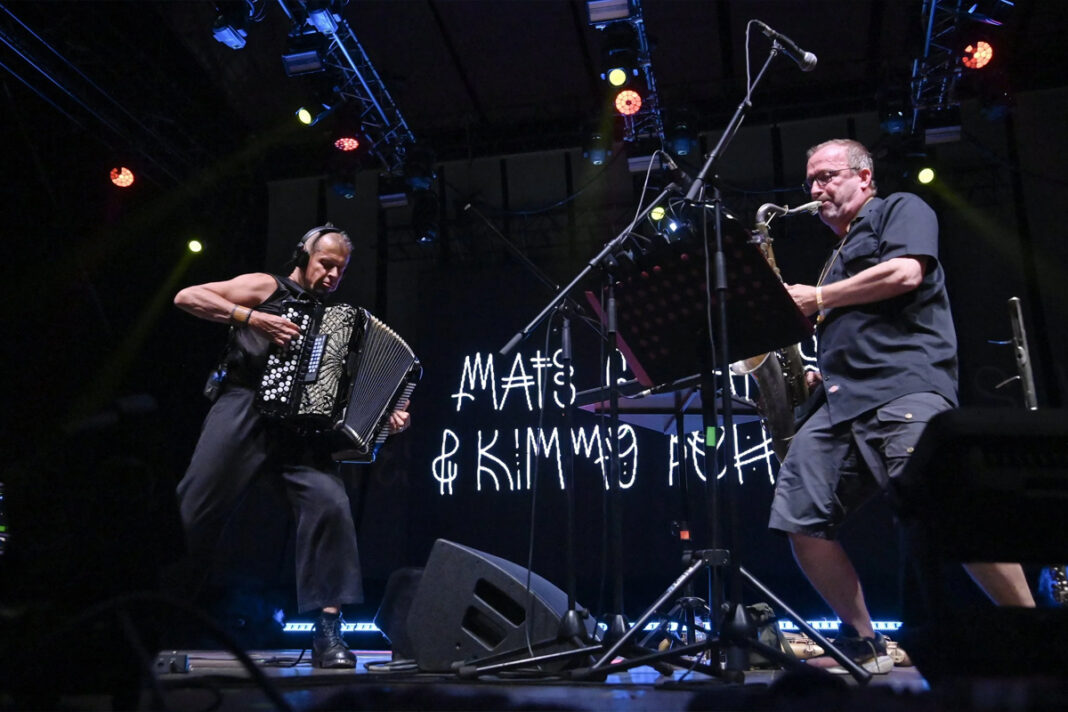
The saxophonist Mats Gustafsson and accordionist Kimmo Pohjonen were born within a few months of one another in 1964 and have enjoyed markedly similar careers. Gustafsson was up and running with his AALY Trio, GUSH and Two Slices of Electric/Acoustic Guitar – groups which between avant-garde and drone experiments would help to chart a new course for Scandinavian free jazz – at the same time as Pohjonen was establishing his early folk projects Pinnin Pojat and Ottopasuuna.
Both commenced solo careers in the late nineties though the essence of Gustafsson’s work in particular has remained collaborative, with both artists uniting with some major figures of the avant-garde – say Ken Vandermark and the Peter Brötzmann Chicago Tentet in Gustafsson’s case and in Pohjonen’s the Kronos Quartet and KTU which sets him alongside members of King Crimson – on their way to becoming titans in their own right of mostly uncompromising experimental music.
Of course there are differences. On some of those early folk projects Pohjonen might play several instruments including the harmonica and gogo marimba, but he has long focused his efforts on his own specially modified electroacoustic accordion. Gustafsson on the other hand appears to draw from an expandable bag of reeds and woodwinds, here on Two Balls Are Enough even adding to the already remarkable array of slide, tenor, baritone and bass saxophones, A-flat clarinet, flute and slide flute and their attendant live effects through forays on the harmonica and organ.
His catalogue is also packed to the brim with genre-busting duets from early sessions with such improvisational stalwarts as Günter Christmann, Barry Guy and Hamid Drake to those with fellow Scandinavian improvisers Christian Munthe and Paal Nilssen-Love or post-rock drifters like David Grubbs and Jim O’Rourke. Most recently he has inaugurated a new duo called Flöjter with Delphine Joussein whose Paris Blow is one of the most restless and abrasive sets of the year to date, whether belching and sputtering and raising the alarm or conjuring flocks of birds and Andean summits as he and Joussein outline their ‘radical commitment to exploiting the flute to its very last layer of nickel silver’.
Despite their similar trajectories and sometimes overlapping milieus Two Balls Are Enough is the first collaboration between the Swedish and Finnish musicians. And from the outset those myriad instruments played by Gustafsson over the course of the album are worthy of some additional commentary. The slide saxophone for instance is an almost archaic instrument that was produced by a small handful of companies for a short period in the 1920s with Gustafsson’s model a 1922 Swanee. It has a vertical slider and no keys and has been part of his arsenal since the release of his solo effort Slide in 2005. The liner notes for that record borrowed some period advertising copy:
The Slide Saxophone – the latest sensation in the musical field – if you can sing a melody you can play this instrument…
Orchestra leaders and musicians who are in close touch with the public taste in music say that the slide saxophone will be used as a solo instrument supported by the regular saxophone in the most up-to-date orchestras before long…
The baritone saxophone is common enough but the bass saxophone takes matters to extremes, an almost implausibly hefty and by all appearances thoroughly unwieldy instrument. By contrast the short stubby A-flat clarinet carries the highest pitch of all those instruments in the clarinet family. So we might well expect this duo to plumb the depths and at the same time muster some ear-piercingly shrill highs never mind the various slides and lapping drones and scuzzy electronic treatments.
The other inescapable aspect of this duo revolves around their rowdy percussive fingerings. Pohjonen’s accordion – which triggers samples and loops his tone in real time – especially amplifies the sound of his fingers running headlong across the keys, a practice which can produce a rolling patter of percussive effects. Gustafsson is no slouch either whether he is tapping out an almost dirge-like rhythm to accompany the deep pitches of his baritone and bass saxophones or tangling sometimes even more frantically with the keys of a flute or that compact A-flat clarinet.
Two Balls Are Enough begins through some crudding and ricocheting percussion while Gustafsson on at least the baritone saxophone introduces a marching sci-fi theme. Snatches of other music seem to emanate steadily from this opening ‘Ice Heaven’ whether Bollywood songs, arabesques or calls to prayer as Gustafsson maintains a bloozy tone while the beat continues to ping-pong around at the base of a squawking and sputtering mix. In fact as the rhythmic interplay between those percussive textures and the saxophone continues to impress itself ‘Ice Heaven’ almost sounds like a warped take on trance or techno or kosmische.
The sense of a skewed ritual or a cinematic space opera full of ominous electronic cladding and imposing villain reveals stretches throughout Two Balls Are Enough, a combination of the brassy bombast of Gustafsson’s low end and the sizzling projections of Pohjonen’s accordion. A blaring electronic drone opens ‘Magna’, like a carnival ride gone haywire. Gustafsson picks up the flute as his swirling eddies and shrill howls jostle or pierce the rickety, trundling percussion before the last minute of the piece puts us through a blender by way of a barrelling stream of saxophone skronks, accordion yelps and buffeting beats. So while at the start of ‘Magna’ we’re stuck on a fairground ride by the song’s close it feels like we have just been dragged through 2001: A Space Odyssey and its Star Gate sequence.
But on the lengthy ‘Snow. Linat.’ the duo show an equal knack for more organic scenes as an unadorned woodwind is accompanied by watery splunks and pulses, the air becoming blowsier and raspier as Gustafsson’s antic style is buffeted by more enveloping static. We pass through a wind tunnel or perhaps some kind of dank, monstrous cave to be greeted on the other side by an overripe pastoralism, whose harmonies however baleful and sludgy still call to mind something of Antonín Dvořák’s graceful New World Symphony.
Then we’re right back to the clamorous depths as the bass saxophone treads over the frenzied glisses of the accordion, the duo effectively swapping positions with Gustafsson playing the beefy low notes while Pohjonen suggests a whirligig fairground ride as his instrument evokes the concentrated tones of the bandoneon or some other type of concertina. They lock into a cosmic drone and then a psychedelic groove with the saxophone again building to a fever pitch, full of huffing and rasping breaths before a bluesy, balladesque close that even calls to mind late-fifties film scores by composers in the mould of say Adolph Deutsch or Elmer Bernstein.
Shorter experiments fill the middle of the album with the title piece abounding in the watery splunks and spurts of the clarinet and its attendant fingerings, plus some blare and bleed from the accordion and moments of squealing modem-like signal static. ‘its body falls open’ reverts the formula with Pohjonen running his fingers lightly like the crest of a wave over his accordion keys while Gustafsson sputters away on the saxophone.
The piece becomes a storm surge of swelling noise, presumably responsible for all kinds of capsizing before ‘worn out’ dials everything down to just a binary patter of data. The percussive nature of those instrument fingerings here calls to mind the plucks and tines of a mbira though ‘worn out’ too acquires a demonic or demiurgic momentum, an orchestral swarm as bellows and reeds appear to be joined by short spasms of organ.
The album notes for Two Balls Are Enough give thanks to Konstantin Drobil the Trost Records founder and Bogdan Benigar the director of Druga godba the esteemed Ljubljana music festival. Perhaps even more interestingly from the perspective of engaging with the record, Gustafsson and Pohjonen also pay special thanks to Swedish and Finnish ice hockey culture.
And while the gesture may be one of shared pastimes and a similar hard-hitting ethos there is a real musical link between Gustafsson and Pohjonen’s output here and the goal horns or stings and jingles which air during ice hockey games in Sweden and Finland. While all manner of popular music is now prevalent across sporting arenas worldwide, traditionally those goal horns – blaring brass, foghorn drones or the occasional bell chime – have been followed by punchy, guitar-driven pop-punk chants, sleeker arena pop or dansband music with its roots in schlager and country, early rock and jazz swing.
The gesture also reaches across the ocean to the United States and the penchant for organ music in American sporting arenas. The organ was introduced in a sporting context during an ice hockey game at Chicago Stadium upon its opening in 1929, with the instrument operated between 1930 and 1974 by the famous nine-fingered Bulls and Blackhawks organist Al Melgard. Organs soon made their way to Madison Square Garden and the Boston Gardon while in 1941 the Chicago Cubs began to experiment with organ music at Wrigley Field.
That connection with Chicago is especially resonant given Gustafsson’s long professional engagement with the city. And while there is a lengthy organ repertoire with certain pieces triggered around specific events, some European folk and classical fare such as ‘Kalinka’ and ‘The Blue Danube’ still gets aired alongside pop, hip hop and blasts of ‘The Final Countdown’ or ‘Seven Nation Army’.
‘slow down the beating’ is reedy and meditative in the opening moments, almost with the folksy melodicism of a tárogató or shakuhachi. Suddenly the accordion keys effect the sound of someone tumbling down the stairs and hitting every step hard owing to the intense amplification of the instrument. Another menacing sci-fi beat leads us in to a climactic interstellar battle sequence only somebody has arrived on the scene with brass knuckles or one of those baseball bats studded with nails and barbed wire, as keyboard presses sound like güiro ratchets.
So here it is Pohjonen who builds that atmosphere of gritty menace while Gustafsson retains an elevated position, almost Popol Vuhing it over the top of the beats and hits and samples. The combined effect is like if Werner Herzog’s mistily spare historical epic Aguirre, der Zorn Gottes was turned into a space warfare fantasy. So imagine say Klaus Kinski playing the role of Darth Vader.
A bit of soul blues swiftly turns into a more dramatic fusion before ‘Naga’ effects all kinds of animal sounds from trumpeting elephants to lowing cattle. The syncopated percussion as it ricochets all over the mix once again calls to mind Kraftwerk and their techno progeny. Gustafsson’s beefy bass sax here even takes a backseat to the spectral whip of the beat, yet by the halfway mark reeds and bellows have joined forces for one big peal and as before it has the chance to decay everything blacks out. We are left in spare, reverberant space like an abandoned warehouse or experimental research facility but gradually a low end begins to emerge, assuming form like the Mississippi Delta gospel blues as we listen with a certain awe to this deep murmuring chorus.
Two Balls Are Enough ends with a rendition of ‘Backengrillen’. The reference is to Mats Gustafsson’s new band with Dennis Lyxzén, Magnus Flagge and David Sandström the core members of the Refused which debuted at Umeå Jazz Festival in 2022 and released their self-titled debut album earlier this year, billing themselves and their music as ‘anti-fascist, anti-racist, freeform death jazz in the memory of Lars Lystedt’.
One might wonder whether this is Gustafsson and Pohjonen’s nod to that project as a whole rather than a reinterpretation of its title piece as a muffled, staticky opening is permeated by gossamer notes from a harmonica harmonica, lovely and light-bearing and slipping through all of the gaps. Pellucid and full of grace notes, this ‘Backengrillen’ is elfin and wondrous and limpid and light as the accordion joins in through a gentle accompaniment.
We start to hear the wop wop wop of a drone or rotor blade – wondering perhaps whether that’s just the distant sound of whatever helicopter that landed us here. The scene is a paradise as washes of the accordion oscillate beneath the harp-like peals of the harmonica. And the song is certainly a respite from the sludgier tread and barrelling noise of so much of the album as beyond a jazz or folk or freeform noise context I begin to hear for instance traces of the saxophone tone from David Bowie’s albums Young Americans and Low or more clearly the vocal line from ‘Born Free’ the popular song and onetime Oscar winner by Matt Monro, the acclaimed baritone singer.
In fact this ‘Backengrillen’ is a close cover of the original, but where Magnus Flagge’s bass once carried the theme here Gustafsson transports us to another realm as the harmonica imbues the piece with a new set of characteristics. It sounds earnest rather than impish, less swampy than bucolic with that sense of a verdant idyll enhanced once Gustafsson switches over to the sax by the way that he slurs the line, his legato playing turning ‘Backengrillen’ from a stomp into something sweetly melodious.
Short saxophone loops stick with the motif while Pohjonen adds glittering accordion accompaniment and the duo allow the piece to get bloozier and more untethered without losing that rustic air of roaming bonhomie. So they draw to a close but it would be scant surprise to find them back with their balls out tomorrow or the day after.