


Over a couple of sides for the Gothenburg label Discreet Music the Italian-Swedish composer Timoteo Carbone Hansson blends winds and percussion to limpid and spellbinding effect, winding a course or cleaving a verdant landscape as he cuts between aspects of folk, new age and early music.
Gwethilu: Songs for the Dark Lake comprises two sides of about equal length, each stretching out without too much slack for a debut album by the composer of just over thirty-three minutes. Side A consists of the four movements ‘Circle’, ‘Gathering’, ‘Water Dance’ and ‘Soothsaying’ and its winds seem to possess a steep Andean fragrance accompanied all the while by ritual percussion, with the rhythms built around the weaving patterns of the woodwinds and a steady bass drum while shakers, gongs and chimes provide the accoutrements.
The album at least in its digital edition does not furnish much additional information, but looking at the artist’s socials it seems that Timoteo Carbone Hansson has played the violin and produced music for various sound installations but has focused more recently on designing and crafting his own set of instruments which he tunes here according to a specially devised system of intonation. He grounds his work in the harmonic series, implying just intonation though he differentiates himself through an interest in a distinctly Nordic tradition. Harking back to instruments like the willow flute and natural horn, for Gwethilu: Songs for the Dark Lake he has also drawn upon Daseian notation, a ninth-century notation which contributed some of the earliest written examples of polyphonic music.
Seeking to summon the spirit of the Baltics, he has specially crafted a collection of woodwinds and percussion instruments for Gwethilu: Songs for the Dark Lake with a recent instance of that process showing him collaborating with Blåsemaker Grønnesby in Oslo on a traditional Meråker shepherd’s clarinet which is tuned to his discrete intonation system.
That sound is the defining aspect of Gwethilu: Songs for the Dark Lake with its rich, bassy tone and gushing overtone layers. Lighter winds are redolent of flutes and recorders or even panpipes and there are some plucked strings in the manner of a harp, lute or zither – or perhaps closer to the artist’s purview the Baltic psaltery family of instruments which includes the kantele and a musical culture spotlighted recently by old recordings of Teppana Jänis and the interpretations of Arja Kastinen.
The core motif on the opening side of Gwethilu: Songs for the Dark Lake offers a hypnotising and cascading blend of those bass tones and their accompanying percussive textures as it drags the listener along, one’s head bobbing under the surface of the water for a moment before one inevitably cedes to the flow, even where the low end of the music suggests something ominous like rainclouds gathering high above in the darkening aether.
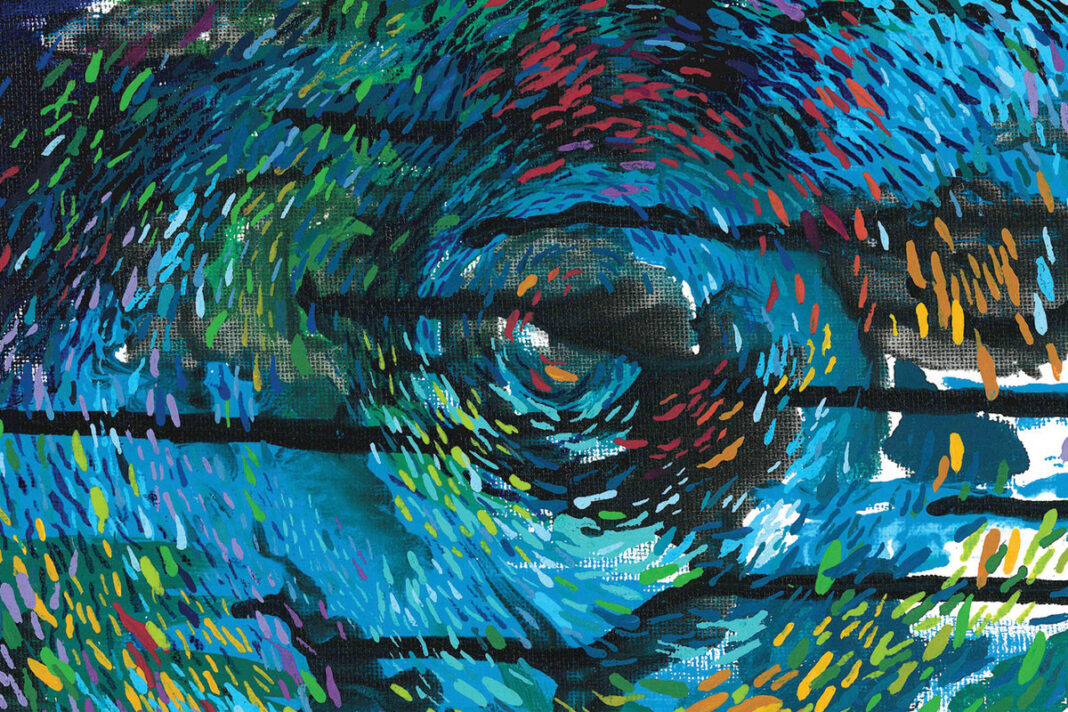
From just before the twelve minute mark, Gemma Hansson Carbone (who also designed the swirling album cover) contributes some murmuring vocals as the bass tones and slinky percussion briefly become more strident and clangourous. At times the Andean airs or array of folksy textures evoke the fourth world music of Jon Hassell or a bit of Popol Vuh while the layered winds which provide a pastoral close to this first side almost mimic the circular breathing of say Colin Stetson, albeit within a very different landscape or climate.
Side B sustains the pastoral character but in a somewhat elegiaic register as it opens out, sounding at once more folksy in a traditional manner and at the same time more liturgical. Amid those willowing winds which wisp and coil or drift faintly into the distance and the more overt roundedness of the clarinet there is the suggestion of a pipe organ and strings or harp whose plucks and slaps produce an effect of hand percussion. Therefore in these opening stages of the second side I am even reminded of something like June Tabor on her cult classic Aqaba though the shifts and sworls on Gwethilu: Songs for the Dark Lake soon draw us away from any semblance of spareness or austerity towards something more verdant and watery and ripe.
The second side is comprised of the movements ‘Meditation’, ‘Lu Lullaby’, ‘Water Dance II’ and ‘Circle’ with ‘Travel Song’ billed as something like a coda to the piece. Through harmonic layers and swells it attains an orchestral fullness though in terms of instrumentation and the melodic line its component parts continue to tell of the melding of folk, aspects of fourth world and jazz and contemporary classical trends which conspicuously evoke early music. Timoteo puts together mellifluous and sometimes vertiginous polyphonies and calls to mind the interplay of such early woodwinds as the shawm, flutes and recorders in a way that sometimes broaches the manner of the medievalist Laura Cannell, who specialises in such instruments as the bass recorder and overbowed violin and has released albums of drone music and synth pop plus a reimagination of the songs of Hildegard von Bingen.
More plucked strings in the final third of the composition cede to a solitary wind, swirling and rustling and sediment-shifting before Timoteo builds the piece up again through an idiophone which sounds like a marimba or celeste. This portion of the piece is the ‘Travel Song’ which stands apart from the rest of the side – and indeed from the rest of Gwethilu: Songs for the Dark Lake – by foregrounding these struck bars in all of their dewy moistness.
The movement shows the artist’s penchant for music box melodies of a kind familiar to Björk fans from her albums Vespertine and Medúlla or even the earlier Gling-Gló with its bells and jazz-inflected vocals and accompaniment. Then finally Gwethilu: Songs for the Dark Lake relinquishes itself in more gusts of real wind, an album that presumes nothing and demands nothing but proves utterly absorbing as it gives up a whole world to the listener.