


Not wishing to brag, about a decade ago I made a series of short ‘songs’ or really fragments using my rudimentary knowledge of Ableton Live, transposing samples from the 1930 film Prix de beauté – a winsome and at the same time startling meta-narrative which is best remembered as the first sound film to star the flapper icon Louise Brooks – before layering these samples with stock woodwinds and a few lurching or reedy synths. To my louche but still fairly discriminating ears, this combination of the looped and pitch-shifted samples with improvised winds and reeds proved compelling, but my knowledge was too rudimentary and my ambition or endurance so limited that the prospective ‘Prix de beauté’ extended play was ultimately left hanging mid-air.
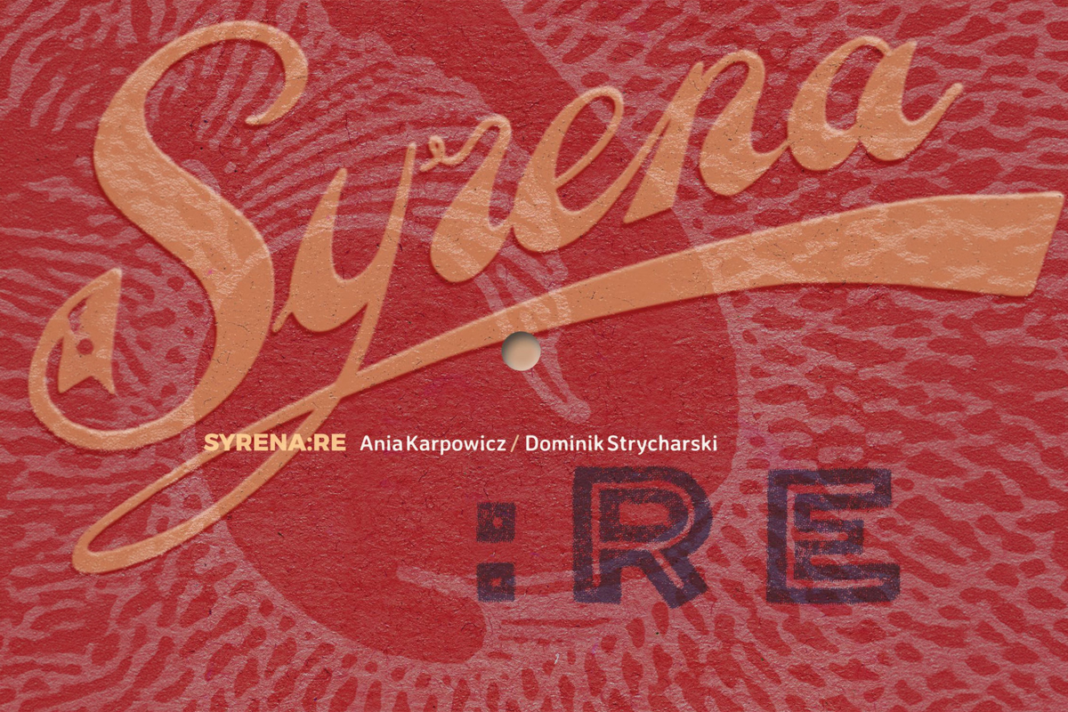
I was therefore struck and in a good way when I pressed play on the new album SYRENA:RE by Ania Karpowicz and Dominik Strycharski which sounds not unlike my amateur experiments from several years ago. More conceptually rigorous, more skilful and sustained Karpowicz and Strycharski’s project is of course the more successful (plus it was finished: it exists in the world). Instead of a dubbed curio from the outset of the talkie era, the duo have drawn their samples from old popular songs, synagogue cantors and the blended sounds of the Shmuel Weinberg orchestra, recorded material which they recombine and reinterpret through the added lens of their own instrumental prowess, as they play flutes and blockflutes, airs which pulse and stretch through Karpowicz and Strycharski’s plentiful use of extended techniques.
Born in the present-day Moldovan capital of Chișinău, from the age of seven Shmuel Weinberg had taught himself to play the violin. With a series of pogroms compelling his decision to depart his hometown, he took up life as a touring musician, playing and conducting for a series of theatrical troupes which travelled across eastern Europe. After spending time in Vilnius and Łódź he settled in Warsaw where he became involved in the Yiddish theatre, conducting an orchestra which set Yiddish folk songs and performed various accompaniments. His son Mieczysław would study at the Warsaw Conservatory before fleeing for the Soviet Union at the outset of World War II, where he befriended Dmitri Shostakovich and through various trials and tribulations forged a successful career as a composer, famed both for his score for the Soyuzmultfilm animation Winnie-the-Pooh and for his work in a concert setting. Shmuel and the rest of the family had remained in Warsaw, and were moved first to Łódź then to the Trawniki concentration camp where they were murdered in 1943.
Shmuel’s orchestral work remains little-known but around a decade ago a series of his recordings became more widely available online. Dating to the late 1920s and 1930s and originally caught on wax by the Polish label Syrena, most of these recordings are of secular Yiddish songs but several feature traditional settings of texts from the Torah as sung by a cantor. Karpowicz and Strycharski’s meaningful engagement with Shmuel Weinberg’s oeuvre therefore summons up spectres of the past while serving to document his work and recapture something of the lived moment, in the manner for instance of the Finnish musician and researcher Arja Kastinen who has recently been reconstructing the melodies of the early twentieth-century kantele player Teppana Jänis.
SYRENA:RE opens amid whirring organ stops, high Alpine whistles and the repeated intonations of a Jewish cantor whose dank low tones are juxtaposed by yodelling highs, which imbue ‘Ribono’ with a real sense of movement. A few woodwinds cradle in the centre of the piece and as their winding, sinuous melody begins to splinter and surge forward, like ribbons swirling in the wind, those sampled highs of the cantor are triggered with a repetitious urgency which feels compositionally bold and emotionally rhapsodic.
This repetition occurs all through the second half of ‘Ribono’ merging rhapsody with longing. Already the duo of Karpowicz and Strycharski on SYRENA:RE are conjuring a stylistic blend which falls somewhere between the whirligig bliss and rich nostalgia of the Alex Weiser album in a dark blue night – a record which itself mucks together in wondrous or starry fashion settings of Yiddish poetry and the Coney Island reminiscences of Weiser’s late grandmother – and the whooshing interplay of the all-German pre-war close harmony ensemble the Comedian Harmonists.
On the second track ‘Lejl’ – which refers to the evening before a festivity – the high-pitched declamations of a female voice are set against a male voice transposed down so that it becomes a low drone, steep and scarcely legible. This drone moans away at the bottom of the composition as little limpid and breathless spurts of flute sound out like water droplets. ‘Lejl’ at times calls to mind The Wizard of Oz both for Judy Garland’s voice and the song ‘Ding-Dong! The Witch is Dead’, with the flutes and recorders of blockflutes seeming to co-opt the melody.
At times the flutes mimic the comic spring or piston popping of a slide whistle, with the female register now lower in the mix as sparks and spectral visions emerge from the combination of stranded voices. As the long fifteen-minute ‘Lejl’ progresses it sustains the grinding rhythmic quality of krautrock or the motorik beat, a sense which occasionally recedes to those castaway vocals.
‘Drejdl’ sounds orchestral in the dramatic sense through its surging keys, with a few airy hoots soon vying with a spiralling vocal which seems to judder and recede, as though it were being sucked into a vortex. As the flutes and blockflutes become more strident and copious, the orchestral motif continues to rampage beneath the piece with ‘Drejdl’ attaining a martial quality even as it navigates near cacophony, a march caught up in harshly swirling winds. As if to emphasise or embellish the moment of distress, towards the end of the competition the flutes strike a shrill note of climax.
Yet in response to the blustery or high-wire drama of tracks two and three, ‘Devarim’ befits its title by sounding steeply liturgical, as a cantor orates slowly and sings through more lyrical passages while the flutes and recorders almost trace an arabesque, changing paths of flight and approaching ever nearer or becoming more voluminous. At moments this cantor sounds like he is in free fall, wailing as he tumbles in cartoonish and cartwheeling fashion from a lofty summit (or echoes out from inside of a cavern, again as a Wizard of Oz analogue this time leering from behind the screen). Which is to say that SYRENA:RE is a strange and sometimes trancelike album, capable of conjuring a retinue of spirits from the past, always tottering happily in this seesawing borderland or hinterland between liturgical gravity or solemnity and popular notions of slapstick or farce.
Still the record closer ‘Ohn’ at first sounds more velvety and naturalistic, an evening commingling of wind and sand with birdcalls twittering somewhere in the distance until a woman’s voice emerges hiccuping to blot or lacerate the scene. The woodwinds really for the first time begin to mime saxophones, with a brassy and burnished quality, horns smearing and dragging across the page. Then lighter flurries of flute add moments of crashing emphasis, elevating the atmosphere which remains laden with a certain tension, compelling the narrative towards a sense of lucid discovery. Perhaps it is only my imagination but towards the end of the piece, there is a sense of the woodwinds and their practitioners perching themselves on some kind of stoop or wire, at languorous if watchful remove from those whirligig winds and sands which continue to flare up out from over the horizon.