


In recent years Bill Nace, no doubt best known for his stellar work as an experimental guitarist, has been steadily making the two-string taishōgoto his instrument of choice. That was partly the case on his last effort for the North Carolina label Three Lobed Recordings, an album titled 43/80 where Nace played astride his longtime collaborator Samara Lubelski as their combination of violin and taishōgoto on ‘Gravity Drains’, the first of two long sides, roared to life and stole the show. Slightly paraphrasing, I wrote at the time:
Over two long sides the Samara Lubelski and Bill Nace duo shred their violin, two-string taishōgoto and electric guitar into a series of fathomless and hallucinatory drones. The first summons up the white light and heat of ‘Sister Ray’ plus the stygian guitar of underground contemporaries like Bobby Would, while the second piece sounds more vaulted and spectral, like a phantom train screeching perpetually to a halt, the driver cranking the break in the manner of pipe organ works by Charlemagne Palestine and FUJITA.
That penchant for the taishōgoto was present again on Rinse Cycle, his collaborative album with the saxophonist Sakina Abdou, whose steep alto and ferromagnetic tenor saxophone played brusquely but thrillingly off Nace’s trusty guitar, two-string taishōgoto and egg shaker. The result sometimes skronked with a combustible charge or sounded like the pair were tangling inside of a washing machine and at other times turned more spare, as a mix of percussive gestures from the saxophone keys, egg shaker and some close miking gave the impression of two railroad workers chugging down the line, checking whistles and horns and catenary wires or in the anticipatory limbo of passing trains laying down new track.
Next up on Nace’s own Open Mouth Records and still more sustained was Branches live with Evan Parker at the London experimental venue Cafe OTO, where the effect of the iconic saxophonist’s squawking over Nace’s taishōgoto drone was both a revving dynamism and something which fluttered and twittered and billowed as Parker made characteristic use of his split-tone multiphonics and circular breathing.
Now though Nace has gone solo and produced one of the great feedback records. As a phenomenon it remains most intimately associated with rock music and the electric guitar. Yet its manifestations are diverse with Sonny Sharrock in the context of free jazz and Bill Orcutt in the realm of improvisational noise music among the notable pioneers.
Its properties are also being harnessed by a new wave or vanguard of musicians, with Ava Mendoza and her band Mendoza Hoff Revels summoning up some vigorous punk interplay, jazz-funk harmolodics and heavy metal histrionics on Echolocation while Nina Garcia on Bye Bye Bird incorporated extended techniques and effects within an improvisational noise milieu, and Klein barrelled forth out of the murk on marked and thirteen sense through some blistering guitar distortions, burning all of the way into the red without quite relinquishing those steeped atmospheres or vestigial traces of grime and sodden soul. Perhaps more to the point though it’s not just guitarists who are in on the act, with Lori Goldston on the cello and Toshimaru Nakamura on his no-input mixing board among the artists who seem to draw from that rock tradition while resolutely branching out on their own.
The taishōgoto is its own beast, a Japanese string instrument which was devised by Gorō Morita in 1912 after his travels in Europe and America left him with the desire to produce a low-cost alternative to some of the sounds and instruments he had heard overseas. It might feature five or six strings in its soprano variant or just one or two strings at the lowest bass register, with Morita adding to this basic zither a row of numbered typewriter-style keys which can be pressed down on the strings to change their pitch. The taishōgoto is therefore the foundational typewriter zither and the basis for the bulbul tarang in India, the benju in Pakistan and the German akkordolia while it found some usage among krautrock bands, famously featuring on the debut album by Neu!
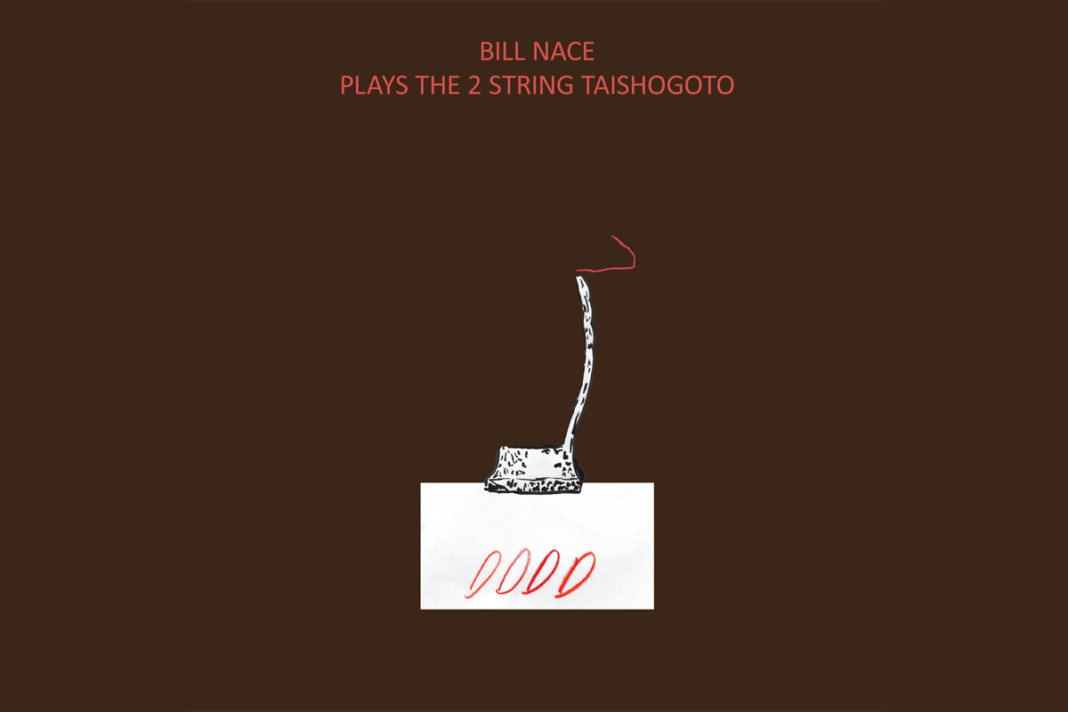
Still the first track from Nace’s new album – which is simply and smartly titled Bill Nace Plays the 2 String Taishogoto – reminds me most of the Shenzhen-based musician Mamer whose own trajectory took him in almost the opposite direction, from Kazakh folk music and the dombra to lutes like the bouzouki and rawap and the first album for solo sherter to ferocious yet evocative noise music primarily played on the electric guitar, and to the Velvet Underground on ‘Sister Ray’, where Maureen Tucker’s drums kept the backbeat and sometimes crested the wave of Sterling Morrison’s bluesy Fender Stratocaster (who switched the pickup from the bridge to the neck in order to get a fuller sound), Lou Reed’s electric guitar and John Cale’s combo organ, with the drone student routing his Vox Continental through a distorting guitar amp.
‘Over/Under’ announces those long tones and their overtones like loud foghorn blasts, as though something has gone drastically awry out at sea or as if many ships having multiplied from the same original source are now engaged in a motley and ribald chorus. The sustained tones and rippling distortions of Nace and his taishōgoto oscillate with some rubbing or rumbling textures closer to the surface of the recording, again as though in contrast to the steep waves out at sea a little row boat closer to the shore is being irked or buffeted on the garrulous tempest.
The second of two long tracks is dedicated to the pedal steel guitarist Susan Alcorn, who readily inhabited both durational or deep listening and improvisational or avant-garde jazz modes before her death in January of 2025 at the age of 71 years old. She and Nace formed a trio with the drummer Chris Corsano for the 2019 album Live at Rotunda and otherwise shared several collaborators, with Nace’s ode here calling to mind some of her compositions inspired by Olivier Messiaen on And I Await the Resurrection of the Pedal Steel Guitar or her trio effort with a couple of free jazz titans in Joe McPhee and Ken Vandermark entitled Invitation to a Dream.
It is therefore a more wiry piece and while the overtones and harmonics remain piquant and potent it is perhaps just as much about the movement of the strings themselves. Wiry and rattling, the gap in between seems to acquire a certain ornateness as the track progresses, miniature hand-scrawled curlicues making their way infinitesimally between the strings.