

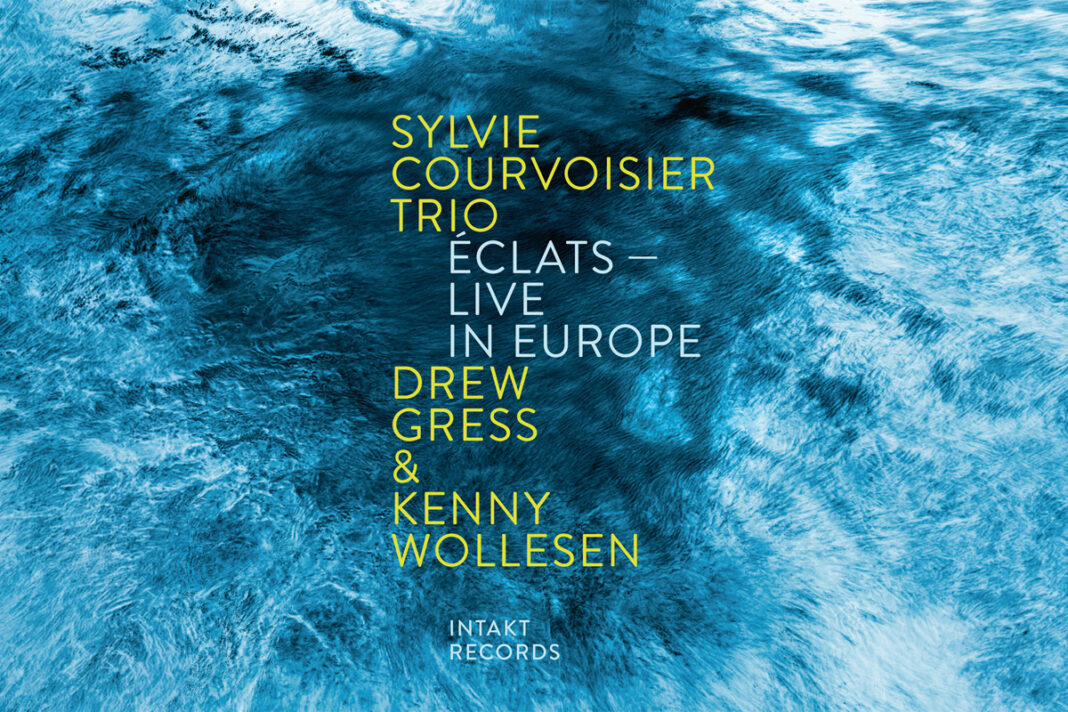
Sylvie Courvoisier has had a busy couple of years with To Be Other-Wise her long anticipated return to the solo format swiftly followed by a couple of outstanding collaborations, including the duo albums Bone Bells with the guitarist Mary Halvorson and Angel Falls with the trumpeter Wadada Leo Smith. Yet last February over a series of dates in Germany and France she managed to capture the current mood of her longstanding trio, which has been working for well over a decade with the pianist accompanied by Drew Gress on the double bass and Kenny Wollesen on drums.
Éclats largely interprets the three studio albums heretofore released by the trio. To Be Other-Wise was a self-portrait of sorts even as Courvoisier relayed the album as a series of fond tributes to her fellow artists and formative influences, from Halvorson and Smith to Olivier Messiaen and Conlon Nancarrow to her three cats with a final ballade for her father. Dedication with a degree of homage was also the sentiment of the trio’s album D’Agala from 2018 and here it is the song ‘Éclats (for Ornette Coleman)’ from that album which opens their live testimony.
Wollesen especially crashes into the composition at full force. Short scampering piano runs and his skipping cymbals gambol like two young friends, suspending themselves in the air like on gossamer wings before they come together with a hefty splat. There is some rubbery strutting from Gress on the bass and the strings of Courvoisier’s piano sound like they are snapping in cartoon fashion as she uses extended techniques to wring the most out of her instrument.
‘Éclats (for Ornette Coleman)’ shifts between bluesy vamps or hints of old Dixieland themes and humping or clattering sounds as though the ensemble had been tasked with shifting furniture. Wollesen’s percussion sometimes ratchets or slaps like a cajón and a cymbal-crested drum solo gets a big round of applause as altogether the piece builds a sense of helpless momentum, like someone tumbling down a flight of stairs and crashing into every painting or ornamentation while still managing to carry the affair off with a certain amount of grace.
‘Just Twisted’ from the album Free Hoops in 2020 commences on a note of anxious rhapsody, tumbling headlong before turning more stop and start. Indeed the pianist’s signature is a kind of cartoon rhapsodising, a teeter-tottering down flights of stairs that slide or pivot at scarcely a moment’s notice into passages of the most tender and eloquent sentiment. One can imagine say a Looney Tunes sketch animated or a Martin Short sketch performed to a Sylvie Courvoisier piece of music each with an ennobling effect.
Gress on the upright bass tends to add buoyancy to the compositions yet ‘Just Twisted’ develops a manic ferocity, with some wild hammering on the keys and frantic runs as his pizzicato sounds viscous, as though every pluck was leaving his hands slightly stuck. The music quietens down through some dry rattling percussion then goes again before finally becoming more pensive, the ensemble initiating a shugging groove that through some confusion or malady circles back on itself or can’t quite find its feet.
There’s a lovely, lapping opening to ‘Requiem d’un songe’ by way of an ostinato which starts on the keys then is picked up by the bass. That allows Courvoisier to embark on twinkling flights of fancy, while Wollesen’s brushwork sounds like one shuffling paper or sifting sand. This is a stunning composition that becomes something of a chase, with the bass setting the tempo and the drums clearing the path. And after that dashing middle section, in halting, sometimes queasy fashion as the piano engages in some slapdash swing it is Gress who teases his way back to the theme.
‘Imprint Double (for Antoine Courvoisier)’ chugs through sludge or sand, a straining effort from the three musicians until the wheels of the train and their coupling rods break loose of their tethers. It’s still no easy journey but the travail gives way to spectral airs and a sense of space, as Wollesen’s cyclical pulses suggest West African rhythmic traditions while Gress plays a slinky bass. ‘Imprint Double (for Antoine Courvoisier)’ then becomes swampy again, charting a course through various geometries and abstractions before trundling on its way.
And on ‘South Side Rules (for John Abercrombie)’ a bowed drone leads us quaveringly into a pastoral scene, quite redolent of the guitarist’s work for organ trios beginning with Timeless, before the piano here rolls us into the thicket or the deep. We face steep ascents and descents, vertiginous fare through some glisses and broken chords while the bass rocks back and forth, woozy and seasick.
With a nod to Coltrane in the title, Éclats debuts a Courvoisier original as ‘Big Steps Towards Silence’ is the only composition on the album not to be found on a previous release. Jaunty and impish, the bass feels precariously poised and there is a sense of the ensemble waving something off or deflecting expectations, ‘Big Steps Towards Silence’ evasive through its faint brushstrokes and cymbal patter and shimmering keys. The first few minutes of the performance really lull the listener in, like a nice deep sigh and you can even hear a few murmuring vocalisations before the first of several flurries or incipient grooves peters out. One of them does break free before the end of the composition, a caper before the trio cede back to the quiet.
The bandleader and her trio return to Free Hoops for the next couple, with the title piece from that album another headlong tumble that does find its footing as it becomes a dance and suggests at times the concertina or bandoneon, whose bellows push wafts of air bright or dulcet through free vibrating reeds. ‘Lulu’s Dance’ comes with explicit billing as an ostinato with an Afro-Caribbean flavour (almost like the famous riff from ‘La Bamba’) is played by the bass of the keys.
Courvoisier remains in the lower register despite the wave-like crashes of the ensemble until a spare middle section combines slithering, rattlestick percussion, faint pulsing woodwind sounds and moonlit arpeggios or silvery keys while the bass picks up that original ostinato. A few gongs or chimes ring out and Wollesen agitates the stillness before the trio stir from that place of rest and repose and in somewhat spindly or loose-limbed fashion return to the dancefloor and the ‘La Bamba’ riff.
Then the concluding rendition ‘Downward Dog’ proceeds with barely a break, as a few shrill pitches strike with swiftly decaying overtones. The piece is the sole offering from the Sylvie Courvoisier Trio’s debut outing Double Windsor from 2014 and finds the piano and drums spilling forth in a lively duet. Gress and Wollesen then pair off and quicken the tempo, while the piano serves up accents until Courvoisier dashes off on her keys some sparkling runs and deft glissandos.
It’s a spritzer of a piece, carbonated and sweet and as Courvoisier continues to dash, light on her feet and darting about in short turnaround circuits, Wollesen taps out a brief clave pattern while Gress matches him through a bass ostinato, the percussionist soon peeling off to effect all sorts of drum rolls and cymbal crashes like so many staggered waves crashing into outcrops and cliffs. All that froth and spume adds to the cocktail like an elixir, the trio pouring back one last drink before tilting readily into the night.