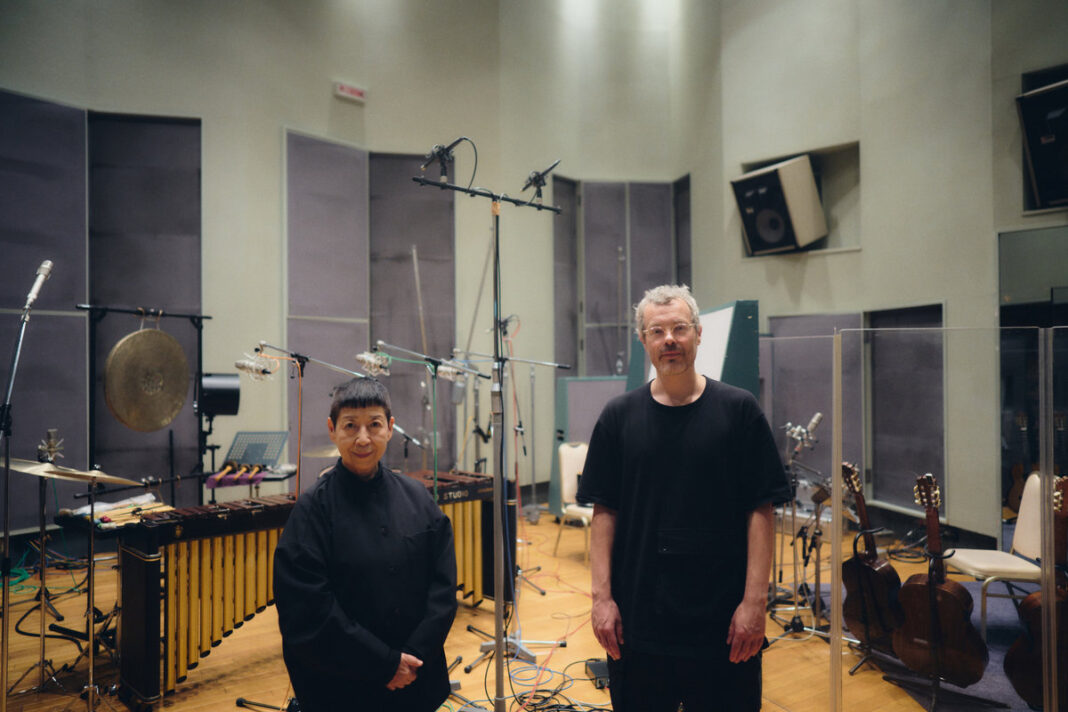



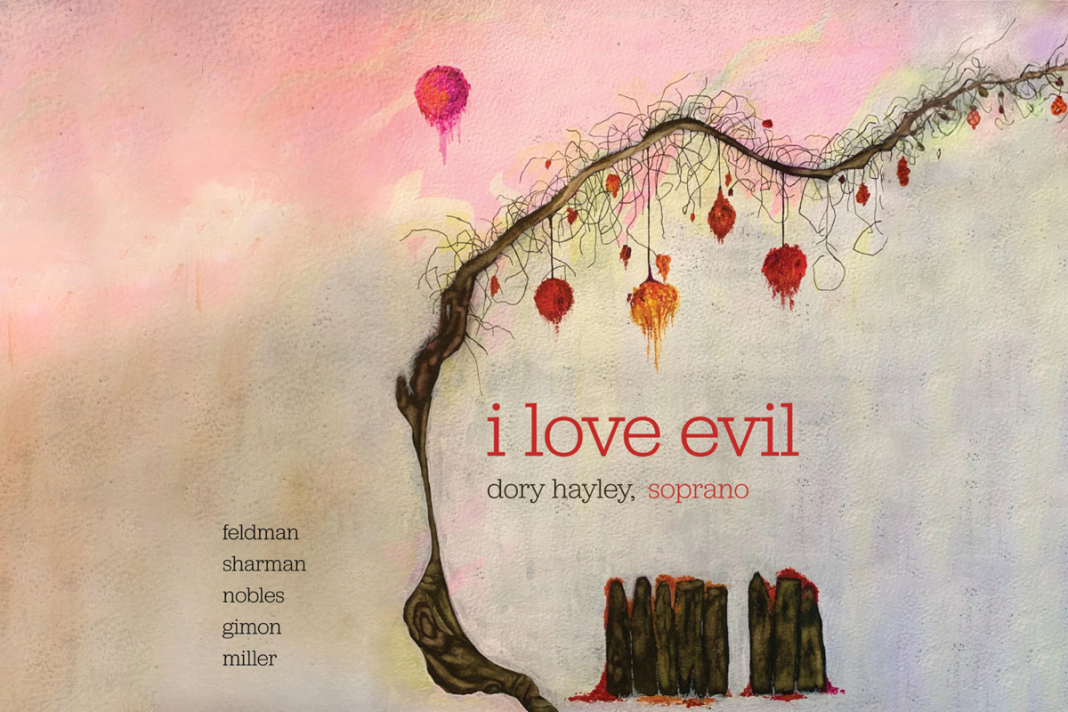
The soprano Dory Hayley’s new work i love evil doesn’t so much tease out the possibilities inherent within Morton Feldman’s elegant 1982 composition Three Voices as flex like putty its component parts. To this end she combines her own recording of Three Voices with four commissioned pieces by some of Canada’s most delicate and inquisitive homegrown talents.
Feldman composed Three Voices in homage to his friends Philip Guston and Frank O’Hara, drawing a couple of lines which were written especially for him from the New York poet’s short and snow-whorled ‘Wind’. He dedicated the composition meanwhile to Joan La Barbara, the experimental vocalist and celebrated pioneer of extended techniques. While the work consists of three vocal parts which can be sung by three separate vocalists, Feldman’s intention and the common practice today is for Three Voices to be performed by one singer accompanied by their own pre-recordings.
Like many of Feldman’s late works, Three Voices the last piece he composed for solo voice requires a degree of physical and emotional stamina from its performer even though it contains few words but mostly open vowels and their resonances. Enacted live and captured on record by the likes of its original interpreter La Barbara, Marianne Schuppe and Juliet Fraser, the piece doesn’t stretch as long as his String Quartet of 1983 or dedicatory For Philip Guston of 1984, both of which can reach towards or even exceed five hours. But it routinely falls somewhere around the fifty-minute mark, with Hayley’s version capped at just beyond an hour and seven minutes.
From the outset the three parts carry a haunted, vestigial warbling. While O’Hara died after being struck by a jeep in 1966 the visual artist Guston died in the summer of 1980, shortly before Feldman began work on his composition, though their friendship had fallen into a state of disrepair in the late sixties when Guston turned away from abstraction towards figurative painting. With his passing still fresh and a source of lament, it has been suggested that the two pre-recorded parts which make up Three Voices are in effect those of Feldman’s deceased friends.
A litany of ‘ohs’ and ‘aahs’ and ‘oohs’, the short phrases of the opening moments where we hear Hayley’s every intake of breath soon cede to soaring arcs which carry a little bit more of a trill. The piece might become more plaintive and at some points the voices ring out like bird calls or nocturnal hooting, but it never loses its ghostly effect. At ten minutes the three voices trill in unison and at around twenty minutes they forego their phantasm airs to sound like a soothing balm, with the first lines from O’Hara’s poem falling after almost 27 minutes. That poem ‘Wind’ was written for O’Hara and Feldman’s first collaboration, The O’Hara Songs of 1962 which Feldman set for bass-baritone voice, chimes, piano, violin, viola and cello. Also furnishing the album i love evil with its title, the text of the poem reads in full:
       WIND
(to Morton Feldman)

Who'd have thought
              that snow falls
it always circled whirling
like a thought
          in the glass ball
around me and my bear

Then it seemed beautiful
                      containment
snow whirled
            nothing ever fell
nor my little bear
           bad thoughts
imprisoned in crystal
beauty has replaced itself with evil
And the snow whirls only
       in fatal winds
briefly
              then falls

it always loathed containment
               beasts
I love evil
Three Voices only repurposes a couple of lines from the poem, as Dory Hayley divides the phrase ‘Who’d have thought that snow falls’ between the three vocal layers, sometimes honing in on one word like ‘snow’ or ‘falls’ until at 38 minutes she gives a carefully enunciated rendition of the full question in all of its wonderment, in a manner which resembles ‘One By One’ by the folk singer Connie Converse, a blackened and lovelorn stroll.
As the lyric fades in and out of the rendition, pitter-patter repetitions of ‘that’ and flurries of ‘snow’ introduce another section of the poem through sworls of the words ‘whirled’ and ‘nothing’. And when Hayley relinquishes the text her instrument still draws from it as the three voices continue to make whirling and whooshing sounds like the whipping and curlicuing of a chill wind, the singer sometimes sounding frostbitten. There are some sustained banshee-like howls before the close and Hayley sings with a steady, lilting rise and fall like water droplets splashing into a deep well or a swallow diving before she delivers one last recital of the chorus.
‘XYZ’ by the acclaimed composer Jordan Nobles at first centres a sibilant ‘ks’ while Hayley’s other more euphonic renderings of the letter spread out over the mix like an angelic chorus. It is followed alphabetically by quavering ‘y’s then buzzing ‘z’s for a piece which is always otherworldly or cherubic, as though hoisted up on gossamer strings.
In three parts ‘Shadow/Light’ by Katerina Gimon first evokes plainsong like the Kyrie eleison only caught between much chattering and burbling while the main vocal line takes its time to emerge. Amid the stormy and rainswept field recordings of this opening movement, which pauses to evoke the eerie silence of a cemetery at dusk, suddenly Hayley’s voice coheres as she sings ‘What a strange sound this silence, the words are stranded’ before ceding back to the enveloping darkness. The second movement ‘Time Soup’ elaborates its concept over the scratchy ticking of a clock while ‘New Light’ opens out onto a brisk and verdant landscape replete with waterfalls and chirruping birds, almost tropical in atmosphere and making the most of Hayley’s soaring and swooping soprano before the soundscape becomes more tumultuous at least momentarily leaving Hayley limning the edges of the scene.
The layering of her voice is the hallmark of i love evil whether in three prismatic parts, as a disorientating swarm or through bucolic and cherubic murmurations as in the closing moments of ‘Shadow/Light’ which is the album’s most lush and luscious pass. Then the former Morton Feldman pupil Rodney Sharman changes the vibe once again with a wavering depiction of the ‘wyrd sisters’ from Macbeth all set over a thudding backbeat. ‘Thrice to mine’ the singer Hayley repeats with shrill urgency on the second of four movements ‘First Charm’, while the helium ascents and stiff salutations of three overlaid voices on the third movement seem to augur more sinister spells, the ‘eye of newt’ and bubbling cauldron and pricking of the thumbs which foretell the eventual undoing of the Scottish king.
The climax of i love evil is a lovely lilting, swirling and babbling composition by Cassandra Miller who is perhaps best known for her Duet for cello and orchestra from 2015. A frequent Juliet Fraser and Quatuor Bozzini collaborator, a couple of years ago her first vinyl offering with Traveller Song/Thanksong recast two disparate pieces of music in the form of a tune by an anonymous Sicilian cart driver, which was captured by the ethnologists Alan Lomax and Diego Carpitella sometime in the mid-fifties, and the third movement of Beethoven’s late string quartet in A minor, a ‘holy song of thanks from a convalescent’ as the German maestro at least temporarily recovered from an intestinal illness. The Guardian has called Duet for cello and orchestra one of the best classical music works of the twenty-first century while the equally meritorious Culturedarm listed Traveller Song/Thanksong as one of its compositions of the year for 2023, describing a fusion of the sacred and mundane whose late smattering of recording booth chatter ‘adds to the air of companionly uplift’.
Tracking a conversation between the composer and the soprano Hayley, the opening of ‘How weird he must think the world is’ entails a lively discussion of practice with the single spoken-word vocal at times doubling as it is appended by the same voice now cast at a higher pitch. The piece is punctuated by peals of giggling laughter and creaking yawns which congeal to become elongated, toady groans as a swooning chorus carries the melody in the background of the piece, ever so gradually coming into full focus.
A composition which shows Cassandra Miller’s usual penchant for keen development and a kind of burgeoning eloquence, finally as the layering of her and Hayley’s voices begins to recall Björk’s album Medúlla on tracks like ‘Öll Birtan’ that chorus narrows into a compressed series of spiralling rhapsodies somewhere between a fly’s buzz and a bird’s call. ‘How weird he must think the world is’ therefore provides a charming and engaging close to i love evil which at the same time synthesises some of the record’s gestures and themes.