


A brisk sweep of American letters might suggest the title of Thomas Wolfe’s second posthumous novel You Can’t Go Home Again as a kind of crystallisation or riposte of F. Scott Fitzgerald’s now classic The Great Gatsby, whose main character could look out over the teeming quiet of the Long Island Sound, described in the novel as a ‘great wet barnyard’, and see a green light flickering with promise in the distance or whose narrator might evoke those sailors who first set eyes on the island, which by the 1920s was busy becoming a suburb of New York City, and in doing so write:
Its vanished trees, the trees that had made way for Gatsby’s house, had once pandered in whispers to the last and greatest of all human dreams; for a transitory enchanted moment man must have held his breath in the presence of this continent, compelled into an aesthetic contemplation he neither understood nor desired, face to face for the last time in history with something commensurate to his capacity for wonder.
Yet while Fitzgerald and Wolfe were friends who shared an editor – Fitzgerald once responding to Wolfe by defining him as a ‘putter-inner’ while he Fitzgerald was a ‘taker-outer’ – they emerged from different literary perspectives and a gulf of time separated those novels, as Wolfe’s attention steadily turned from bildungsroman centred upon his hometown of Asheville in North Carolina to focus on a post-depression landscape and the social travails of life in New York City, the commodification of experience and an understanding of the world, shaped by his travels in Europe, where the tide of fascism was about to reach a terrible crest.
At the current political moment it might seem like concern for the climate is having to take a most untimely backseat. Countries are easing off on their climate targets, rolling back environmental regulations or embracing like bosom buddies fossil fuels even as the world ejects record emissions and races to breach key warming thresholds like the 1.5 degrees Celsius temperature increase which the Paris agreement had hoped to set as a limit.
From dwindling biodiversity to coastal erosion and floods or to droughts, wildfires and a multi-pronged threat to global food security, the assorted impacts of the climate crisis might leave people with a sense of gnashing on the margins, shouting into a void or even mourning silently a tangible sense of loss. In response the philosopher Glenn Albrecht coined a term meant to define the distress that can be caused by the fact and the prospect of environmental change, especially to one’s most intimate surrounds. ‘Solastalgia’ then as defined by Albrecht suggests a sinking and disorienting and hapless kind of feeling, referring to ‘the homesickness you have when you are still at home’.
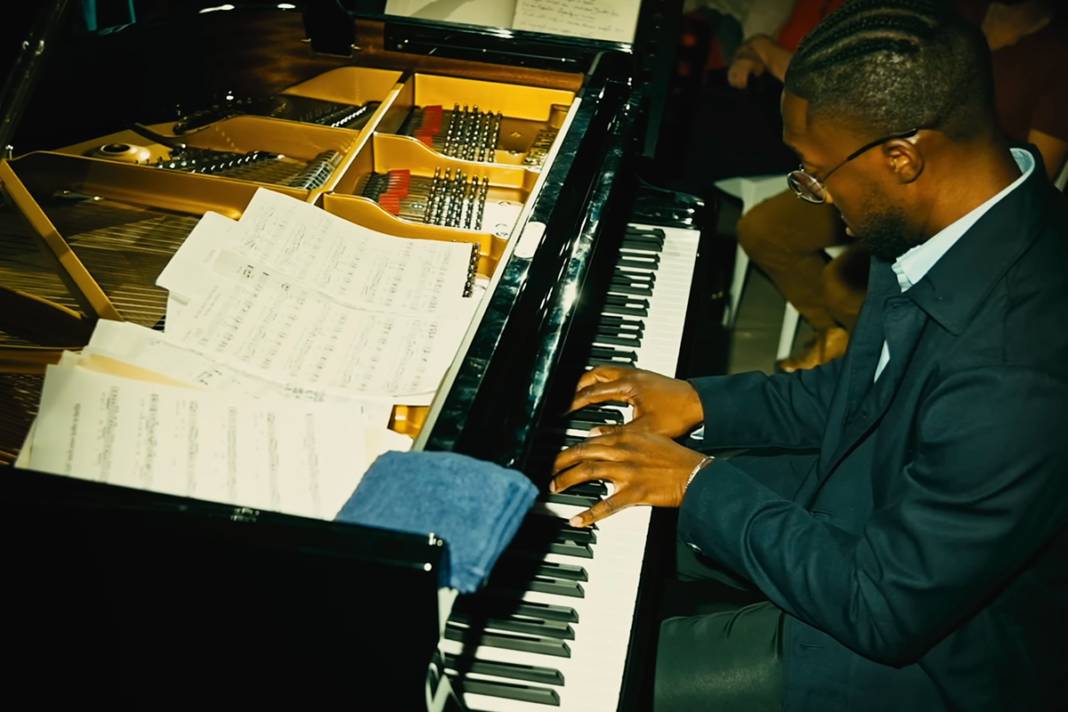
For a couple of decades, from about the turn of the century, the pianist Kris Davis based her home and work life in New York City. Inhabiting an experimental milieu as she routinely collaborated with the likes of Ingrid Laubrock, Tyshawn Sorey, Mary Halvorson and Tony Malaby, she was so much a fixture in the clubs of Brooklyn, Manhattan and their surrounds that The New York Times in early 2013 considered ‘one method for deciding where to hear jazz on a given night has been to track down the pianist Kris Davis’.
The following year she completed a master’s degree in classical composition at the City College of New York and in 2016 she founded the Brooklyn-based label Pyroclastic Records, which has gone on to release acclaimed projects by Cory Smythe, Ches Smith, Sylvie Courvoisier and Patricia Brennan in addition to Davis’s own works, before in 2019 she headed north to Boston as she became an associate program director of creative development at the Berklee Institute of Jazz and Gender Justice.
Yet whenever she heads back home these days to her native Canada – Davis was born in Vancouver, grew up in Calgary and then majored in jazz piano at the University of Toronto – she notices a change in the atmosphere, saying ‘The environments are different, the climate’s different – the whole connection with nature is different, from climate change and from our relationship to technology’. I can share in some of that sentiment having spent two decades now living on and off in Umeå in the north of Sweden, where the winters have become less reliable so that instead of the months-long patter of snow underfoot residents these days might show you their fear in the skittering of ice or a handful of slush.
On both microscopic and macroscopic levels Davis’s music has increasingly reflected a desire to commune with and learn from the natural world. Her celebrated 2019 album Diatom Ribbons explored the hidden realm of unicellular microalgae in the company of a broad swathe of old and new collaborators including Esperanza Spalding, JD Allen, Tony Malaby, Ches Smith, Nels Cline, Marc Ribot, Trevor Dunn, Val Jeanty and Terri Lyne Carrington. At the time, Davis said of Diatom Ribbons:
While writing for this album I learned about diatoms, which are unicellular microalgae that live in the oceans and freshwater and soils. They contribute massively to the planet’s oxygen supply, and there are something like one hundred thousand species. From satellite images above oceans and lakes, huge blooms sometimes appear as beautiful zigzags and ribbons. Up close under a scanning electron microscope, you can see these incredible, ornate structures. So seeing these plants extremely close-up and then so far away, I made a connection between the process of composition and my experience of nature, and that changing your proximity to the same object or idea can dramatically alter your experience of it, often yielding unexpected and inspiring results.
Diatom Ribbons emerged from a series of tribute concerts for Geri Allen and drew inspiration from the Monk Centennial and the works of Cecil Taylor, who had recently passed away. Davis then became just the fourth female instrumentalist to lead a recording from the Village Vanguard, following in the footsteps of Shirley Horn, Junko Onishi and Allen, with her live setting of the Diatom Ribbons material keeping a core trio of Val Jeanty, Trevor Dunn and Terri Lynne Carrington intact while adding the roiling licks of the guitarist Julian Lage to make for an unconventional quintet.
Diatom Ribbons Live at the Village Vanguard brought new voices into the frame but the birdsong of Olivier Messiaen – especially the little bird sketches of his Petites Esquisses d’oiseaux – proved one of several connecting threads. Meanwhile with the bassist Stephan Crump and drummer Eric McPherson the pianist has now released three albums as the Borderlands Trio whose very name, concept and album titles – from Asteroidea and Wandersphere to their latest Rewilder – seem to involve a conscientious attempt through musical improvisation to terraform or find new ways to traverse and engage with our natural world.
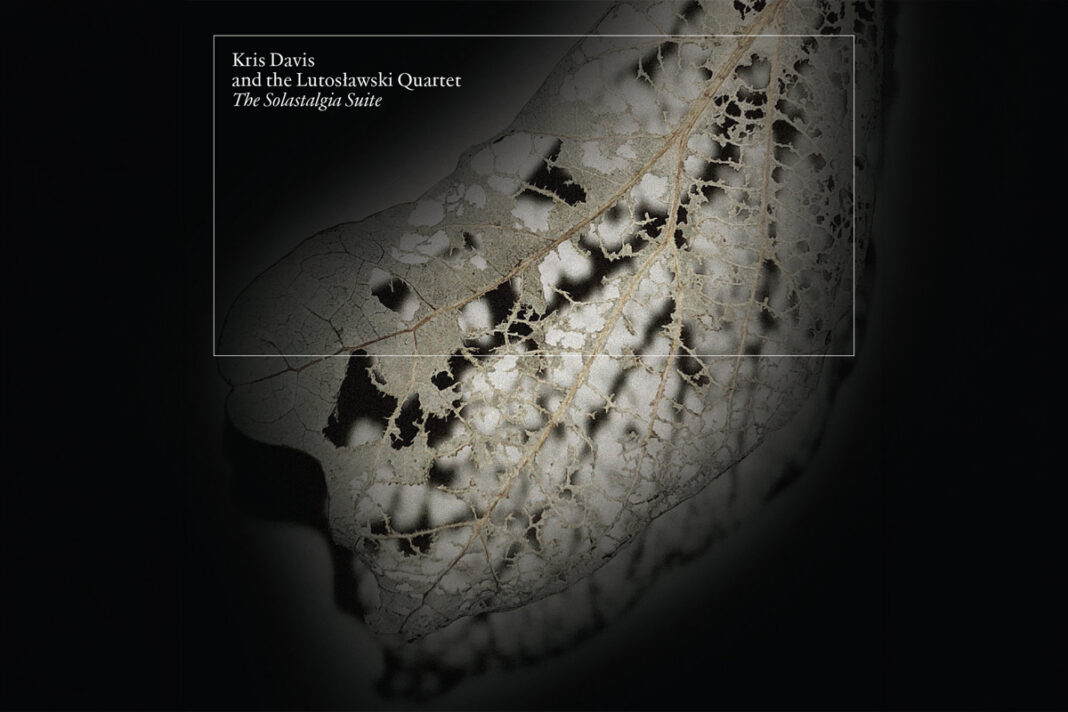
Davis’s new album, with its suggestive and evocative title The Solastalgia Suite, finds the pianist in tandem with the Lutosławski Quartet. Named after the twentieth-century Polish composer Witold Lutosławski, the string quartet was founded in 2007 and has collaborated with a string of significant jazz musicians like Vijay Iyer, Craig Taborn, Kenny Wheeler, Uri Caine and Benoît Delbecq.
The first piece of music Davis has written for piano and string quartet, the suite was commissioned by the Jazztopad Festival in Wrocław and premiered both there and at Dizzy’s Club in Lincoln Center in 2024. Once more her composition draws explicitly from Messiaen, in particular his Quartet for the End of Time which he wrote as a prisoner in German captivity during World War II. Conceived within this different context, The Solastalgia Suite is described as Davis’s attempt to ‘viscerally capture’ those feelings of ‘yearning, dread and desperate hope’ about the climate, with live performances of the suite using Julian Charrière’s images and videos as a backdrop, the French-Swiss conceptual artist’s practice taking in the world’s glaciers and volcanoes, deep sea ecosystems and nuclear test sites from Semipalatinsk to Bikini Atoll.
The Solastalgia Suite opens with what is portrayed as an ‘Interlude’, as if to imply that vacillation or deferral or hiatus is the steady state of things, with the moment of consequence just waiting to occur. Yet the music itself evinces a certain eagerness from the outset, with the Lutosławski Quartet bowing ornately across their strings as Davis from behind the piano begins to stab and throb at her keys, providing the music with its tangled undercurrent.
For the Lutosławski Quartet, it is Roksana Kwaśnikowska and Marcin Markowicz on first and second violins with Artur Rozmysłowicz on the viola and Maciej Młodawski on the cello. This cello produces a few sawing textures or gradients as pizzicato plucks of violin suggest something tethered, like a puppet on a string or little glimmering spots of sunlight on the water’s surface.
There is a folksy passage of violin with the piano exerting a kind of metronomic control over proceedings and as one violinist begins to gnaw on the edge of a string, this sudden sense of wariness and haste is matched by Davis who begins playing a Jaws-like ostinato pattern. The second violin and Rozmysłowicz on the viola attempt various gestures and dances and sweeps but get caught up in the maw of the sautillé bows and ostinato keys before breaking free for an anticipatory climax.
‘An Invitation to Disappear’ features an almost pastoral opening section, introducing some elegant interplay between the strings as if to show how elegance itself can be receding. The tone is matched by a wispy piano and the strings approach a drone through their long, aching bows as Davis and the quartet enact the moment of disappearance itself before a lulling quality subsumes the remainder of the composition. ‘Towards No Earthly Pole’ maintains the sense of quiet but through raspier textures, the strings as though scraped by a fingernail or evoking the sound of a door which swings loose of its hinges, aired in the manner of woodwind instruments while Davis unspools a piano preparation like so many tinny water droplets.
‘The Known End’ on the other hand starts out with a real sense of urgency and drama, the strings keeping the frame tautly poised for Davis’s limpid runs and tremolos and glisses. She then joins in with the low end and as the tempo quickens the violins begin to squeak and screech, in a high pitch through rapid bows with some harmonics. The movement crumples to a halt and a series of comic slumps define the middle of the composition, the ensemble dashing up one staircase and sliding down the next, falling over or rapping against closed doors with a sense of stunted haplessness. Yet the remaining three minutes of ‘The Known End’ are breathlessly exquisite, with all that breathlessness entails including at times a murmurous or foreboding character as the Lutosławski Quartet bow slowly over Davis’s ostinato.
In this manner The Solastalgia Suite lives up to its concept and theme, with an atmosphere that might at times feel uneasy or elegiac yet whose compositions are engaging and most of all listenable. ‘Ghost Reefs’ evokes both lost and bleached corals, at once eerie and mournful while possessing that double aspect or movement between what is dead and the possibility for rejuvenation. The music at the midpoint reaches a kind of delirious fever pitch, with Davis saying that the piece was inspired by her studies with Henry Threadgill. And on ‘Pressure & Yield’ we get a series of whinnying cries from the strings, as though a horse was refusing the bit with the viola and violins growing ever louder or more dynamic, their wails only accentuated by the low end of the cello and piano.
‘Life on Venus’ drops the question or ambition and simply places us within an alien atmosphere, queasy and spindly and altogether unsettling. There is the odd creeping pizzicato string and one violin sounds almost like a panpipe as it conjures these rootless and disembodied, wheezing puffs of air. The harrowing nature of the piece is further elaborated through a few rustling percussive gestures and the subtle shifting of Cytherean sediment.
Then the album closer ‘Degrees of Separation’ barrels right out of the gates, a turbulent piece that seems to rock to and fro in one place both in terms of the textures and in terms of the technique, even as Davis runs the gamut from those tinny or tine-like water droplets to more spectral accompaniments while briefly dazzling through her tremolos and glissandos.
The strings sound coiled and springy and slide through a few portamentos before ‘Degrees of Separation’ falls into a lull from halfway, now quiet and mousey and creeping steadily despite the odd escapade or chase sequence or other hijinks. At last Davis offers a few glistening reflections and glimmering refractions from her keys, almost hinting at a rag, something familiar but forgotten and forlorn, in the end only deepening the sense of unease which is the pith and prod we’d rather not heed, the plunging sensation and the keening emotion of solastalgia.