



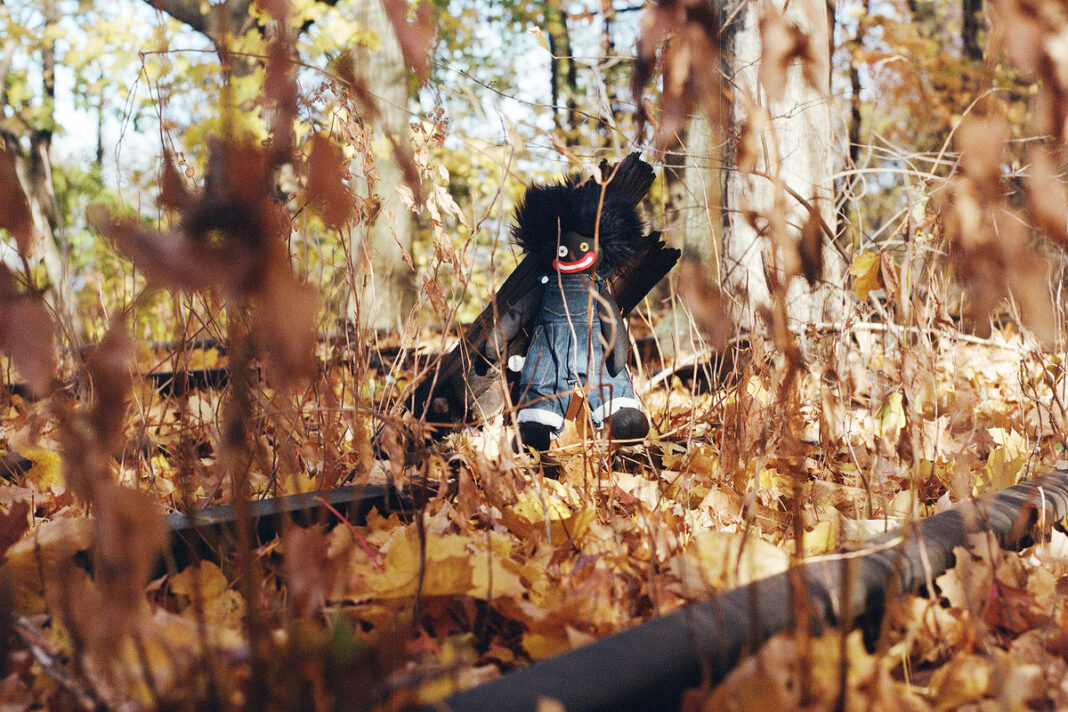
It speaks to the plethora of racist caricatures and epithets which proliferated in the United States that the golliwog rag doll with its black skin, frizzy hair and blood-red lips has been described by the Jim Crow Museum as the ‘least known’ of the group. That certainly wasn’t the case when I grew up in England, where the golliwog despite courting its share of controversy has remained for some a beloved figure of childhood and has adorned jam jars and biscuit tins as a mascot, a dubious predilection which appears to have echoes and parallels across the Commonwealth.
billy woods grew up in places that were part of the Commonwealth and still struggling in various ways to slough off some of the impacts of British colonialism. His father was a Marxist intellectual in exile from Zimbabwe and his mother a literary scholar from Jamaica when they met as graduate students in New York City, with woods spending nine years of his early childhood in Zimbabwe following the war of independence as his returning father took up a couple of government jobs. Portions of his youth were also spent in Jamaica after his father died and woods and his mother made their home back in the United States.
By naming his new album GOLLIWOG then woods appears to be prodding at his audience in ways that may or may not be deemed characteristic. The rapper has managed to share more than most whether it comes to his everyday routines and perennial mindsets or his family history or his sense of politics and the sore state of the world.
At the same time the use of the woods pseudonym, the fact that he blurs or otherwise obscures his face in all of his videos and promotional materials whether solo, serving as the head honcho of Backwoodz Studioz or making up with ELUCID one half of Armand Hammer and the literary density and textural murkiness of his material seems to make him both mythic and obscure, in a way that echoes and refracts the persona of MF Doom, another artist of Zimbabwean heritage and one with an overt influence on this record.
In this sense billy woods remains something of an outsider who seems able to subvert conventional material to his own ends, resituating it contextually, drawing out its perversity or allowing the presentation of contested imagery to sprawl and deepen once the initial shock subsides. GOLLIWOG does each of these things but that moment of shock, which proves as it turns out eminently repeatable, is also very much a part of the point.
The cultural historian Eric Lott in Love & Theft explored the double aspect or subversive qualities of blackface minstrelsy, a form which both embedded prejudice and created the space for more nuanced and fond relationships to emerge. Many artists who have engaged with the black musical tradition have embodied some of that doubling in their work but on GOLLIWOG it seems that woods is grounding himself less in musical or literary or historical contexts than in some of the currents of contemporary cinema, where auteurs have turned to genre for crackling expositions of racial dynamics and recursive political trends, often lacing them with pop-cultural references and a surreal sense of humour.
GOLLIWOG is an album that roots itself in horror tropes though woods himself has cited everyone from Joseph Conrad and Stephen King to Toni Morrison and Flannery O’Connor among its influences while emphasising anthology films like Cat’s Eye and Creepshow as much as horror classics like Rosemary’s Baby or Poltergeist. In a recent interview with Passion of the Weiss he also mentioned short story collections by Mariana Enriquez and Carmen Maria Machado who have used horror forms and the grisly matter of folklore or urban legend to explore everything from depression, poverty and eating disorders to the riven undercurrents of motherhood and romantic desire.
That interest in horror as a genre is foregrounded sonically before woods gives his droll and lilting delivery to what’s been set down on the page. Horrorcore started with Gravediggaz, Flatlinerz and Three 6 Mafia while a sometimes loosely related strand of Afrofuturism and science fiction situated within a hip hop context stretches back to Kool Keith and runs through OutKast and Digable Planets or Definitive Jux artists like Cannibal Ox and Mr. Lif plus some of Doom’s aliases and beyond.
Yet for contemporary takes on dark guttural textures and woozy or horror-inflected atmospheres woods doesn’t have to look any farther than his own backyard, as several Backwoodz-affiliated artists including Fatboi Sharif, SKECH185 and the producer Steel Tipped Dove have plied their music with doleful and scabrous yet at the same time smartly comic distortions.
So the opening ‘Jumpscare’ on GOLLIWOG flickers to life like an old film reel before we and it are sucked into a dank vortex. A warped music box melody airs like a lullaby over clackety or clockwise beats and ticks as woods introduces the titular rag doll and starts with the film references. ‘Rabid dog in the yard, car won’t start, it’s bees in your head / Daddy longlegs stride your home like Cecil Rhodes’ he advances, linking the semblance of sinister creep to the British mining magnate and founder of Rhodesia, which post-independence became Zimbabwe and Zambia.
On this opener woods offers several gestures and images which evoke something of his art and its concepts as he notes ‘Death poems folded in breast pocket [. . .] It’s a dark road, but ain’t no accidents / No coincidences, it’s all praxis’ and compares ‘morose villagers’ queuing in the sun and his own looping thoughts to the ouroboros that ancient tail-eating symbol of death and rebirth or the endless cycle.
Then after both a ritual summons and a bitter lament – ‘The dead drift like empty boats / My people fled to the mountains, but it’s nowhere a white man won’t go’ – he recognises his heritage and his own capacity for transforming it as he raps ‘The English language is violence, I hotwired it’ and proceeds to exemplify that process. With the nursery rhyme melody having fallen away and his drawl replaced by a snarl, ‘I’m Deng Xiaoping, smoking oil in the wok’ and ‘Afrofuturist Acura Legend on the cinderblocks’ he raps in a stunning and tongue-tingling commingling of continents and resources.
There is a brief two-line reading from Florence Kate Upton’s book The Adventures of Two Dutch Dolls in the outro or coda to ‘Jumpscare’. Published in 1895, that children’s book introduced the golliwog character though despite its title it was apparently not based on the infamous Zwarte Piet but on a blackface doll which the Uptons had played with as children and which then resided in Florence’s aunt’s attic. For his part woods says that the golliwog imagery stems from an old story he wrote as a child and suggests that he is using the redolence of the word rather than exploring its legacy.
For the rag doll pops up at disparate moments throughout GOLLIWOG but it would probably be a mistake to see the album as some kind of mission statement or anthology, at least in the sense of being thematically pure or elaborating the circumstances of any recurring character beyond that of woods himself. The title figure and the horror theatrics are formal manoeuvres which allow him to crack his knuckles or his skull in a a novel way. He has also noted that the mix of producers on the album serves counter-intuitively as a kind of restraint in so far as it prevents him from locking in to any one flow or rhythm.
Aethiopes offered a panoramic vision not only of New York City but of places farther afield as the sole producer Preservation incorporated aspects of the Zimbabwean mbira and samples from Éthiopiques in a way that matched the political purview. ‘Haarlem’ evoked the rapaciousness and casual vandalism of European colonisation while the album opener ‘Asylum’ imagined the brutal Derg chairman Mengistu Haile Mariam as his neighbour within the context of a tense and portentous family scene as woods keenly portrayed the maladies of life in the doldrums or the slums.
Church with his longtime collaborator Messiah Musik felt more intimately personal as woods bore down through the smoke clouds of faith, fate and memory. And on Maps – over production by Kenny Segal for the first time since Hiding Places in 2019 – the rapper sipped daiquiris and flaunted the restlessness of mundanity, caught in a dissociative state whether at the airport or the dawning of a new day as he told the stories of roads taken and untaken and the long route back home.
In the meantime woods and ELUCID hopped over to Fat Possum for We Buy Diabetic Test Strips, where they dropped the trauma mic and exposed the bust of Bathsheba over the junk percussion and pungent production of DJ Haram, tested the limits of Siri and groped for the heaving embonpoint over beats by JPEGMAFIA and referenced the likes of Gil Scott-Heron and Harry Belafonte on a joint by El-P as they represented New York and ruminated with a steely glint while Moor Mother, Shabaka Hutchings, Pink Siifu and Cavalier rounded out the features.
Here the second track ‘STAR87’ unfolds over classic boom bap from Conductor Williams as woods portrays the slaughtered cow that welcomed his father’s return to Zimbabwe, the subsequent exodus of many migrants to South Africa and weaves in through the steady enunciation of his rhymes an ode to his ‘sources’ or inspirations which are ‘Antipop Consortium, Co-Flow and every line of “Accordion”‘.
Then after a crescendo of snippets from the 2006 horror flick When a Stranger Calls on ‘Misery’ he re-ups on bad dreams and bags screams in an interpolation of the early MF Doom classic ‘Gas Drawls’ before drolly and yet with an air of glum dejection elaborating his fateful part in a love triangle. In fact some of the lines on the song evoke another Doom standout, the two-way dialogue between him and Apani B. Fly on ‘Let Me Watch’ from the Viktor Vaughn album Vaudeville Villain. Here puffs of fairy dust and a vampiric intent take the place of glib smutty talk and coming-of-age sentiment.
‘And with them titties, she never unaccompanied / And she not goin’ home in a pumpkin’ he takes an educated guess – though it’s notable that woods elides the moonlit luridity of the breasts the second time around. The woman he is into has a husband and ‘a summons for sex in public’ and at the ‘Full moon, she came to me already wet with sex’. There’s a kind of crestfallen aspect to the production by Kenny Segal, an engine which never really gets going but whirs and smears as shared time is compressed rather than sacred and bad energies are made manifest.
A world albeit a cramped one is conjured in just over two minutes, but ultimately it’s a one-way relationship despite the late night grandeur and the apparent triptych as woods concludes ‘Dark turtleneck on the basis and her husband keep his collar turned up / Ragged holes in my throat, but I love to see those lips shiny with blood’.
Segal, Messiah Musik and Steel Tipped Dove get several of the production credits on GOLLIWOG but there are also a number of one-shot deals as woods reunites with a slew of other old collaborators, from Preservation and Willie Green to DJ Haram and The Alchemist. There is a certain consistency of tone and texture as many of the tracks make use of blackened and staticky soundscapes plus chugging beats. Still there is plenty of movement between the lines as several songs feature plucked strings, wailing screams or the smudged and pitch-shifted vestiges of funky bass riffs while GOLLIWOG is also animated by a select troupe of featured rappers.
On the loping ‘BLK XMAS’ the sly fox Bruiser Wolf depicts poverty and a life interwoven with drugs and the streets as a series of encounters with the supernatural or just plain gory before woods digs down into a more empathetic scene. He depicts a family with young kids being evicted from their home just before the holiday season but sticks around as their neighbours and then he himself sifts through the remnants, scooping up pots and pans and a few worn clothes, seeking out the the tastiest scraps. With lyrical naturalism – ‘Light drizzle drove me back inside the house’ – the rest of the song bears his dreams and reflections which muck together a seedy mixture of foreboding and regret.
The weepy and solemn ‘Waterproof Mascara’ returns to Zimbabwe and the rapper’s childhood and the scene of the crime, so to speak. He recalls his father’s sudden death and suggests that both he and his mother felt waves of shock and fear but also relief, dwelling to some extent on the dependency between children and parents (and paralysed by weed) before the last verse interpolates and samples in turn Goldilocks, the ‘Rainy Dayz’ of Raekwon and the stark or thunderous reverberations of the cult Japanese horror film Cure.
‘Counterclockwise’ juxtaposes another slippery or sputtering encounter with other instances of prescribed or circumscribed sleep, closing with a cycle of CIA torture and ‘Corinthians’ draws from that famous phrase about seeing ‘through a glass, darkly’ from the Pauline epistles as woods pictures himself as a ‘Scarecrow in a field, watching the spectacle’ which unfolds all about. The track is doom-laden but it seems to dwell mostly upon a shattered social media landscape where we might scroll past the ‘uncanny valley’ of artificial intelligence through the horrors being perpetrated in Gaza as woods with a rejoinder adds ‘Best believe them crackers won’t make it to Mars’.
‘Pitchforks & Halos’ with its lurching swagger and glissando keys plays out like a nocturnal revery down winding roads and rollicking highways limned by the ‘carnival glow behind us’. And over the rub and clink of gongs on ‘All These Words are Yours’ we are transfixed once more behind the computer screen, taking in visuals we’d better not see if it weren’t for the desire-cum-obligation not to turn away. ELUCID takes the reins and whips through the scene like a holographic or cryogenic being as the soundscape judders and rumbles around the Armand Hammer duo.
In a syrupy croak al.divino contributes to some of the record’s recurring themes as his opening verse on ‘Maquiladoras’ portrays the unexpected end of a relationship (‘she left no note’) and a robbery gone awry in a way that implicates what kids might do to their parents rather than the damages wrought by parents upon kids. Then woods takes up the psychiatrist and pan-African thinker Frantz Fanon’s concept of amputation which he used in Black Skin, White Masks as a metaphor for the psychic and cultural damage wrought by colonialism and racism, though as he observes from some remove Fanon’s death woods considers that amputation may be the price for survival, then and now in the United States of America where you ‘Can’t get away if you don’t leave something behind’.
The spare and stuttering production on ‘Maquiladoras’ – alternately windswept and suffused by radio static with the strictly musical accompaniment limited to a few ominous and forlorn piano keys – is handled by Saint Abdullah and Eomac who over the course of several albums have produced singular meditations built around samples of Persian music and Islamic chant, Middle Eastern rhythms and contemporary beats that would sound equally at home in Detroit or rubbing up against the jazzier concoctions of Madlib.
The kind of rustling quality they conjure here ripples throughout GOLLIWOG in a coming together of the organic and the synthetic. One of the consequences of the horror theme is that both the natural world and more toxic urban or sterile laboratory environments might equally be the site of mischief. On the album cover the titular rag doll stares out with their round white eyes and big red grin from their place in a backwoods setting, amid a crispy covering of autumnal leaves and blackened charcoal-like pieces of timber.
‘Maquiladores’ ends with a sweet saxophone fanfare and the old assertion that ‘time is on my side’, a rare moment of clemency and affirmation. Making the most of a deeper and brassier and somewhat more doleful horn, ‘A Doll Fulla Pins’ opens with a reference to a short story by Ray Bradbury as woods evokes the stresses and suffocations of a DC summer.
It’s one of the tracks that engages most fully with the golliwog figure as woods – aided by the soulful exhortations of Yolanda Watson in the chorus – imagines sticking it with pins like a voodoo doll or envisions it as a kind of sinister elf on the shelf ready to mete out unjust punishment. ‘Wasn’t no timeouts, we got welts from the belt’ woods cries as the percussion chugs and the saxophone smears in the second verse, turning ‘A Doll Fulla Pins’ into the deepest groove and one of the most heightened moments on the record.
Then with a demonic bent and another excerpt from Bradbury, out of chars and ashes ‘Golgotha’ emerges and barely relents as woods dwells on ghouls and other spectres, the accompaniment by Messiah Musik calling to mind vaudeville or marionette shows or some other kind of comic denouement. In fact it reminds me of the classic Avalanches cut-up ‘Frontier Psychiatrist’ only slowed down to a glum drawl as woods hands the piece a nightcap by way of another hapless romantic liaison, adding with barely a sting ‘I used to love her, now I see it was just a fling / Took two glasses out the cupboard and poured us a parting / drink (She waited for me to take the first sip though)’.
With its rickety high bounce, ‘Cold Sweat’ features one of billy’s best opening couplets as he recalls a notorious Detroit Pistons draft bust, rhyming ‘I had my community sick / When they unraveled, I time traveled and still picked Darko Miličić’. He has the quintessential musician’s nightmare of having to dance in front of a room full of record executives and imagines an alternate life with an old ex, then turns to a theme familiar in his past work from Hiding Places to Maps in the form of his unstable living quarters. Here woods turns the tables on his landlord, who wants to sell the building only woods keeps paying up. ‘Every slave dream of the day he get ahold of the whip’ he raps with an impish and barely subdued revelry, explaining through his ‘Shit-eating grin, I pay rent, they mad as shit’.
Amid whorling strings and thickly treading kicks ‘BLK ZMBY’ indicts the ‘staggering post-colonial African zombie state’ for chasing its people ‘into the waves’ either to die on makeshift rafts or make ends overseas instead of spurring revolution. And on ‘Make No Mistake’ woods seems to encapsulate where he is coming from through the opening bars ‘It’s easy for you, but it’s hard for me / To forget the things we did ’cause we had to eat / At least that’s what we said when we did the deed / Some lost they lives, some still ain’t lose a wink of sleep / I said what I said, you can tell ’em you heard it from me / I told a few lies in my time, but never once over a beat’.
Yet the track continues to roil and muddy the picture as woods later suggests ‘I hide everything in the rhymes, that’s why I keep it dark onstage’ while the outro, snipped from an eerie sixties Baby Secret talking doll commercial, notes ‘she looks so real, the way she moves her lips like yours’ and in a guide to play advises ‘You can have fun keeping secrets together. What kind? If we told, they wouldn’t be secrets anymore’ before the doll herself whispers ‘I know a secret. Do you?’
While at this point it seems safe to count on at least the outlines of the artist’s stated family history and the personal legitimacy of his postcolonial concerns, and while woods summons his past and imbues his present everyday home life with a textural consistency whether discussing old flames, landlords or the conflicts of parenthood (a topic broached with tenacity and intimacy when he featured on ‘Bad Pollen’ from ELUCID’s acclaimed Revelator) still woods is equally careful about what he doesn’t say.
His penchant for socially conscious and pure narrative storytelling traditions also destabilises his work in so far as he is able to zoom in and out seamlessly or almost surreptitiously from widescreen visions and diagnoses to petty squabbles, nagging pressures and the workaday. He can print big or paint miniatures and weave tapestries that make sense from a distance or bring you up close to make sense of the knotty and tangled neps. He also isn’t afraid, especially through the various portrayals of exes and depictions of desire on GOLLIWOG, to sometimes play the comic foil or allow himself to look small.
Anyway on ‘Make No Mistake’ we get the first sense that woods is readying to wrap this thing up as he sighs ‘Not a whole lot left to say’ and ‘We flying, but my foot hovering on the brakes’. ‘Borne Alone’ then has a kind of flickering lamplit atmosphere, a nocturne as he slips on a dead man’s pair of shoes – one of the more explicit examples of the type of deed he may once have done in order to make his way in the world – and borrows a line from ‘Fazers’ by King Geedorah (another Doom alter ego) which goes ‘Born alone, die alone no matter who your mans is’. As shoes are taken and worn in and cobbled and replaced, or kicked off in unexpected moments of poverty or violence, ‘History never repeats, it do rhyme though, tryna catch the loop’ woods lilts and there is the sense, just like in the figure of the the ouroboros, that whatever goes around will come back around again.
The final two tracks on GOLLIWOG feature woods’s partner ELUCID with the penultimate ‘Lead Paint Test’ also starring Cavalier, the Brooklyn-born and New Orleans-based rapper whose Different Type Time was released on Backwoodz last year though he remains to some extent affixed to his near-legendary reputation for live performances.
‘Lead Paint Test’ really brings it all back home as over rolling beats, plangent keys and horn fanfares the trio bewail and portend those spectres which still reside in the places that they grew up, recalling moments or seasons of trauma and cycles of neglect or abuse. The moments or figures involved are kept mostly at arm’s length and turned almost into horror tropes in a way that deepens the sense of pathos. Instead on their verses ELUCID and Cavalier focus on the crumbling architecture, with ELUCID gesturing towards a ‘corner creeper’ but finding something truly ghostly in a jigsaw parquet floor, cracked plaster, exposed brick and a wood door which ‘swings under a stiff in the summer’ before rapt with the past he envisions himself flat on his back and ‘looking up at the same ceiling’.
So there are forms on the walls, drifting and flickering and cohering, and those typically eerie sights and sounds of creaking doors and crumbling plaster. The chorus – repurposed by Willie Green and DJ Mo Niklz from the Maps single ‘Soft Landing’ – recites ‘God bless this sweet home, my beloved haunt’ in a nod to Toni Morrison while Cavalier calls his uncle ‘the ghost of Thanksgiving past’ and walks by his mother’s old room in what might seem like embodied or animated reminiscences. But there’s no juice here or fondness nor the capacity for comparmentalisation or forgetting as he recalls ‘when the bandos were brick skeletons’ and notes the ‘crooked paths of the lizards’ have been replastered while still ‘Forgiveness like the cold wind, old men remember’.
Then woods is up and he offers another one of those evocative yet troubling anecdotes, this time about his father putting the family cat out of her misery on the kitchen floor following an horrific car accident. He makes handy use of a quintessential horror device by conjuring a locked door with some furtive mystery behind it, but knows too that trauma cleaves or separates as well as cohering to the logic of the cycle. ‘I’m not my ancestors’ dreams / They in the room wishing they could smoke and eat’ he says and that’s a powerful line, with ‘Shadows reach for my son in dreams / Some shadows that deep, shadowing me’ another one as it evokes the legacies that no parent wishes to leave.
Truth in the end gnaws more than fiction. ‘These ain’t pains, these the regular aches’ states Cavalier with a brisk matter-of-factness and ‘It ain’t evil, just sad / Come on, step through’ is the invitation proffered in the outro or coda. So there’s nothing to be fought and won just stuff to be endured as texture. But that stuff can still be weighed and sifted or illuminated and there is a sense of this in the GOLLIWOG closer ‘Dislocated’ where limned by strings and barracked by freeform drums, both ELUCID and woods shine their beams while speaking in mirrors and staying resolutely just beyond our grasp.