


At the start of this year, the bass clarinetist Jeff Anderle – perhaps best known as a member of the ensembles Splinter Reeds and Sqwonk – founded Clairvoyant Records in a bid to boost the accessibility of contemporary and experimental classical music, particularly that which involves reed instruments.
It’s a noble goal from an artist who is deeply entwined with the contemporary canon yet whose renditions always sound immediate and buoyant and fresh while crossing over with broader trends in experimental music. That was true of the Splinter Reeds album Dark Currents and its two long sides, as the quintet opened with the cascading Tall Grass by the Bang on a Can co-founder Michael Gordon and concluded with Paula Matthusen’s multifaceted Antenna Studies which combines acoustic instrumentation with radio transmission and mobile streaming, both of which were premiered by Splinter Reeds. And it is true of Anderle’s recent album Warp & Weft where the bass clarinetist put together a couple of ensembles in order to interpret the tight yet supple rhythms or more gaseous terrains of the exuberant post-minimalist composer Marc Mellits.
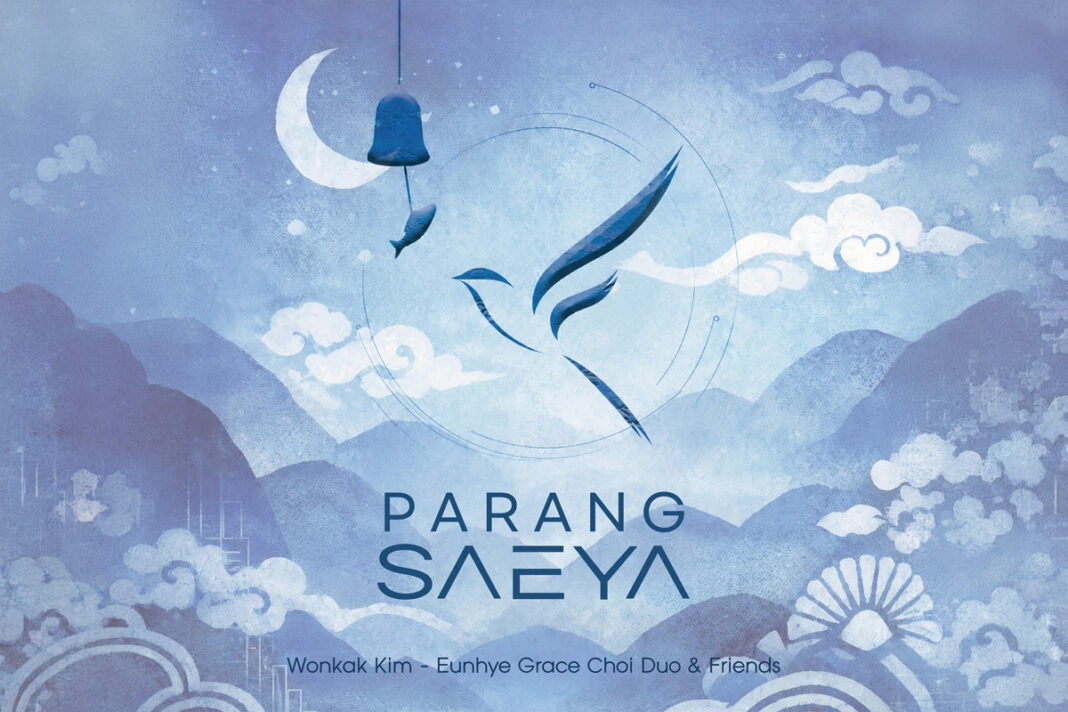
Clairvoyant Records has already released an extended play by the oboist and electronic musician Kyle Bruckmann plus a couple of live outings by Improbable Beasts, the throng of bass clarinetists whose sound ranges from Renaissance choral music to klezmer. Now the fledgeling label spreads its wings on an album by the clarinetist Wonkak Kim and pianist Eunhye Grace Choi, whose Parang Saeya offers a stirring and rippling blend of Western with traditional Korean instruments.
Parang Saeya commences with a couple of folk songs in ‘새야 새야 파랑새야 Bird, Bird, Blue Bird’ and ‘상주아리랑 Sangju Arirang’. The lulling ‘Bird, Bird, Blue Bird’ with its imagery of falling flowers and spectral fields evokes the tumult of the Donghak Peasant Revolution, which rose up against the perceived corruption of the ruling class and railed against the intrusions of Japan and Western culture before events spiralled into the First Sino-Japanese War.
‘Sangju Arirang’ meanwhile is a northern Gyeongsang version of ‘Arirang’, the folk song of ardent longing which has an estimated 3,600 variants and is believed to be more than 600 years old. ‘Arirang’ became a resistance anthem during the Japanese occupation of Korea and is included twice in UNESCO’s list of intangible cultural heritage, after being submitted by both the south and the north. Parang Saeya subsequently in ‘Gumiho’, ‘A Subtle Celebration’ and ‘천안삼거리 Cheonan Sam-Geo-Ri’ features the world premieres of compositions by Max Mabry, Joseph Rondeau, and Sang-Gu Kang.
Emotionally the album certainly embodies some of this fare with its atmosphere of reflection and yearning melancholy. Even more though it is defined collaboratively and texturally, by the sheer juxtaposition between its several instruments. Three traditional Korean instruments play a major part on Parang Saeya, with the gayageum as played by Eonhwa Lee probably the most familiar to already curious listeners.
A plucked string instrument like a long zither, usually with twelve strings and based on the Chinese guzheng while bearing similarities with the Japanese koto, the gayageum is for instance one of two zithers – alongside the geomungo – played by the duo of Ha Suyean and Hwang Hyeyoung as Dal:um while it is also the instrument of choice of DoYeon Kim, who has brought the gayageum into experimental jazz contexts, performing with musicians like Joe Morris, David Leon and Brandon López before debuting as a bandleader on the stunning Wellspring from earlier this year, an album with a formidable cast as Kim was joined by Tyshawn Sorey, Mat Maneri and Henry Fraser.
More surprising then might be the presence on Parang Saeya of the daegeum, a large transverse flute made out of bamboo which is here played by Hyejeong Im. Beyond the nature of all transverse flutes where the performer blows across the embouchure hole, breathily splitting the airstream, the daegeum incorporates a buzzing acoustic membrane called a cheong which gives the flute a general rasping quality with a squawk at the tail.
Finally we have the haegeum, a kind of fiddle with a hollow soundbox and two silk strings. Played here by Eunah Noh, the haegeum is positioned upright on the knee of the seated performer, who passes a thick horsehair bow between those two strings. The continuous pitch that results has something of the character of a vox humana, a weeping quality that can be full of pathos or sound slightly shrill even as it warbles tearfully. Yet there is also something fowl to its tone and that can imbue the haegeum with a certain comedy, as though we were listening to Donald Duck serenading Daisy his lover.
These are striking sounds that remain unusual even in contemporary classical, jazz or other experimental and avant-garde contexts, thought within Korea the haegeum, daegeum and gayageum all have a long history of use in both courtly and folk music.
Kim and Choi’s rendition of ‘Bird, Bird, Blue Bird’ opens through bright and impish piano glisses with a more plaintive clarinet then leading us into the wail and caw of the haegeum. The string instrument possesses a martial air even amid the sworls of this composition, which sounds defiant and proud but also poignant as the forsaken haegeum aches and yearns while the wind swirls above in a wistful searching. Still those swirls of the clarinet do add a kind of propulsion or narrative bent to the production, taking an overview (or a bird’s eye view) with the keys percussively beating out the time then harmonising keenly with the haegeum before the piece shakes off the remnants of flight and cooly settles its feathers.
‘Sangju Arirang’ rounds off some of the edges, commencing through limpid and elegant keys while showcasing the daegeum at its wispiest. Taking turns with the clarinet, at times ‘Sangju Arirang’ almost whispers sweet nothings and other tendernesses into the listener’s ears, with only some overblowing introducing the slightest tinge of harshness or dissonance. In the final third of the piece, winding melodies serve to indicate both the sweet and sharp sides of the daegeum, emphasising that buzzing membrane, with Kim on the clarinet playing short pulsing notes before ‘Sangju Arirang’ draws to a graceful close.
The gayageum can sometimes sound like rockabilly guitar and while ‘Gumiho’ – the Max Mabry composition – doesn’t quite tend in that rhythmic direction it still makes the most of the instrument which here might range from twangy plucks like the revs of an engine to shrouded bell or chime-like small percussive twinkles. With their left hand adding ornamentation, Lee navigates riverbent, harp-like passages which the clarinet accompanies through some breathy low notes. And together with the piano the musicians scramble up out of the ravine on this brisk and dashing piece which refers to the legendary nine-tailed fox of Korean folklore.
‘A Subtle Celebration’ uses the haegeum in a more sweeping and orchestral setting, though it can still produce a tender and tremulous sigh when accompanying the clinking lullabies of the keys. The songs on Parang Saeya are effectively trios with a traditional Korean instrument adding another voice to the clarinet and piano, yet here the haegeum takes more of that accompanying role as it rasps out a rickety or oscillating drone beneath the Swan Lake escapades of the clarinet before the musicians shift roles and move variously towards their exquisitely rendered conclusion.
Lastly on the pastoral ‘Cheonan Sam-Geo-Ri’ it is the haegeum which once again adds a certain rippling quality to the sweetly rolling keys of the piano and sinuous folds or turns of the clarinet. Parang Saeya is a smartly conceived and delicately performed album that amply displays the robustness and intriguing textural properties of some traditional Korean instruments. It is an easy but rewarding listen from a young label that gives contemporary classical music a sleek approach while tugging oh so gently at its borders.