



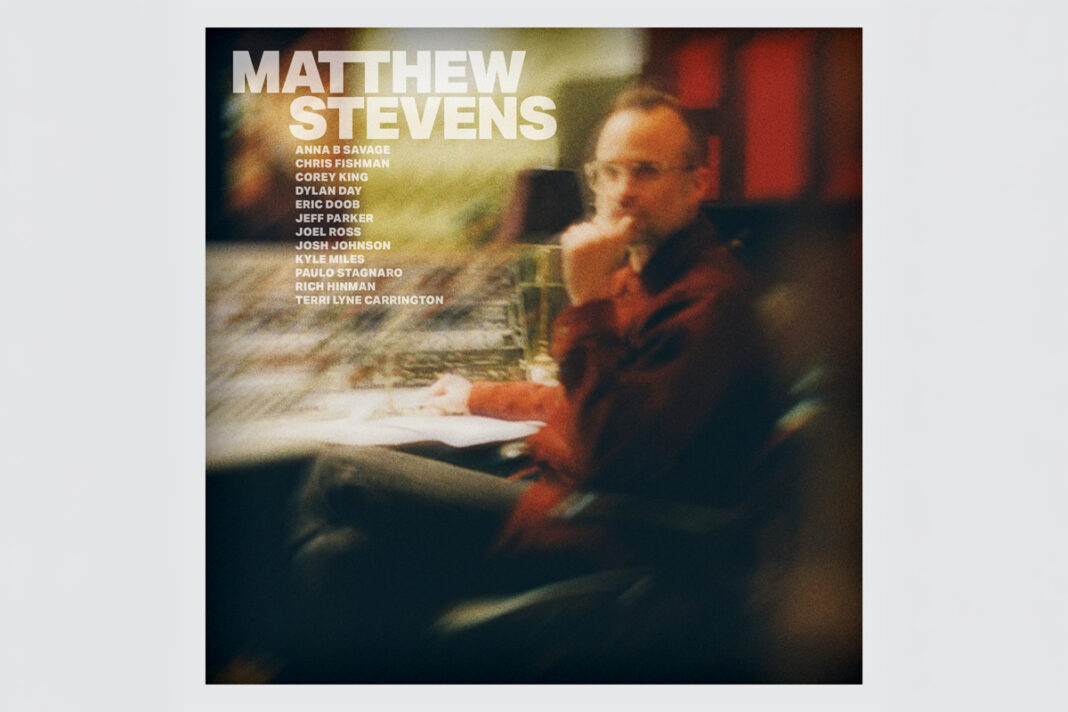
Self-titled and typically understated, at first glance the new album by Matthew Stevens might scan as a solo record, just like Pittsburgh the prior release under his own heading which has become one of my most cherished and listened to works of unaccompanied guitar.
In fact this Matthew Stevens is a group outing with a stable lineup and a steady rotation of featuring artists. Already there seems to be some kind of gentle skewing or resetting of expectations. The album leans into some of its features plus a couple of standout covers. But something about Matthew Stevens urges you to keep listening, and while it roots his artistry in the collaborative process on those repeated listens it comes to seem like a deft personal statement through its canny blend of choices and textures and musical styles.
All of that deftness and understatement is not to say that Matthew Stevens is somehow a receding or quiet or compact kind of record. Pittsburgh was released almost five years ago, a product of the pandemic as Stevens hunkered down in his wife’s hometown and began to work up a series of sketches or song ‘starts’. A broken elbow fixed the solo nature of the endeavour and made the fulfilment of those early sketches a core part of his rehab.
The resulting album moved briskly between framing components, a couple of experimental pieces which bore more of a focus on texture. The heart of Pittsburgh lay in the intricate arpeggios of songs like ‘Purpose of a Machine’ and ‘Can Am’ or the more wriggling ‘Buckets’ and ‘Cocoon’ which were redolent of the style brisé or flamenco guitar. On the second side ‘Ending is Beginning’ and ‘Blue Blues’ fringed roots music as Stevens throughout showed both curiosity and a certain meditative restraint over the six strings of his vintage mahogany small-bodied Martin acoustic.
Matthew Stevens writes some of those interests and divertissements in a bolder pen. Whereas Pittsburgh made a virtue out of the solitary and mundane the collaborative enterprise here feels both purposeful and quietly exuberant. If the former seems like the grittier record the latter is no less spirited and really no less introspective but foregrounds a sense of ease and fun.
It opens with ‘Take Heart’ a dubby, funky workout featuring Joel Ross on vibes. The vibraphonist recently released his own highly personal statement in the form of the biblically sprawling Gospel Music and advances one of the emergent aspects of Matthew Stevens, an interplay between some of the sounds and players who are busy populating the east and west coasts.
With the Brooklyn-based vibraphonist and Blue Note mainstay cresting the rhythm, ‘Take Heart’ is a colourful slice of fusion to open the album, making the most of some fine harmonies which circulate between the guitar, keys and saxophone all bolstered by a chugging beat. As it also showcases the skills of Paulo Stagnaro on additional percussion, from that tethered sense of propulsion the piece sometimes broaches the Afro-Cuban tradition where it traces out patterns and accents associated with claves or castanets.
The core band on Matthew Stevens comprises the guitarist alongside Chris Fishman on keyboards, Eric Doob on drums and Kyle Miles on bass. Josh Johnson is as ubiquitous on the alto saxophone as he already has been throughout the jazz scene so far during the first few months of 2026. He was part of the ensemble for Gospel Music, produced and played across the much-covered solo outing Honora by the Red Hot Chili Peppers bassist Flea, has core projects with the Jeff Parket ETA IVtet and SML impending on International Anthem and is set to feature on the color of rain by aja monet.
Johnson is at the centre of a certain west coast scene that circles around International Anthem and Leaving Records plus other similar or related ventures and projects, having also played alongside his label cohorts Jeremiah Chiu and Marta Sofia Honer as well as the likes of Carlos Niño and Sam Wilkes. He has contributed further afield and in other contexts over the course of the past year, with everyone from Miley Cyrus to Brandee Younger, Hand Habits and Valerie June. Having defined an abstract sound a couple of years ago on his solo album Unusual Object, that smeared horn with its rubbery intimacy and diffuse blare or throb is one of the defining materials on Matthew Stevens.
Matthew Stevens blends acoustics and electronics to winning and almost seamless effect. The introduction to ‘Hazy’ is a gauzy ambiance, with smeared keyboard arpeggios and the glisses and bends of Dylan Day on the slide guitar and Rich Hinman on the pedal steel. That fabric flows in slightly more lilting and billowing fashion on into the song itself. Shakers conjure a sandy rhythm and Johnson delivers a solo which sounds wispy and pliable with some pulls and other effects by Stevens as the bandleader follows the saxophonist in taking centre stage.
‘SLMS’ might suggest some kind of extension or reconfiguration of the reedman Johnson’s work with Anna Butterss, Jeremiah Chiu, Gregory Uhlmann and Booker Stardum as SML where jazz improvisation merges with electronic processing and aspects of kosmische. Here the duo of Stevens and Johnson with accompaniment from Fishman’s piano define a shimmering harmonic field. Some reverberant strums and able fretwork give way by the halfway point of the composition to the cooing and lulling vocals of Corey King.
The admixture of chugging and Latinate percussion with smudged guitar and saxophone – accentuated by an assortment of chimes and slides and bends – also characterises ‘1000 Times’ before ‘Edgewood’ closes out the first side of the record with a change of atmosphere. The guitarist Jeff Parker, a sizeable influence on the bandleader, joins Stevens with the pair rolling out a languid melody as Day offers glimmering reflections from the slide guitar. It is a porchside affair and the most overt piece of country music on the album, stretching out into a night spent under a cover of stars.
On the back side of Matthew Stevens we are treated to more collaborations with Parker and with the bandleader’s mentor Terri Lyne Carrington on drums. Both artists feature on a warm and shuffling rendition of ‘Who Does She Hope to Be?’ which remains one of the most cherished songs in all of Sonny Sharrock’s catalogue. While neither Stevens nor Parker wail quite like Sharrock nor share in the same air of anguish and despondency, they manage to echo the grace and tenderness of the original, summoning a burnished and hopeful kind of sentiment as the collective shows a constitutional even keel.
The trailblazing electric guitarist whose distinctive attack was part of the first outpouring of free jazz was joined for his original composition on the 1991 album Ask the Ages by an astonishing lineup which included Pharoah Sanders on the saxophone, Elvin Jones on drums and Charnett Moffett on bass. Here on Matthew Stevens the twin guitarists fill out the solos and parts while Carrington plays with poise and perspicacity from behind the drum kit. Meanwhile the tandem of Fishman and Miles continue to root the engagement on keys and bass, with some snuffling arpeggios towards the close of the piece.
‘Born of Silence’ belies its title by proving really sunny and upbeat, all positive vibes and uplift with a groove that splits the difference between bluesy hard bop and fusion in the second half of the track. Then a pared-back gathering of just Stevens and Johnson with the vocalist Anna B Savage interprets the folk and blues standard ‘Alberta’ with echoes of sixties revivalists from both sides of the pond, the London singer-songwriter Savage evoking some of Vashti Bunyan or Shirley Collins.
Something about the moist atmosphere of the production however plus the pooling low end of this verdant if somewhat dolorous song reminds me of Astral Weeks, especially on tracks like ‘Sweet Thing’ and ‘Slim Slow Slider’ with Stevens and Johnson managing to match some of the estimable contributions of Richard Davis, Jay Berliner and Van Morrison himself.
Stevens plays alternating bass notes and fond ambling melodies while the alto of Johnson puffs and tugs in spurts as the singer repeats the line ‘Alberta let your hair hang low’ and offers gold to their beloved only to find time a gilded cage or like a field of hay, no sooner greening and blonding the landscape than it is harvested.
Matthew Stevens then draws to a close back with a full ensemble. ‘The Air is Thick’ almost slips away from beneath your feet, in the manner of a groove laid out by Makaya McCraven. Here the bassist Miles lays down a thick line and Stevens with the rest of his band delivers one last subtle twist, the component parts twining and blinking with alien identity or the shared aspect of a neo soul collective.